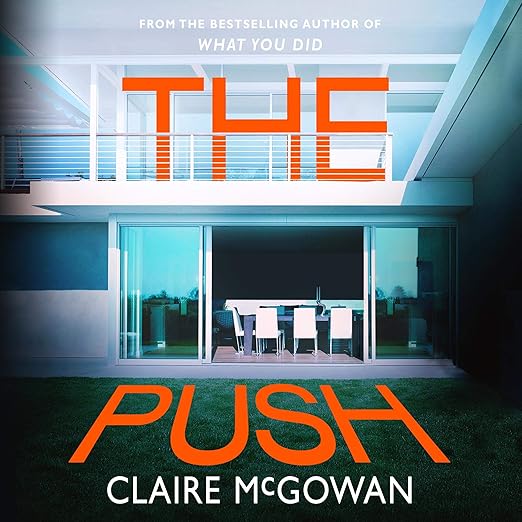
DS Alison Hegarty arrives at a party where someone has fallen from a balcony, and this audiobook opens on the specific kind of social horror that Claire McGowan writes better than almost anyone working in British crime fiction. A note before proceeding: the metadata for this listing attributes the book to Tommy Caldwell and categorizes it under sports and biographies, which is an error in the data. The audiobook under this listing is Claire McGowan's psychological thriller The Push, narrated by Justine Eyre, and readers looking for Caldwell's climbing memoir should seek that title separately. This review covers what is actually in the audio file: McGowan's locked-party investigation of a death that may be murder.
Our Take on The Push
Six couples from the same baby group, six newborns, one luxurious house, and by 3:02 PM someone has gone over the balcony. McGowan's setup is precise in ways that reward attention: each couple carries a specific secret, and DS Hegarty, who is herself struggling with infertility, is positioned as the detective most likely to see through the performance of new parenthood to what lies beneath it. The structural ambition is considerable. The novel cycles through multiple points of view: wealthy Ed and Monica managing their teenager's near-house-arrest alongside their newborn; Hazel and Cathy and the anonymous sperm donor that Hazel believes she knows; Anita and Jeremy and the American adoption that has not materialized; Kelly, who lost her baby and came anyway; and Jax, whose strange incidents suggest she may be a target rather than a suspect.
McGowan handles this ensemble with varying success. The strongest chapters are those where Hegarty is at the center, applying pressure to people who are very practiced at projecting competence. The weaker chapters are those where the rotating POV structure becomes predictable in its patterns. But the social observation that underlies the thriller mechanics is McGowan's genuine strength: the particular anxiety of new parenthood, the competitive dynamics of parent groups, and the way people construct public versions of private catastrophes are observed with sharp, unsentimental attention.
Justine Eyre is well cast for this material. She navigates the ensemble without making the multiple perspectives feel performatively distinct, which is the correct choice for a book where the narrative distance between characters needs to feel consistent rather than dramatized. McGowan's prose runs clean and purposeful, which works well in audio format where ornate construction can slow a thriller past the point of engagement. Listeners who came to this audiobook for the thriller plot will get what they came for; listeners who appreciate the social novel underneath the crime structure will get more.
The novel's portrait of how new parents present themselves to peer groups, and how much of that presentation is protective fiction, gives the mystery its most compelling texture. Hegarty's infertility struggle, which positions her as simultaneously outside and inside the social world she is investigating, is one of McGowan's stronger character choices across the DS Hegarty series, and it gives the detective dimension beyond procedural competence. Eyre handles that interiority with appropriate restraint, keeping Hegarty's pain present without over-dramatizing it.
The book's ensemble construction also reveals how McGowan uses the baby group format to examine class and aspiration in contemporary British life. Ed and Monica represent a particular kind of performative affluence, the kind that requires constant maintenance and produces a daughter kept under near-house-arrest to prevent social exposure. Hazel and Cathy's donor conception storyline introduces questions about biological parenthood and disclosure that the novel handles with more seriousness than the thriller format sometimes allows for subsidiary plot threads. Each couple is carrying a specific kind of social or biological anxiety, and Hegarty's investigation is also a kind of exposure: what falls away when the performance of new parenthood collapses under the pressure of a potential murder investigation is a social portrait as much as a crime narrative.
What to Watch For in The Push
The novel carries content warnings for ageism, sexism, and racism, which are present in the behavior of certain characters and should be considered by sensitive listeners before starting. The narrative also requires significant patience in the middle section, where the rotating character introductions can feel more like setup than story. One reviewer noted returning to the book after initially abandoning it, which is an accurate description of the experience: the investment required in the first third is real, and the payoff in the final sections is proportionate to that patience. The mystery plotting is solid if not surprising; listeners who read extensively in the genre will likely identify the direction before the reveal, though McGowan's handling of the final section is stronger than the middle sections might lead you to expect.
Who Should Listen to The Push
This audiobook suits listeners who enjoy British domestic noir with ensemble casts, particularly those who have already worked through McGowan's DS Hegarty series and want to continue with Hegarty's investigation. It is also a strong choice for listeners who want thriller mechanics in a setting that is recognizably mundane rather than exotic: a party, a house, a group of people who know each other just well enough to lie convincingly. Justine Eyre's narration makes the audio version a solid listening experience at just over ten hours, and the thriller's focus on the specific anxieties of new parenthood gives it a social specificity that distinguishes it from more generic crime fiction in the British domestic noir category.
- Performance: Justine Eyre navigates the ensemble cast with consistent distance, the correct approach for a novel where POV uniformity matters more than vocal distinction.
- What it covers: New parenthood as social performance, the secrets couples keep from other couples, and a detective whose personal circumstances make her perceptive.
- Feel: Domestic and claustrophobic, with the particular tension of watching polite people keep dangerous secrets in close quarters.
- Our call: A solid British domestic noir with sharp social observation; the rotating POV structure requires patience in the first third but pays off in the final act.
Note on metadata: this audiobook is listed under Tommy Caldwell as author. Is that correct?
No. The audio content is Claire McGowan's psychological thriller The Push, narrated by Justine Eyre. The Tommy Caldwell attribution and sports/memoir categorization in the listing metadata is an error.
How explicit is the content in this audiobook?
The thriller includes content warnings for ageism, sexism, and racism within character behavior. The content is not explicit in terms of sexual or graphic violence, but the social dynamics are at times uncomfortable by design.
Does this audiobook work well for listeners who are not usually crime fiction readers?
The social novel elements are strong enough that readers who prefer character-focused literary fiction may find this accessible. The thriller mechanics are conventional enough to follow without prior genre experience.