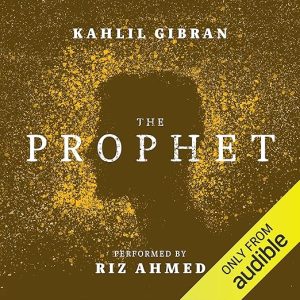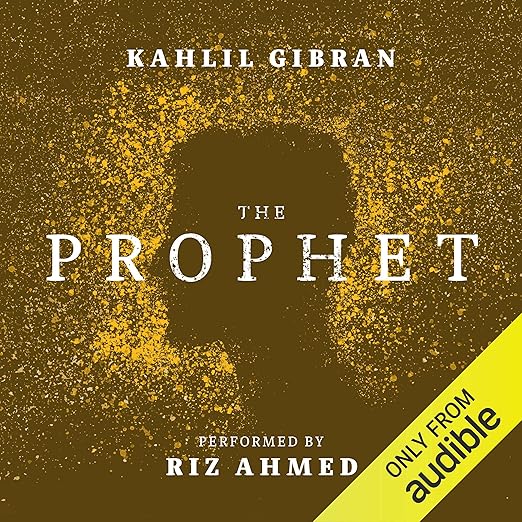
Kahlil Gibran's The Prophet has been in continuous print since 1923, translated into over 100 languages, and absorbed into the collective subconscious so thoroughly that many of its lines feel like things you have always known rather than things you first encountered in a book. This audiobook makes a specific and audacious casting decision: Riz Ahmed, the actor and musician, as Al Mustapha, the prophet preparing to return to his island home after twelve years in the city of Orphalese. At one hour and twenty-five minutes, this is a concentrated listen , and in this particular production, one of the most distinctive audiobook recordings in the philosophical poetry genre.
First, the Big Picture
Gibran's structure is deceptively simple. The people of Orphalese gather to say farewell to Al Mustapha and ask him, before he sails, to speak on the things that matter most: love, marriage, children, giving, eating and drinking, work, joy and sorrow, houses, clothes, buying and selling, crime and punishment, laws, freedom, reason and passion, pain, self-knowledge, teaching, friendship, talking, time, good and evil, prayer, pleasure, beauty, religion, and death. Each of the twenty-six sections is a fable in miniature, a poem built from aphorism and image. The accumulation across the collection is what gives The Prophet its weight: no single section carries everything, but taken together, they produce something that functions less like a book than like a framework for how to pay attention to your life.
The lines that have soaked deepest into shared language appear throughout: you talk when you cease to be at peace with your thoughts; let there be spaces in your togetherness; love possesses not, nor would it be possessed; it is well to give when asked, but better to give unasked. These are not simply quotable lines; they are complete arguments compressed into the space a line can hold. Hearing them rather than reading them restores something of the oral tradition from which Gibran was drawing.
The case for this audiobook is the case for Riz Ahmed specifically. Ahmed is a musician as well as an actor, and his understanding of rhythm and breath in language is what makes his performance of Gibran transformative. He does not read these poems neutrally or with the kind of solemn reverence that can make spoken poetry feel ceremonial and distant. He reads them with something closer to personal recognition , as if Al Mustapha is speaking from hard-won understanding rather than elevated wisdom. The effect is that Gibran's universalism feels intimate rather than abstract, which is precisely what the poems require to work.
The production notes describe this as a perfect bedtime listen or walking companion , something to take time out from the world with. Ahmed's pacing supports exactly that use. He allows silences between sections, brief pauses that give the listener space to absorb each subject before the next one opens. For a collection that covers everything from pain to prayer to the nature of evil, that structural breathing room is not merely stylistic; it is what makes the material processable rather than overwhelming.
Things to Know Before Starting The Prophet
One thoughtful reviewer noted finding the spiritual value of the collection somewhat disappointing after expecting something that would come close to religious revelation. That is a useful calibration point. The Prophet is a work of philosophical poetry rather than theology, and its wisdom is more meditative than prescient. Gibran was drawing on Sufi mysticism, Christian symbolism, and his own Lebanese cultural heritage in ways that produce a kind of generalist spirituality , deeply felt, genuinely wise, but not anchored to a specific tradition or doctrinal claim. Listeners who need that specificity may find the collection elusive in its universalism. Those who are comfortable with poetry that opens questions rather than settling them will find it richly rewarding.
At just eighty-five minutes, this audiobook invites repetition in a way that longer books do not. Several listeners describe returning to specific sections in the same way you might return to a piece of music , not for narrative information but for the experience of the language itself. Ahmed's narration rewards that kind of repeated listening; you hear different things on a second or third pass, which is probably the highest compliment available to a recording of poetry. The collection became a cultural touchstone for the counterculture generation, inspiring figures from John F. Kennedy to the Beatles, and Ahmed's recording brings it back into the present without sentimentalizing that history.
The collection's influence on the 1960s counterculture, which the production notes reference in naming Kennedy and the Beatles as among its admirers, is genuinely audible in the text. Gibran's universalism, his refusal to anchor wisdom to any single tradition, made The Prophet a natural touchstone for a generation questioning inherited structures. Ahmed's narration does not perform this history, but it is there in the way he handles the more radical passages, the ones about freedom from laws, about children belonging to life rather than to their parents, about the irrelevance of possessive love. These lines still have the power to unsettle, and Ahmed treats them with appropriate seriousness.
Is This One for You?
This audiobook suits anyone who has ever encountered a line from Gibran in a wedding speech or a graduation ceremony and wondered about the broader work. Riz Ahmed's narration makes it a distinctive and genuinely moving audio experience that goes beyond simple rendition. Listeners who engage with contemplative or philosophical poetry will find the eighty-five minute runtime the right length for the kind of sustained attention this material rewards. Those looking for narrative or argument should look elsewhere. Those ready to sit with language that asks to be absorbed rather than analyzed will find this a rare and lasting listen.
Frequently Asked Questions
Why is Riz Ahmed narrating this audiobook, and does the casting work?
Ahmed is both an actor and a musician, and his instinct for rhythm and breath in language translates directly to Gibran's poem cycle. The casting works exceptionally well , he brings a quality of personal recognition to Al Mustapha's words that prevents the material from feeling ceremonially distant, which is the key risk in recording poetry this well-known.
At eighty-five minutes, is this audiobook long enough to feel complete?
The Prophet is a poem cycle rather than a novel, and its completeness is not a function of length. The twenty-six sections cover the full range of subjects Gibran intended, and Ahmed's narration with appropriate pauses between sections makes the runtime feel carefully considered rather than abbreviated. Many listeners return to it repeatedly because the brevity rewards re-listening.
Does this audiobook work as a spiritual or meditative listening experience?
Gibran draws on Sufi mysticism, Christian symbolism, and Lebanese cultural tradition to produce a generalist philosophical spirituality rather than doctrine. The audiobook works well as a contemplative listen , Ahmed's pacing allows space for reflection , but listeners seeking specific theological guidance should know it operates through poetic wisdom rather than religious instruction.