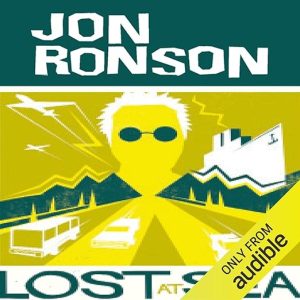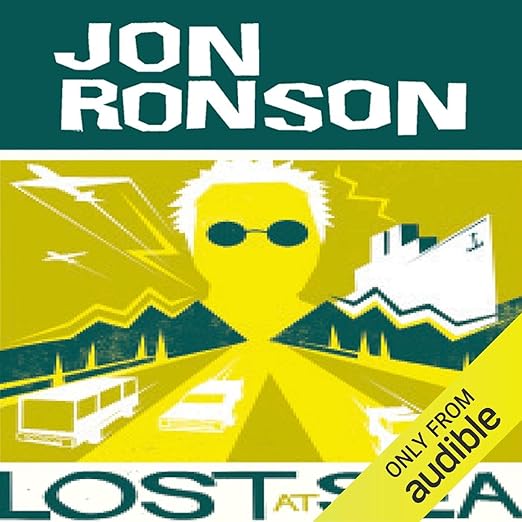
Can a single writer cover Robbie Williams at a UFO convention and a man who has assisted in more than a hundred mercy killings and make both pieces work as part of the same coherent project? The answer this audiobook of Jon Ronson's Lost at Sea: The Jon Ronson Mysteries provides across fifteen hours and twenty-two minutes is: yes, if the writer has a particular quality of attention that treats human belief with simultaneous humor and genuine respect. Ronson narrates every word himself, and the result is something that collapses the distinction between audiobook and audio journalism in the most productive possible way.
The collection gathers journalism originally published in The Guardian and GQ America, representing what Ronson has selected as the best of his adventures into extraordinary behavior and the human mind. The subjects include the Robbie Williams UFO convention, the Reverend George Exoo who claims to have assisted in over a hundred mercy killings, the Deal or No Deal contestants who believed they had a system to beat the banker, America's real-life self-styled superheroes, and an extensive exploration of Stanley Kubrick's personal archives. The updated edition adds a new afterword written and narrated by Ronson, giving the collection a retrospective dimension that the original publication lacked.
What Jon Ronson Delivers
Ronson's method is harder to replicate than it looks. The surface quality is the journalism of someone who seems genuinely uncertain about what he is going to find and honest about that uncertainty as he goes. He meets the woman building a robotic replica of her late partner and does not arrive with a pre-formed thesis about grief or technology. He goes to the Insane Clown Posse expecting one story and discovers another , that they have been evangelical Christians all along, a revelation buried beneath their public persona for years , and the genuine surprise of that discovery is legible in his prose. He forces his opinions rarely, and when he does, the restraint shown throughout makes the moment more rather than less powerful.
What accumulates across the fifteen hours is something the individual pieces do not fully prepare you for: a sustained meditation on longing. The UFO enthusiasts, the mercy killing assistant, the Deal or No Deal believers with their systems , what connects them is a profound wish for the world to contain something more than the randomness and mortality it appears to offer. Ronson is funny about this without being dismissive of it, which is the line most writers cannot walk without falling off one side or the other. One reviewer describes growing progressively more melancholy deeper into the collection, beginning to feel the deep longing that animates even the apparently comic subjects. That experience is structurally embedded in how the pieces are sequenced.
What Jon Ronson Gets Right
Ronson narrating his own material is one of those cases where the question of whether to seek the audiobook rather than the print edition answers itself immediately. His voice carries the same qualities as his prose: mild anxiety that reads as charm, self-deprecation that prevents him from ever seeming smug, and a curiosity that sounds genuine rather than performed for effect. The Kubrick archive piece benefits particularly from his narration , the careful, slightly overwhelmed quality of someone confronting the sheer volume of a creative obsessive's life work is in his voice as much as his words.
At fifteen hours and twenty-two minutes, the collection sustains real variety. The pieces differ substantially in tone , some openly comedic, some genuinely disturbing, some somewhere between the two , and the sequencing manages the tonal range without producing whiplash. The new afterword adds reflection on what these investigations meant to Ronson in retrospect, and it is worth staying through the main collection to reach it. It reframes the whole in small but meaningful ways.
Where Jon Ronson Loses Some Ground
Listeners familiar with Ronson's book-length work , particularly Them and The Men Who Stare at Goats , will recognize the sensibility immediately but will find a different structural experience. The anthology format means the immersive buildup of a sustained investigation is replaced by the variety of many shorter encounters. Both formats suit Ronson's voice; they produce different kinds of reader experience, and knowing which kind you are in the mood for matters.
The sourcing (Guardian, GQ America) matters for calibrating expectations. This is long-form magazine journalism, which means individual pieces have their own rhythms and the collection has no single overarching narrative arc. What holds it together is Ronson's sensibility rather than a plot or argument. Listeners who enjoy essay collections and literary journalism will be entirely at home; those who need a through-line narrative structure may find the anthology form less satisfying than Ronson's book-length investigations.
Who Should Pick Up Lost at Sea: The Jon Ronson Mysteries
This audiobook belongs to fans of long-form literary journalism with a strong authorial voice, listeners who already know Ronson's work and want to explore the magazine pieces that sit alongside his books, and anyone with a fondness for writing about human belief and behavior at its strangest and most poignant. This is also an excellent starting point for listeners new to Ronson , the variety of the anthology gives a strong sense of his voice across many subjects before committing to a full book-length investigation. Start here if you want to assess the sensibility; move to The Psychopath Test or Them if it hooks you.