Quick Take
- Narration: Ben Ayers brings measured authority to Machiavelli’s prose, the measured, deliberate pacing suits a text that rewards careful attention rather than speed.
- Themes: Power, necessity, and political realism; virtue versus fortune; the ethics of effective rulership
- Mood: Cold, precise, and unsettling in the way only genuinely honest political writing can be
- Verdict: An indispensable political text that remains essential reading after five centuries, this edition is a clean, accessible entry point for listeners who have not yet engaged with the original.
There are books that have been called dangerous for so long that the charge has lost its ability to prepare you for the actual experience of reading them. The Prince is one of those. I came to Machiavelli properly, not through secondhand reference or the casual adjective derived from his name, later than I should have, somewhere in my mid-twenties after years of assuming I already knew what it said. What I found, and what I find again in this audiobook edition narrated by Ben Ayers, is something considerably more nuanced than its reputation allows for: a document that is as much a confession about the nature of power as it is an instruction manual, and one that remains relevant in ways that would have dismayed Machiavelli’s more optimistic contemporaries.
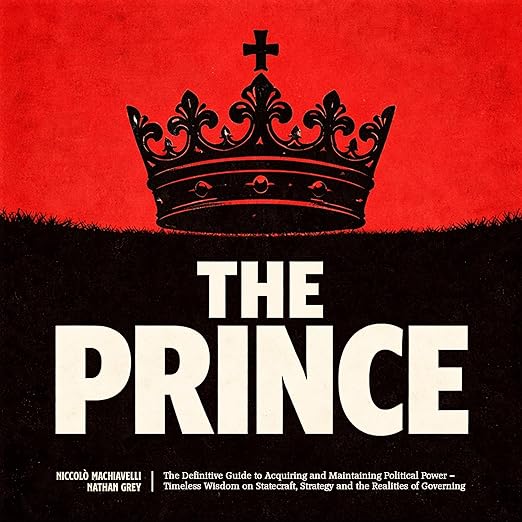
This Library of Alexandria edition, running just under five hours, is subtitled as a definitive guide to acquiring and maintaining political power. That framing is accurate to the spirit of the text without being reductive: Machiavelli is interested in how power actually works, stripped of the moralized language that political theory typically deploys to make uncomfortable realities more palatable.
Our Take on The Prince
The question that opens this edition’s framing, why do virtuous leaders often fail while the cunning rise to the top, is precisely the question that has made The Prince both celebrated and condemned for over five centuries. Machiavelli’s answer is clinical and, by the standards of Renaissance political writing, almost shockingly direct: politics is governed by necessity, force, and strategic intelligence, not by moral goodness. The lion and the fox, his central metaphor, captures this economy of means with an elegance that has survived because it is accurate rather than merely memorable.
The sections on virtue versus fortune and cruelty versus mercy are where Machiavelli is most frequently misread. He is not arguing that cruelty is good; he is arguing that a leader who deploys cruelty badly, or at the wrong time, creates more suffering than one who deploys it decisively and ends it. That distinction is subtle enough that it gets lost in summary but fully legible in context, and the audio format, by forcing a linear engagement with the text rather than allowing selective dipping, actually serves the argument better than casual reading might.
Why Listen to The Prince
Ben Ayers is a good fit for this material. His delivery is authoritative without being theatrical, which suits a text that makes its case through accumulated logical pressure rather than rhetorical flourish. The measured pace gives Machiavelli’s arguments room to develop and for listeners to track the reasoning without losing the thread. At under five hours, the runtime is appropriate for the text’s length and allows for a complete engagement that situates each chapter in relation to the whole.
The audio format has a specific advantage for The Prince that is worth noting: this is a text that is often encountered in fragments, the most quotable and controversial sections stripped from their context. Listening from beginning to end, in sequence, gives you the argument as Machiavelli built it, which is considerably more coherent and considerably less cynical than the selected-highlights version most people encounter first.
What to Watch For in The Prince
The edition does not include an introduction or scholarly apparatus, which means listeners come to Machiavelli without contextual framing about the historical circumstances of the text’s composition or its immediate political targets. Knowing that The Prince was written in 1513 by a man recently removed from office and possibly hoping to demonstrate his usefulness to the Medici family changes how you read certain passages. Those who want that context may want to supplement the audio with some brief secondary reading before or after.
The text’s terseness can feel abrupt in audio. Machiavelli moves briskly between examples and conclusions, and some sections benefit from a moment’s pause that listeners accustomed to more expansive modern nonfiction may not give themselves. The deliberate pacing of the narration helps, but this is a book that rewards a second listen for its full argument to settle.
Who Should Listen to The Prince
Anyone with a serious interest in political philosophy, leadership theory, or the history of ideas owes themselves a complete engagement with the actual text rather than the secondhand version that most people carry around. This edition makes that engagement accessible in under five hours, which is a reasonable investment for a five-hundred-year-old document that has shaped political thought in ways that are still observable.
Students of history, political science, and organizational leadership will all find directly applicable material here. General listeners who are curious about why The Prince remains a reference point in conversations about power and leadership will find that the text’s directness answers that question on its own terms. Readers seeking comfort, moral resolution, or inspiration should look elsewhere, Machiavelli is offering clarity, not consolation.
Frequently Asked Questions
Is this a new translation of The Prince, and does the translation quality affect the audiobook experience?
The edition is presented as a definitive guide translation, published by Library of Alexandria in 2026. The quality of the translation is a relevant concern for any classical text, and the clean, clear English prose in this edition handles Machiavelli’s original arguments accessibly without domesticating the sharpness of his thinking. Listeners with Italian or who have read other translations may notice differences in emphasis.
Does Ben Ayers’ narration distinguish between Machiavelli’s direct argument and his historical examples?
Yes. The pacing and tone shift appropriately between Machiavelli’s analytical passages and the historical examples he deploys from Roman, Italian, and biblical history. The examples are numerous and Ayers handles the proper nouns and historical references clearly enough that listeners without deep Renaissance history knowledge can follow the argument being illustrated.
Is The Prince in this edition accompanied by any scholarly introduction or contextual notes?
The text itself does not appear to include extended scholarly apparatus based on the available information. Listeners who want historical context about the circumstances of the text’s composition, its relationship to the Medici family, and the Renaissance political environment in which Machiavelli was writing may want to seek brief supplementary reading before engaging with the audio.
How does the audiobook compare to reading The Prince in print, particularly for a text this dense with historical examples?
The audio format enforces a linear reading that actually serves The Prince’s argument, the text is frequently encountered through excerpts, which strips the reasoning from its context and makes Machiavelli seem more simply cynical than he is. Listening from beginning to end gives you the full argument as built. The trade-off is that dense historical passages cannot be reread immediately, so a second listen or a print copy for reference may be useful.