Quick Take
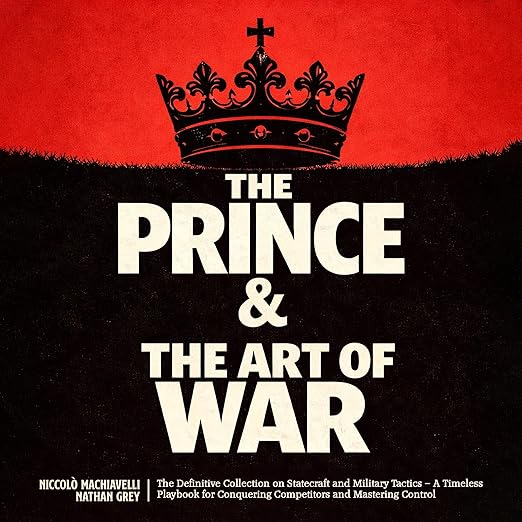
- Narration: Ben Ayers delivers both texts with authority and a clear, deliberate pace that suits the gravity of the material – measured rather than theatrical, which is the right call for Machiavelli.
- Themes: Realpolitik and the ethics of power, military organization and discipline, the relationship between strength and cunning
- Mood: Formal and intellectually bracing – Renaissance political thought at full intensity
- Verdict: A well-produced pairing of two essential texts that belong together – the combination illuminates both works more fully than either does read in isolation.
There is a version of reviewing a collection of Machiavelli that would spend most of its time on the arguments themselves, because they are extraordinary and still actively contested five centuries later. I want to do that, but I also want to be honest about what this particular edition is doing, because the curatorial decision to pair The Prince with The Art of War is genuinely more interesting than it might first appear. These two works are usually treated separately, the first as a text of political cynicism and the second as a practical military manual. Read together, they reveal a unified philosophical project about what it means to exercise power without illusion.
This Library of Alexandria edition, narrated by Ben Ayers and released in March 2026, runs to just over eleven and a half hours. The translator and translation version are not specified in the listing, which is a minor frustration for anyone who cares about such things, since multiple English translations of The Prince exist and they vary considerably in interpretive tone. Ayers’ reading sounds contemporary rather than archaic, which suggests a modern rendering rather than a Victorian one, and that choice serves the audiobook format well.
Our Take on The Prince and The Art of War
The Publisher’s framing around this collection emphasizes the contemporary applicability of Renaissance-era principles, and there is a version of that argument that is reductive, a self-help gloss on texts that deserve more serious engagement. What saves this edition from that trap is the completeness of the included works. Both texts are presented in their entirety, and that means listeners encounter the full complexity of Machiavelli’s thinking rather than a curated selection of quotable maxims.
The Prince is, among other things, a work about contingency. Machiavelli’s prince is not a tyrant by preference but by circumstance and necessity. His argument about the relationship between fortune and virtue, between what happens to you and what you make of it, is subtler than the Machiavellian reputation suggests. The fox and the lion metaphor that the collection highlights in its framing is not simply an endorsement of cunning over strength; it is an analysis of the different kinds of threats a ruler faces and the different capacities required to meet them. Ayers reads this with the gravity it deserves.
Why Listen to The Prince and The Art of War Together
The juxtaposition is intellectually productive. The Art of War, often overshadowed by the more notorious Prince, is where Machiavelli’s practical reasoning finds its most detailed application. He was deeply concerned with the difference between a citizen militia and mercenary forces, arguing that a ruler who depends on hired soldiers depends on others’ interests and therefore can never be secure. That argument echoes throughout The Prince’s chapters on military organization and the dangers of relying on auxiliaries. Reading them in sequence makes Machiavelli’s consistency of thought visible in a way that individual readings obscure.
At nearly twelve hours, this is a substantial listening commitment, but Machiavelli’s prose, even in translation, moves with a clarity that sustains the pace. He is a terse writer. He makes his argument, illustrates it with a historical example, draws the principle, and moves on. Ayers honors that economy in his delivery, reading without padding or dramatization. The texts feel like what they are: clear-eyed political philosophy by someone who had seen firsthand what misgovernment looks like.
What to Watch For in The Prince and The Art of War
The modern application angle raised in the collection’s framing is the territory where listeners most often bring their own interpretive frameworks. Business and management readers have been strip-mining Machiavelli for leadership lessons for decades, and some of those readings are reductive in ways that would have puzzled him. The Prince is a text about statecraft in the context of fifteenth-century Italian city-state politics, complete with specific historical figures and specific political crises. The principles generalize, but they generalize most productively when you understand the specific context from which they emerge.
Listeners with some background in Renaissance history, in the Borgia papacy, in the Medici family’s relationship with Florence, in the French and Spanish invasions of Italy that shaped Machiavelli’s world, will get significantly more from these texts than those coming in cold. The audiobook format does not provide that context, which is a case where a brief supplementary reading before or after listening would be worth the investment.
Who Should Listen to The Prince and The Art of War
Philosophy and political theory readers who want to engage with these texts as they were meant to be engaged, seriously and completely, will find this collection a well-executed production. Business and leadership readers who have encountered Machiavellian concepts through secondary sources and want to read the primary texts will find the collection accessible and the pairing illuminating. Students of military history will find The Art of War a useful complement to Sun Tzu, arguing from a very different cultural context toward some overlapping conclusions about discipline and strategic organization.
Listeners looking for a simplified, quotable summary of Machiavelli’s advice should know this is the full texts, not an adaptation. At eleven-plus hours, it is a genuine reading of both works. Those who want to dip into the famous passages rather than sit with the full argument will find the format mismatched to their purpose. For everyone else, Ben Ayers and nearly twelve hours of Renaissance political philosophy is a serious and worthwhile undertaking.
Frequently Asked Questions
Which translation is used in this edition of The Prince and The Art of War?
The listing does not specify a translator, which is a gap worth noting. The narration sounds contemporary rather than Victorian in register, suggesting a modern translation. Listeners for whom translation fidelity matters should sample the audio before committing, or check the Audible product page for updated translator information.
Why are The Prince and The Art of War paired in this collection?
Because they are philosophically continuous. Both texts are concerned with how power is built and sustained, the first in political terms and the second in military terms. Read together, they reveal Machiavelli’s consistent argument about the relationship between dependence and vulnerability, and the necessity of citizens-based rather than mercenary strength.
Is this collection appropriate for listeners with no prior background in Machiavelli or Renaissance history?
You can follow both texts without prior background, but the experience is richer with some. Knowing the historical context of the Medici, the Borgia papacy, and the French and Spanish invasions of Italy that shaped Machiavelli’s thinking helps the specific historical examples he uses land with their full weight rather than reading as abstract illustrations.
How does Ben Ayers’ narration handle the formal, philosophical register of the texts?
With appropriate gravity and restraint. Ayers does not dramatize or editorialize, which is the right approach for primary philosophical texts that need space to be heard. His pace allows the listener to sit with the arguments. The delivery feels authoritative without being stiff.