Quick Take
- Narration: Zhang Xiuye reads the Mandarin text with clarity and appropriate pacing for Level 1 learners, making the phonological content accessible without condescension.
- Themes: Identity and social class, classic story in simplified form, Mandarin vocabulary acquisition
- Mood: Gently literary, with the familiar story providing narrative comfort as the language does its work
- Verdict: One of the more enjoyable graded reader audiobooks available for Mandarin beginners, the familiar source text removes story-comprehension anxiety so you can focus on the language.
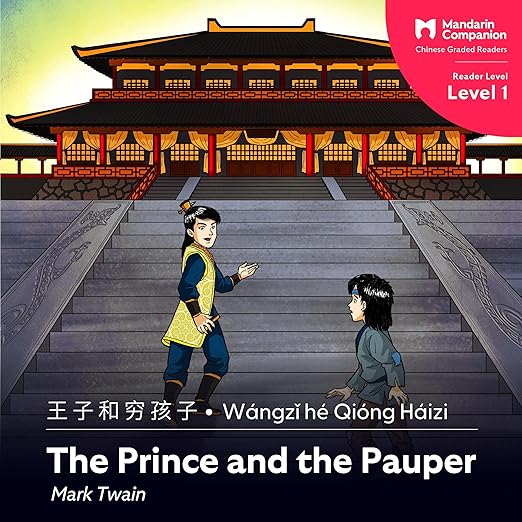
There is a particular freedom that comes from listening to a story you already know in a language you are learning. The narrative anxiety drops away. You are not spending cognitive resources tracking plot, you already know what happens when two boys, one a prince and one a pauper, decide to exchange lives. What you can focus on instead is the sound of the language, the vocabulary, the rhythm of Mandarin sentences, without the additional weight of keeping a new story’s threads in hand. The Mandarin Companion graded readers series understood this, and The Prince and the Pauper is one of the cleaner executions of the concept.
Mark Twain’s original novel has been adapted here for Level 1 readers, simplified vocabulary, controlled grammar, aimed at learners with roughly a few hundred characters and basic sentence patterns under their belts. Narrator Zhang Xiuye reads the simplified Chinese text, and the one hour and forty-two minute runtime sits comfortably within a commute or a focused evening session. The 4.8 average from sixty-two ratings is the strongest signal in this batch that the product is delivering on its promise for a meaningful number of listeners.
What Graded Reading Actually Does for Acquisition
The research behind graded reading is fairly robust: comprehensible input, material you can understand with a reasonable but not excessive challenge level, accelerates vocabulary acquisition more effectively than either content that is too easy or content that is too difficult. Level 1 of the Mandarin Companion series targets the threshold where learners can follow a narrative with minimal dictionary interruption, which is the sweet spot for acquisition rather than mere study.
Reviewer Kari captured this directly: noting that the story was told in language simple enough for the level without sacrificing the narrative, calling it their favorite of all the Level 1 readers. That judgment reflects exactly the quality the series is aiming for. Reviewer Donald Beduhn praised the use of common words, not obscure vocabulary or jargon, providing great practice with words needed for day-to-day activities. These are not accidental virtues; they are the result of deliberate vocabulary curation against a controlled list.
The Audio Dimension of a Graded Reader
Graded readers are traditionally print products, and the audio edition adds a dimension that pure reading cannot provide: accurate tonal pronunciation. Mandarin’s four tones are the most significant systematic challenge for English speakers, and reading a simplified text does not tell you how a word actually sounds. Zhang Xiuye’s narration makes the audio edition genuinely valuable rather than merely a convenience, you are hearing how the vocabulary sounds in connected speech, at a pace calibrated for your level, which is an input type that silent reading cannot replicate.
Reviewer Beaudine noted buying this for her daughter, who enjoys learning and practicing Chinese with it, which suggests the product also works as a parent-guided learning tool for younger learners. The story, familiar enough for children from school, not condescending for adults, travels across age ranges in a way that many graded readers do not.
The Simplified vs. Traditional Character Question
The full title specifies Simplified Character Edition, which matters for learners to note. If you are studying for use in Taiwan, Hong Kong, or in the context of classical Chinese, you will want the Traditional Character edition if available. For mainland China, Singapore, and most contemporary international Chinese language programs, Simplified is the appropriate choice. The audio itself is neutral, Mandarin pronunciation does not vary between simplified and traditional written systems, but the accompanying text materials, which you would need to study alongside the audio, differ.
Series Context and Entry Requirements
Level 1 of the Mandarin Companion series is designed for learners with a specific vocabulary foundation, typically around 300 characters and basic grammar structures. If you are at the absolute beginning of Mandarin study, this is not the right starting point; you need some vocabulary before the controlled input of a Level 1 reader becomes comprehensible rather than confusing. If you have been studying Mandarin for three to six months and are approaching that vocabulary threshold, this is exactly the right kind of listening material to add to your practice.
Who Should Listen
This is for early Mandarin learners who have a basic vocabulary foundation and want engaging listening practice that reinforces rather than merely tests them. It is also a compelling choice for more advanced learners doing a fluency review pass at a comfortable level. Skip it if you are at day one of Mandarin study, or if you need systematic grammar instruction rather than narrative input.
Frequently Asked Questions
Do I need to know the Chinese characters to benefit from the audio edition?
The audio stands alone as a listening comprehension resource, you will hear Mandarin pronunciation and connected speech without needing to read along. That said, the accompanying text is designed to be used alongside the audio, and pairing the two will accelerate both character recognition and phonological retention.
How does Level 1 of the Mandarin Companion series compare to other Mandarin graded reader series?
Mandarin Companion is one of the most respected graded reader series for Chinese, alongside Chinese Breeze and others. Level 1 targets roughly 300 characters, which is slightly lower than some competing series. The production quality and narrative adaptation have made it a consistent recommendation in the Mandarin learning community.
Is this a simplified or abridged version of the original Twain novel?
It is both. The story has been adapted for Level 1 vocabulary constraints and simplified grammar, which means the original text has been rewritten substantially to fit the controlled language requirements. The core narrative, the identity switch between prince and pauper, is preserved, but the language bears little resemblance to Twain’s original prose.
Can I use this as listening practice if I am preparing for the HSK examinations?
Level 1 of this series aligns roughly with HSK 1-2 vocabulary. If you are preparing for HSK 3 or above, the vocabulary and grammatical complexity here will feel below your level. For HSK 1 and 2 candidates, this is a useful and enjoyable supplementary listening resource.