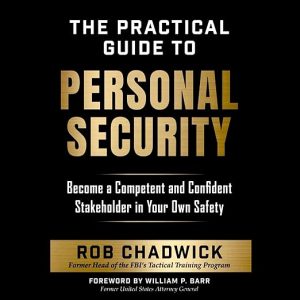
Quick Take
- Narration: Chadwick self-narrates with the matter-of-fact authority of a thirty-year law enforcement veteran, no theatrics, no hedging, and an instinct for which material needs the most emphasis.
- Themes: Threat detection and situational awareness, home defense and safe room planning, legal framework for use of force
- Mood: Steady and confidence-building, grounded in institutional authority without becoming bureaucratic
- Verdict: Chadwick’s FBI Quantico background gives this personal security guide a depth of operational specificity that most civilian-facing books in this category do not reach.
I spent part of a rainy Saturday afternoon listening to the first three chapters of this, having just finished a news cycle that included two separate stories about home invasions in cities I do not live in but could. There is a particular kind of attentiveness that arrives when threat feels abstract but proximate, and I was in that headspace when Chadwick’s voice came in, measured and direct, to say that you are the first line of defense and the question is only whether you have thought about it in advance.
Rob Chadwick spent thirty years in law enforcement and led the FBI’s Tactical Training Unit at Quantico, which is the unit responsible for training the trainers. That context matters for understanding why this audiobook feels different from the dozens of personal security books written by former military or police who are sharing their individual operational experience. Chadwick’s job at Quantico was specifically to develop and systematize tactical training for professional use, and that organizational, systemic thinking shows throughout the book. He is not sharing war stories. He is presenting a framework that has been tested, refined, and taught at a professional level.
The Seven-Second Threat Detection Methodology
The chapter on situational awareness is the heart of this audiobook and the section that multiple reviewers cited as transformative for how they think about their daily environments. Chadwick’s 7-second threat detection approach is a structured scanning methodology that he explains in enough procedural detail that a listener can actually attempt to implement it. The methodology distinguishes between passive background awareness, which most people have to varying degrees, and active environmental scanning, which is a trained behavior. He explains where the eyes should travel in sequence, what behavioral signals to register, and how to process what you are seeing quickly enough that the assessment does not consume conscious attention.
What elevates this section above similar coverage in the Jason Hanson book or generic security guides is the FBI institutional context. Chadwick does not just tell you what to look for; he explains why the human threat detection system is calibrated the way it is, where it fails, and how professional training compensates for those failure modes. The result is material that makes intuitive sense at a mechanistic level, which makes it far more likely to be retained and actually applied.
Home Defense as a Systems Problem
The home defense chapters take a whole-system approach that I found genuinely illuminating. Rather than treating home security as a list of hardware purchases, Chadwick frames it as a multi-layered defense architecture with distinct perimeter, approach, and interior components. The safe room chapter is thorough in ways that most treatments of this subject are not, covering communication redundancy, medical supply staging, and the behavioral protocols for a family under an intrusion scenario. The family emergency planning sections translate well to audio because they are primarily about communication and decision logic rather than physical skills.
The legal framework chapters covering Stand Your Ground laws, use of force standards, and the aftermath of a defensive encounter are substantive and current. Chadwick covers both the criminal and civil liability dimensions of defensive action, which is the complete picture that most self-defense resources skip. This material reflects the kind of legal fluency you would expect from someone who spent decades operating within law enforcement’s legal constraints and training others to do the same.
What the Self-Narration Brings
The decision to self-narrate is the right one here. Chadwick’s delivery is authoritative without being condescending, and he has clearly delivered versions of this material in training contexts where he needed to land both the urgency and the procedure clearly. The reviewers who read the entire book through in a single sitting were responding to something genuine in his voice: the sense that the person explaining this to you has actually been in rooms where these decisions mattered. That quality cannot be reproduced by a professional narrator reading from a manuscript.
Who Gets the Most From This Guide
This audiobook rewards listeners who want the full threat-assessment framework, from daily awareness habits to long-form emergency planning to the legal landscape of defensive response. It is more comprehensive in scope than books like Spy Secrets That Can Save Your Life and more institutionally grounded than the special forces survival tradition. People new to the personal security space will find it an excellent foundation. Those with prior security training will find the legal chapters and the systematic home defense architecture the most valuable additions to their existing knowledge base.
Frequently Asked Questions
Does Chadwick’s law enforcement background make this guide more relevant to US audiences, or does the framework apply internationally?
The legal chapters covering use of force, Stand Your Ground, and police interaction are US-specific. The threat detection methodology, home defense architecture, and crisis response protocols apply across jurisdictions.
How does this book handle the topic of firearms in home defense?
Chadwick covers firearms alongside non-lethal weapons and hand-to-hand options as part of a graduated response framework. The treatment is practical rather than ideological, and he addresses legal and storage considerations alongside tactical guidance.
Is the 7-second threat detection methodology something listeners can practice without formal training?
Chadwick presents it in enough procedural detail that listeners can begin practicing independently. Like any physical skill, proficiency develops with repetition, but the audiobook provides a sufficient foundation to start building the habit.
Does this book address digital threats and online privacy as part of personal security, or is the focus on physical safety?
The focus is on physical personal security, home defense, and threat recognition in physical environments. Digital security is outside the scope of this guide. Readers wanting comprehensive coverage of both dimensions would need a supplementary resource.