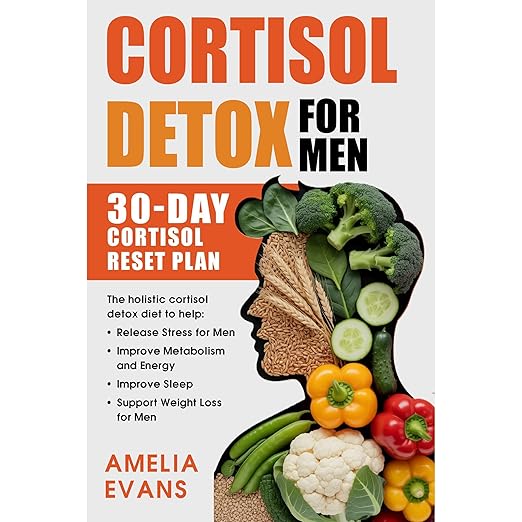
Amelia Evans opens Cortisol Detox for Men with a specific clinical argument: the reason most men's weight loss and fitness plans fail is not insufficient effort or poor diet choices but chronically elevated cortisol. That hormonal framing is both the book's central insight and its organizing principle. Everything in this audiobook, from the nutritional guidance to the workout philosophy to the sleep protocols, flows from the premise that a body locked in a constant stress response will resist fat loss regardless of how hard it trains or how carefully it eats. Evans makes this case with enough physiological specificity to feel credible rather than promotional.
The structure is methodical in a way that suits the audio format well. Evans builds the scientific case for cortisol's role in fat storage, metabolic suppression, and sleep disruption before moving to practical intervention protocols. That sequencing matters because it converts the 30-Day Cortisol Reset Plan from a list of instructions into something listeners can understand mechanistically. Knowing why a recommendation works makes it more likely to be followed, and Evans treats her audience as intelligent adults capable of engaging with the underlying biology rather than needing it simplified away.
The diagnostic section early in the book is one of its strongest assets. Evans outlines the measurable signs that stress hormones are out of balance: the belly fat that resists training, the energy crashes despite adequate sleep, the wired-but-exhausted feeling that makes recovery feel impossible. Reviewer Bruce Diamond called it a good, simple plan for busy guys who feel tired and wired, which accurately reflects the target listener. This is not a book for elite athletes optimizing performance margins; it is a book for the man who is doing everything he has been told to do and still sees no results.
The connection Evans draws between cortisol and multiple downstream effects, including poor sleep, fatigue, burnout, and weight gain, is handled with enough specificity to feel credible without becoming a physiology lecture. She explains how poor sleep raises cortisol, how elevated cortisol worsens sleep quality, and how that feedback loop traps men in a cycle that conventional diet and exercise advice does not address. Reviewer Amanda described her husband recognizing himself in the book immediately, which points to how effectively Evans has profiled the listener she is writing for. That recognition moment is where many health books fail; Evans earns it by being precise about symptoms rather than vague about solutions.
Virtual Voice Delivers Precise Timing Cleanly
The audiobook format works reasonably well for this kind of practical health content. At four hours and twelve minutes, it is long enough to cover the science and the full 30-day framework without padding. Virtual Voice narration delivers the text cleanly, which matters for a book with specific nutritional and timing recommendations where mishearing a detail could be consequential. The material benefits from being consumed in sequence, as the rationale for each intervention becomes clearer once the cortisol-centric framework is established in the early chapters.
The workouts Evans recommends deserve specific attention because they represent a counterintuitive shift from conventional fitness advice. Standard exercise guidance for fat loss often recommends high-intensity training, but Evans argues that certain high-intensity approaches spike cortisol and can worsen the hormonal imbalance this program is trying to correct. The workouts that lower stress hormones rather than raise them section is among the most practically useful in the book and is likely to challenge assumptions held by men with established training habits who cannot understand why harder effort is producing diminishing returns.
Built for Desk Jobs, Missing a Tracker
Reviewer Sarah raised a fair criticism: some of the tips are impractical for men with physically demanding jobs or genuinely chaotic schedules. The 30-day reset plan assumes a level of lifestyle control that men in construction, long-haul driving, or shift work may not have. Evans writes primarily for the desk-job professional whose stress is chronic and sedentary rather than physical and intermittent. Men whose primary stress comes from physical labor will find some recommendations more useful than others and some that will require meaningful adaptation to their actual circumstances.
The book also acknowledges that tracking progress is important but does not provide a companion app or worksheet resource within the audio format. Listeners who want structured tracking tools will need to create their own or seek supplemental resources. The absence of a PDF companion is a minor limitation for an audiobook built around a time-structured program, and it is worth planning for before beginning the 30-day reset. Writing down the specific dietary, exercise, and sleep adjustments from the relevant sections is the most practical workaround for audio-only listeners who want a daily reference point without replaying sections.
Men Already Eating and Exercising Reasonably Well
Men who have been exercising and eating reasonably well but cannot budge stubborn belly fat or break a cycle of poor sleep and low energy will find the most resonance here. The book is particularly valuable for anyone who has never encountered cortisol as a framework for understanding metabolic stagnation, as Evans's explanation of the mechanism is clear and accessible. Men with highly physically demanding jobs or genuinely unpredictable schedules will need to adapt some recommendations for their context. Anyone expecting a radical new diet plan rather than a hormonal reset approach will find the core framework more nuanced than conventional weight loss programs, and more grounded in physiology than in caloric arithmetic.
Does this audiobook require listeners to follow a specific diet, and how restrictive is the 30-day plan?
Evans focuses on food timing and cortisol-supportive nutrition rather than extreme caloric restriction. The plan emphasizes meal timing that supports fat-burning metabolic states and avoids foods that spike cortisol, but it is framed as sustainable rather than restrictive.
Is the Cortisol Detox for Men audiobook backed by scientific research, or is it primarily anecdotal?
Evans grounds her recommendations in hormonal biology and metabolic science, explaining mechanisms like the cortisol-sleep feedback loop with clinical specificity. The framework reflects established endocrinology, though listeners with specific medical concerns should consult a healthcare provider before beginning any new health protocol.
Can men with demanding physical jobs or irregular schedules realistically follow this audiobook's program?
Some adaptation will be necessary. The program is designed primarily for men dealing with chronic sedentary stress, and certain lifestyle recommendations assume a degree of schedule control. Reviewer Sarah flagged this limitation specifically for men in physically demanding trades, suggesting targeted section engagement rather than full program adoption.