At a Glance
- Performance: Attia's self-narration is precise and clinically credible, a physician explaining his own framework with the patience of someone who has delivered these explanations to thousands of patients.
- What it covers: Preventive medicine, longevity science, the four chronic diseases of aging, exercise as medicine, and the inseparability of emotional from physical health.
- Feel: Rigorous, dense, and occasionally demanding, serious medical nonfiction that rewards patient attention rather than passive listening.
- Our call: Among the most substantive popular audiobooks on longevity currently available, demanding but genuinely useful for listeners willing to engage at depth over seventeen hours.
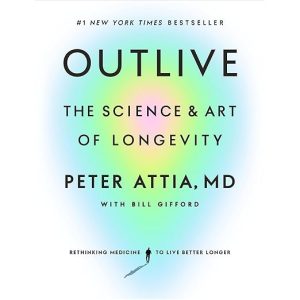
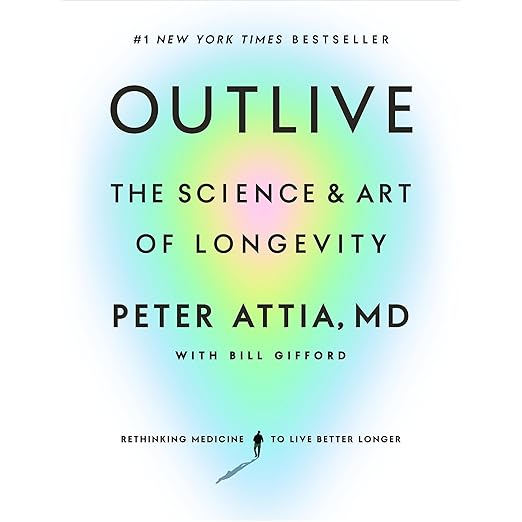
Modern medicine has become extraordinarily good at treating acute illness and surprisingly limited at preventing the chronic diseases that kill most people in wealthy countries. Cardiovascular disease, cancer, neurodegenerative conditions, and type 2 diabetes together account for the overwhelming majority of deaths in the developed world, and mainstream medicine tends to encounter them late, after decades of subclinical progression, when the available interventions are largely palliative. That gap between what medicine can do and what it actually delivers for long-term health is the problem Dr. Peter Attia sets out to address in this audiobook, and his approach in Outlive is both more rigorous and more practically actionable than most longevity content currently in popular circulation.
Centenarian Decathlon Trains Backward From Age Eighty
Attia self-narrates, and over seventeen hours, that choice pays off substantially. He is a working clinician with a research background, not a professional communicator, and his narration reflects that. It is precise, occasionally dense, and consistently credible. He does not simplify concepts to the point of inaccuracy, which means listeners accustomed to popular science that trades precision for palatability may find certain sections demanding. The chapters on lipid biochemistry, NAFLD (non-alcoholic fatty liver disease), and continuous glucose monitoring require genuine attention. That intellectual rigor is a feature of the book, not a failure of communication, and reviewer Wendy Kleven describes it as presenting 'an ambitious yet actionable and evidence-informed strategy' amid a vast wasteland of less credible health writing.
The 'Centenarian Decathlon' framework is the book's most useful organizing concept: the idea that physical preparation for a long, high-quality life requires working backward from the specific physical capacities you want to have at 80 or 90, and training toward those benchmarks decades in advance. Attia develops this idea across several chapters with enough specificity to make it actionable rather than aspirational. He is equally rigorous about the limits of current longevity science, consistently flagging where the evidence base is solid versus where it remains preliminary or contested within the research community.
Late Emotional-Health Chapter Surprises Longtime Listeners
The case for the audiobook specifically rests on Attia's narration and the book's structural design. Attia reads with the patient clarity of someone who has explained these concepts to thousands of patients and has learned exactly where the confusions arise for lay audiences. He knows which technical terms need to be unpacked and which can be deployed without elaboration for listeners who have done some background reading in health science. The result is an audiobook that rewards listeners who bring genuine curiosity about biology and medicine while remaining accessible to those who do not.
The emotional health section, which comes late in the book, is unexpected and genuinely affecting. Attia is candid about his own experience with intensive therapy and the ways in which he neglected psychological health while pursuing physical optimization. His argument that emotional health is inseparable from longevity, that you can maximize every biomarker and still not have a life worth extending, is the most personal section of the book and among the most important for listeners who came primarily for the fitness and nutrition content.
ApoB Chapters Demand a Second Pass
One reviewer described the book as 'not an easy read,' and that is accurate in audio as well as print. The chapters on lipid panels, particularly the case for measuring ApoB rather than standard LDL cholesterol, require careful listening and may benefit from a second pass. Attia assumes a reasonably educated audience and does not slow down for listeners encountering these concepts for the first time. The technical depth is one of the book's genuine strengths, but listeners who prefer lighter nonfiction should know what they are signing up for before committing to seventeen hours.
The book is also long. At seventeen hours, it demands a serious commitment, and the depth is uneven across sections. The exercise and nutrition chapters are among the most detailed and actionable. The sleep chapter is thorough. Some of the supplementation content is appropriately hedged but may feel less immediately useful to listeners focused on day-to-day changes. It is also worth noting that the book includes a downloadable PDF of charts, graphs, and illustrations that the audiobook version references but cannot reproduce aurally. Some of the biochemical content benefits from visual representation, and listeners may want to download the PDF companion to consult during or after particularly dense sections on lipid metabolism or training physiology.
Listeners expecting a quick overview of longevity principles will find the runtime a significant investment. But listeners who want a genuinely rigorous framework for rethinking their health in their 30s, 40s, and 50s, one that is built on clinical experience and current research rather than popular mythology, will find the full seventeen hours well worth the time and attention required.
Attia Admits Where His Own Views Shifted
Attia is also notably honest about where he has changed his mind over the course of his career. The book is not a retrospective on settled knowledge but a current account of how he actually thinks about longevity today, including positions he held previously that the evidence has shifted or complicated. That intellectual honesty, combined with his willingness to name uncertainty explicitly rather than projecting false confidence, is part of what distinguishes this from the genre of health books that present evolving science as established fact.
Physicians Call This a Textbook in Waiting
This audiobook is best suited for listeners in their 30s through 50s who are actively interested in preventive health and willing to engage with moderate technical complexity. Physicians and other health professionals will find Attia's framework intellectually credible and clinically grounded. Several reviewers have described it as a textbook for the next generation of physicians. Curious lay readers frustrated with the shallow treatment most longevity content provides will find it one of the most substantive popular works on the subject currently available. Listeners who prefer narrative-driven nonfiction or find dense science difficult to absorb in audio format may want to consider supplementing the listening experience with the print edition for the most technical sections.
Before You Listen
Is the Outlive audiobook worth it compared to reading the print version?
The audiobook benefits from Attia's self-narration, reading with the patient clarity of someone who has explained these concepts to patients over many years. That said, the book includes a downloadable PDF of charts and graphs that the audio cannot reproduce, so some listeners use both formats together.
What is the Centenarian Decathlon and does the audiobook explain it clearly?
The Centenarian Decathlon is Attia's framework for working backward from the physical capacities you want to maintain in your 80s and 90s, then training toward those benchmarks decades in advance. The audiobook develops this concept over several chapters with enough specificity to make it practically useful.
How long is the Outlive audiobook and is the full runtime necessary?
The runtime is approximately 17 hours and 7 minutes. The depth is slightly uneven across sections, with exercise, nutrition, and emotional health being the most actionable, but the book builds a cumulative framework that loses coherence if major sections are skipped.