Quick Take
- Narration: Maria McCann delivers the clinical material with a clear, professional register that suits the book’s technical ambitions, though the dense biochemistry sections demand active listening.
- Themes: thyroid and adrenal dysfunction across the lifespan, evolutionary endocrinology, diagnostics beyond standard lab ranges
- Mood: Thorough and technical, written for a reader who is exhausted by incomplete answers
- Verdict: The most comprehensive single-author guide to thyroid and adrenal health available in audio, though its depth will serve practitioners and persistent patient-researchers more than casual listeners.
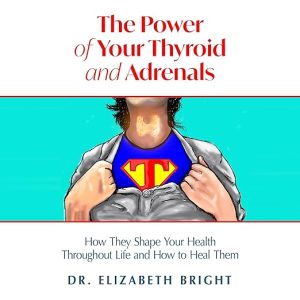
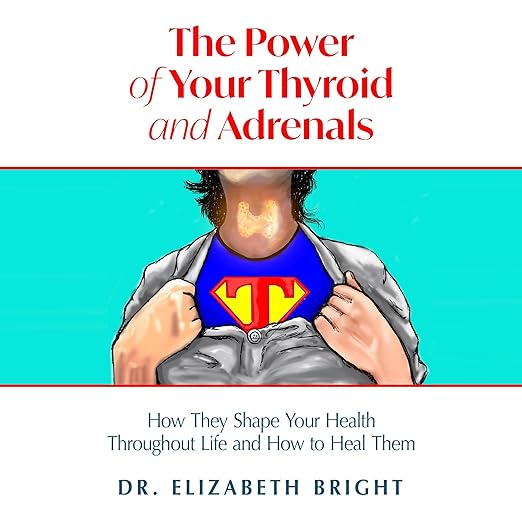
I have a good friend who spent three years being told her lab results were normal while feeling progressively worse, eventually discovering that her thyroid was functioning at the low end of a very wide reference range that her doctor had never questioned. She found Dr. Elizabeth Bright’s work through a specialist referral, and when she told me about this book, her description was precise: it was the first resource that explained not just what was wrong with her but why the standard testing had missed it. That context is why I came to this one with more investment than I usually bring to endocrinology titles.
What Dr. Bright has written is genuinely unusual in the thyroid and adrenal health space. Most books in this category are written for a specific patient population and stay within a fairly narrow clinical focus. Bright’s ambition is larger: she wants to explain these glands across the entire human lifespan, from fetal development through aging, and to situate them within an evolutionary framework that explains why they matter as much as they do.
Why the Lifespan Lens Changes Everything
The book’s organizing structure, following thyroid and adrenal function from before birth through the later years of life, is genuinely clarifying. Most resources focus on adult dysfunction as if the glands exist in isolation from development, immune function, and aging. Bright traces the influence of these glands on childhood growth, metabolic development, immune regulation, and neurological aging in a way that makes the connections between seemingly unrelated symptoms legible. For reviewer artique, who found links between her thyroid condition and other unexplained symptoms throughout her body, this comprehensive framing was exactly what she needed.
The evolutionary sections are the most distinctive part of the book. Bright argues that the thyroid and adrenals were central to human survival and advancement in ways that modern medicine has largely set aside in its focus on individual disease management. Whether or not you find the evolutionary framing fully convincing as a clinical argument, it provides a context for understanding why these glands are so systemically influential and why their dysfunction has such wide-ranging effects.
Advanced Diagnostics as the Heart of the Argument
The section on diagnostics is where many listeners who have had the frustrating experience of being told their labs are normal will find the most immediate value. Bright examines why standard thyroid panels, specifically TSH-only testing without free T3, free T4, and reverse T3, miss a significant portion of thyroid dysfunction. She explains the difference between optimal ranges and laboratory reference ranges, a distinction that is well established in integrative medicine literature but rarely explained to patients. Reviewer Elizabeth H., who had read ten previous thyroid books before this one, specifically noted the missing adrenal piece that Bright addresses more fully than most competitors.
The protocols section, which outlines Bright’s clinical approach to restoring thyroid and adrenal balance, is detailed enough to be genuinely useful but should be understood as one physician’s clinical practice rather than a universal standard of care. Bright advocates for natural desiccated thyroid over synthetic T4-only replacement, a position that reflects a growing body of practitioner experience but is not yet a mainstream consensus view.
Maria McCann Over Nine Hours
At nine and a half hours, this is a substantial listen, and Maria McCann’s narration holds up across the runtime. McCann prioritizes clarity over warmth, which is appropriate for material this technical. The biochemistry sections, which discuss hormone synthesis pathways and feedback loops in some detail, are demanding to follow in audio format regardless of how good the narration is, and listeners who want to understand those mechanisms fully will benefit from pausing and reviewing. This is not a book that rewards passive listening.
The book’s production quality is clean and the pacing measured. Reviewer Nancy Ragsdale, who works with Bright’s clinical practice, noted the thoroughness with which the protocols are explained, and that thoroughness translates to audio well, since Bright writes with precision rather than jargon for its own sake.
Audience and Honest Framing
This audiobook is best suited for listeners who have been unsatisfied with standard thyroid or adrenal evaluations, who have symptoms that have gone unexplained despite normal lab results, or who are health practitioners wanting a more comprehensive understanding of endocrine function than conventional training typically provides. The biohacker and longevity-optimization community will also find value in the metabolic and aging sections.
Listeners looking for a quick protocol book or a simple feel-better guide will find the depth here more than they need. Because the content is clinical and specific, anyone considering making treatment changes based on this book should do so with medical supervision rather than independently. The book is a resource for better conversations with your physician, not a substitute for one.
Frequently Asked Questions
Does the book address Hashimoto’s thyroiditis specifically, or only general thyroid dysfunction?
Bright addresses Hashimoto’s as an autoimmune thyroid condition within her broader framework of thyroid health. She examines the role of immune dysfunction, nutritional deficiency, and toxicity in triggering and maintaining the autoimmune response, which aligns with the integrative medicine approach to Hashimoto’s management. Those seeking a book focused exclusively on Hashimoto’s may want to combine this with a more condition-specific title, but Bright’s coverage is more thorough than most general thyroid books.
What does the book say about natural desiccated thyroid versus synthetic T4, and is this a settled question?
Bright advocates for natural desiccated thyroid as preferable to synthetic T4-only replacement for many patients, arguing that the T3 component more accurately reflects the body’s natural hormone profile. This remains a genuinely contested clinical question: many endocrinologists prefer synthetic T4 for consistency and dosing precision, while a growing number of integrative practitioners report better outcomes with natural desiccated thyroid. Bright’s position is well-argued but should be understood as one evidence-informed view within an active clinical debate.
How much of the book covers evolutionary biology, and is it relevant to the practical content?
The evolutionary framing is more than a rhetorical device; Bright uses it to explain why the thyroid and adrenals are so systemically influential, connecting their evolutionary role in survival and adaptation to their modern dysfunction under chronic stress and nutritional depletion. It occupies perhaps a fifth of the book and gives the clinical sections a coherent theoretical foundation. Listeners who prefer clinical information without evolutionary context can move through those sections more quickly without losing the practical material.
Is this accessible to someone with no medical background, or does it assume existing knowledge?
It sits at the upper end of accessible science writing. Bright explains terminology as she introduces it and does not assume prior knowledge of endocrinology, but the material is genuinely complex and the book does not simplify it for a general audience in the way that some popular health titles do. Listeners who are patient researchers accustomed to reading about their conditions in medical language will be comfortable here. Those wanting a quick-start guide will find the depth challenging.