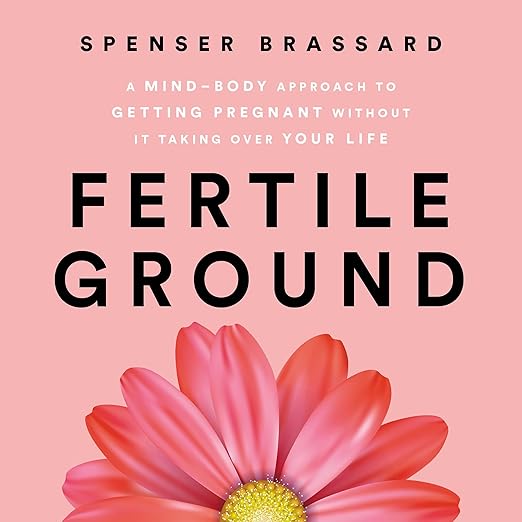
Quick Take
- Narration: Spenser Brassard narrates her own book, and it’s the only way this particular title could work. She spent eight years on the fertility journey she describes, and her voice carries the lived weight of that.
- Themes: Mind-body fertility, shame versus compassion, the stress-conception cycle
- Mood: Tender and reassuring, but not saccharine
- Verdict: For anyone deep in the fertility process who feels the effort itself has become the problem, Brassard offers a genuinely different way of thinking about it.
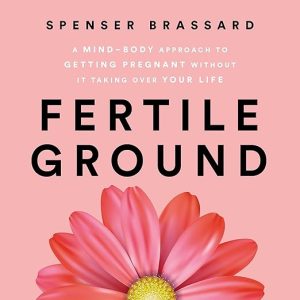
There’s a particular kind of exhaustion that comes with extended fertility treatment, and it isn’t just physical. It’s the exhaustion of constant optimization, of having turned your own body into a project with metrics and timelines and research tabs always open. I’ve heard this described by friends who’ve been through it, and I recognized it immediately in the opening chapters of Fertile Ground. Spenser Brassard doesn’t romanticize the journey. She lived it for eight years, and the specificity of that experience is audible in every chapter.
Self-narrated audiobooks in the health and wellness space can go either way. When an author reads their own work, you either get the intimacy of someone speaking directly from experience, or you get a stiff performance that makes you wish a professional had stepped in. Brassard lands firmly in the first category. Her delivery is warm and conversational, the kind of voice you’d want in a waiting room, which is precisely where one reviewer mentions bringing this book during fertility treatments.
The Mind-Body Case She Makes
The central claim in Fertile Ground is that the state of mind during the fertility process genuinely affects outcomes, with Brassard citing research suggesting a mind-body connection that can increase fertility by up to 55 percent when conditions of stress are replaced by conditions of compassion and growth. That’s a specific claim and a significant one, and I want to be clear that the research landscape here is evolving and contested. Some studies support the stress-fertility connection; others suggest it’s overstated. Brassard doesn’t overreach. She frames the mind-body approach as something that happened to her and that the research supports, not as a guaranteed protocol, which is the honest position.
What she’s really arguing against is the logic of over-effort: the idea that more research, more intervention, more control, and more sacrifice will necessarily produce the outcome. She found, and the research she cites supports, that the constant vigilance associated with intensive fertility treatment can itself become a physiological stressor that works against conception. Trading shame for compassion, as she puts it, isn’t soft or unscientific. It’s a different understanding of what the body needs.
What the Reviewers Describe
The three reviews available here converge on something interesting. None of them are clinical assessments. They’re all emotional ones. One listener describes being helped out of an exhausting mindset of over-effort and self-criticism. Another mentions bringing the book to fertility treatment waiting rooms for relief during heightened emotional states. A third compares reading it to talking to a best friend who knows what the fertility journey is like. The pattern is consistent: Fertile Ground functions primarily as a regulating presence, not as an information delivery system.
That’s both a strength and a useful signal about what kind of book this is. If you’re looking for clinical protocols, dietary frameworks, or a systematic review of fertility intervention evidence, this isn’t it. If you’re looking for a compassionate reframe of the experience you’re already in, it delivers with unusual sincerity.
The Self-Narration as Part of the Argument
At seven hours and twenty-three minutes, Fertile Ground is a manageable listen that doesn’t overstay its welcome. Brassard’s pacing is natural and never rushed. The sections on compassion-based practice and the mind-body reconnection are the most distinctive portions. These work in audio in a way that can surprise you, particularly when Brassard is describing her own lived experience of the shift from control-seeking to presence. Her voice carries that shift in a way that text on a page simply can’t replicate. This is one of those audiobooks where the narration is part of the argument.
Who Should Listen, Who Should Skip
Listen if you’re currently navigating fertility challenges and the process has started to feel like a second full-time job that’s crowding out everything else. Listen if you respond to personal narrative as a vehicle for emotional shifts rather than to clinical instruction. Skip if you want clinical evidence hierarchies and peer-reviewed protocols as your primary framework, or if the mind-body connection in health outcomes is not something you find persuasive. This book works on emotional and experiential registers, and it’s most effective when you meet it on those terms.
Frequently Asked Questions
Does Spenser Brassard’s self-narration add to the audiobook or would a professional narrator serve it better?
Self-narration is essential here. Brassard spent eight years on the fertility journey she describes, and her voice carries the lived weight of that experience in ways a professional narrator couldn’t manufacture. The emotional regulation effect that multiple reviewers describe is directly connected to the intimacy of her delivery.
Is the 55 percent fertility increase claim based on solid research?
Brassard cites research supporting the mind-body connection in fertility outcomes, but the specific figures should be understood as directional rather than settled science. The stress-fertility relationship is supported by multiple studies, though effect sizes vary. She frames it honestly as a research-supported position, not a guarantee.
Is this book only relevant for people using assisted reproductive technology, or does it apply more broadly?
Both audiences will find it relevant. The mind-body framework applies to anyone whose conception journey has become a source of significant stress, whether that involves IVF, IUI, or simply extended time trying to conceive without medical intervention. The emotional architecture she addresses doesn’t require clinical treatment as context.
Does the book include specific exercises or practices, or is it primarily narrative?
Both. The personal narrative of Brassard’s eight-year journey is the backbone, but she weaves in specific practices around compassion, presence, and mind-body reconnection throughout. These are most effective when you have the space to pause and engage with them actively rather than treating the listen as passive consumption.