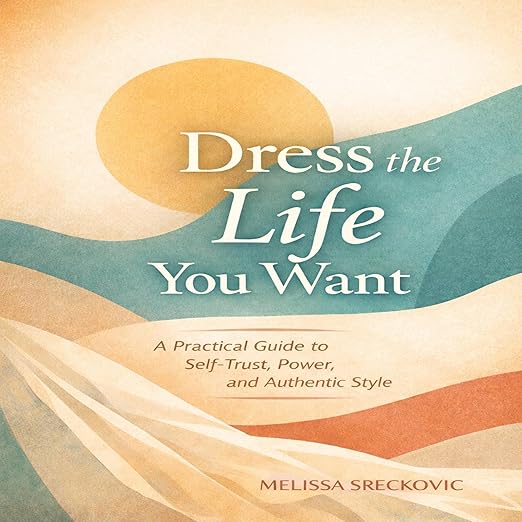
Dress the Life You Want arrives with a clear argument and does not waste your time reaching it. Melissa Sreckovic is not interested in trend cycles, capsule wardrobe formulas, or the kind of "ten pieces that will change your life" content that dominates the style advice space. This audiobook, running at one hour and twenty-two minutes, is about the quieter psychology underneath the daily decision of what to wear, and Scott LeCote's narration carries that quietness without trying to inflate it into something more dramatic than it is. For a book about confidence and self-trust, the restraint is appropriate: Sreckovic is not going to tell you to take up more space. She is going to suggest you start from a different place entirely.
The book's central proposition is that confidence is not primarily about how you look to others. It begins earlier, in the private moment of deciding how to show up for the day. Sreckovic argues that second-guessing what you wear erodes self-trust gradually, that dressing for approval disconnects you from your own sense of self, and that ease rather than effort is the real foundation of authentic personal style. These are not novel ideas in therapeutic or psychological literature, but this audiobook distils them with unusual clarity and without the condescension that often creeps into style guides aimed at women who, in the language of that genre, just need to love themselves more.
Stop Dressing Toward Confidence, Start From It
Sreckovic's framing is deliberately calm. She does not promise transformation or a complete wardrobe overhaul. She asks instead what happens when you stop trying to dress your way to confidence and start dressing from it. The distinction is subtle but the book spends its entire runtime on exactly that subtlety, which will either feel like the right depth or frustratingly abstract depending on what you bring to it as a listener.
LeCote's narration is controlled and pleasant without being particularly warm. For a book about the emotional side of clothing, a narrator whose voice carried more personal investment might have added texture. That said, the measured delivery does suit Sreckovic's tone: this is not a motivational audiobook in the conventional sense, and a high-energy performance would have been a significant tonal mismatch. The audiobook asks for the same quality of attention that Sreckovic is recommending for daily dressing, which is intentional slowness and self-regard rather than urgency.
The runtime deserves direct attention: at eighty-two minutes, this is a genuinely short audiobook. The book does not overstay its argument. The six core themes Sreckovic builds her framework around, why some outfits feel calm while others create tension, how second-guessing erodes self-trust, why dressing for approval disconnects you from yourself, how to build confidence through consistency rather than boldness, how to dress with care on low-confidence days, and why ease is the foundation of authentic style, each receive enough space to breathe without being padded to fill a conventional audiobook length.
LeCote's Pacing Lets Each Idea Settle First
The audiobook format works particularly well for this material because Sreckovic's writing has a meditative quality that benefits from being heard rather than read. The pacing LeCote maintains allows each idea to settle before the next arrives, which mirrors the book's own argument about slowing down the daily dressing ritual and making it a moment of intentional self-regard rather than anxious performance. Listening to this audiobook on a morning walk, or while slowly getting ready, produces a different experience than consuming it in a seated reading session, and the material responds to that contextual listening in interesting ways.
For listeners navigating significant life transitions, rebuilding confidence after a difficult period, or simply tired of feeling unsure every morning about a wardrobe they theoretically chose for themselves, the book offers something genuinely useful. It does not pretend that changing your shirt will change your psychology, but it does articulate clearly how your psychology shows up in how you dress, and that articulation alone can be clarifying enough to shift the morning routine from anxious performance to something quieter and more grounded.
The absence of listener reviews means this audiobook has not yet found its full audience, which is often the case with short, focused works in the personal style space. The field is crowded with bolder claims and bigger promises, and Sreckovic's quieter approach requires a listener who already suspects that the bolder promises have not delivered what they advertised.
Psychological Territory Instead of a Style Guide
This book is not a practical style guide and does not pretend to be. It contains no specific outfit recommendations, no advice on what to buy or avoid, and no seasonal or body-type frameworks. Listeners who want concrete, actionable wardrobe advice will find the book too abstract. It lives entirely in the psychological and emotional register, which is both its strength and its limitation: if you are already comfortable with that territory, the audiobook is exactly what it promises. If you need concrete next steps to feel that you have been helped, the book may leave you wanting something more tangible.
The short runtime also means that some of Sreckovic's ideas get introduced but not fully developed. The section on how to dress on low-confidence days, for example, raises real questions that the book addresses only briefly. Listeners who want extended, chapter-by-chapter exploration of each theme may find the audiobook feels more like an extended essay than a complete book. That characterisation is not entirely wrong, and whether it is a limitation depends on what you came looking for.
About Habit and Self-Trust Instead of Aesthetics
Listeners who will find the most value in this audiobook are those dealing with anxiety around daily dressing, people rebuilding confidence after major life changes, and anyone who has absorbed a great deal of conventional style advice without feeling fundamentally better about getting dressed in the morning. The under-ninety-minute runtime makes it an easy commitment to test before deciding whether the framework resonates. Listeners expecting practical wardrobe guidance, trend information, or body-positive style frameworks in the conventional sense should look elsewhere. The book operates at the level of habit and self-trust, not aesthetics, and that distinction is the whole point.
Common Questions
Does this audiobook provide concrete wardrobe advice, or is it primarily psychological in focus?
Primarily psychological. Sreckovic deliberately avoids trend guides, capsule wardrobe formulas, and outfit prescriptions. The book focuses entirely on the emotional relationship between clothing and self-trust, which makes it useful for listeners who feel stuck despite having absorbed plenty of conventional style advice.
At under ninety minutes, is this audiobook long enough to develop its ideas properly?
Sreckovic's argument is focused enough that the short runtime works in the book's favour. The six core ideas she develops are each given sufficient space, and the book does not repeat itself to fill a longer runtime. Listeners wanting extended chapter-by-chapter exploration of any single theme will find it covers breadth efficiently rather than depth exhaustively.
Is this audiobook suitable for listeners who are not particularly interested in fashion but struggle with daily confidence?
Yes. The book explicitly positions itself as a self-help guide rather than a fashion guide, and the clothing angle is a lens through which Sreckovic examines self-trust more broadly. Listeners with no interest in style as a subject but genuine interest in the psychology of confidence will find it more relevant than the title might suggest.
How does Scott LeCote's narration suit the tone of this audiobook?
LeCote's delivery is measured and calm, which complements Sreckovic's unhurried argument. Some listeners may find the narration slightly neutral for emotionally resonant content, but it avoids the over-earnest quality that can undermine self-help audiobooks that take on a performatively uplifting register. The restraint is a deliberate tonal choice.