Quick Take
- Narration: Y.L. Wright’s self-narration delivers the material with urgent conviction, which suits the book’s investigative tone, though some listeners may find the intensity relentless over nearly four hours.
- Themes: Biological dentistry, heavy metal toxicity, root canal controversy
- Mood: Urgent and alarming, with a strong alternative-health perspective throughout
- Verdict: An impassioned case for biological dentistry and the risks of conventional dental materials, best approached as an informed starting point for further research rather than a clinical reference.
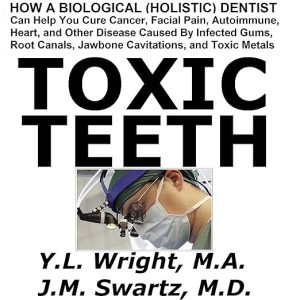
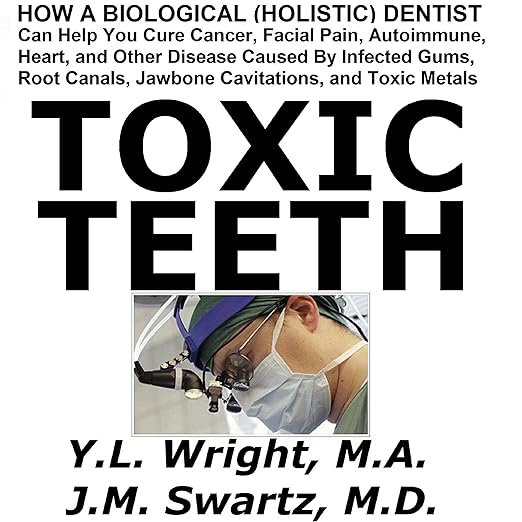
I came to Toxic Teeth with a specific question: I had been reading about mercury amalgam fillings for a piece I was writing, and wanted to understand how this argument sounded when made at length and at full conviction. Y.L. Wright, who writes and narrates under the M.A. credential, does not hold back. This is a book that believes what it is saying with complete seriousness, and listening to it is an unusual experience precisely because the author-narrator’s investment is so total.
The runtime sits just under four hours, and Wright covers a substantial amount of ground: mercury in fillings, root canal toxicity, jawbone infections known as cavitations, and the systemic spread of dental infections through the bloodstream to affect the heart, brain, and other organs. If you have spent any time in the space where integrative medicine and biological dentistry overlap, most of these arguments will be familiar. If you have not, this book is the deep end of the pool.
The Biological Dentistry Case
The strongest section is the extended treatment of heavy metal exposure from dental materials. Wright’s argument is not that amalgam fillings are universally catastrophic, but that continuous low-level mercury seepage from fillings, crowns, and other metallic restorations accumulates over time in ways conventional medicine does not adequately monitor. The distinction between acute mercury poisoning and chronic low-level accumulation is an important one that the book makes clearly. Reviewers who arrived after watching documentary content on similar topics, including the Netflix documentary Root Cause, found the book extended and deepened what they had seen, and at least one credits it with directing them toward a biological dentist who identified infections that had apparently been causing systemic illness for over a decade.
Those testimonials are powerful and should be taken seriously as individual experiences. They should also be held alongside the broader research context, which is more contested than the book presents. Wright writes from inside the biological dentistry tradition, which is a real and growing movement but occupies a minority position relative to mainstream clinical practice. The audiobook acknowledges this gap, at one point noting that your doctor may not believe this, and suggesting that if so, your doctor needs to listen to this book. That framing tells you where Wright stands and also signals the epistemological position of the text.
Root Canals and the Cavitation Hypothesis
The root canal section will be the most controversial for listeners with conventional dental backgrounds. Wright’s argument draws on older research, including the work of Weston A. Price and more recently the work associated with the IAOMT, to argue that root canal procedures leave behind anaerobic bacterial environments that seed infections through the body. Mainstream dentistry disputes both the mechanism and the claimed downstream effects.
The cavitation section, covering jawbone infections that Wright argues develop silently after tooth extractions in a significant percentage of cases, is similarly positioned at the edge of mainstream dental acceptance. The listener who arrived skeptical will remain so. The listener who arrived with unexplained chronic symptoms that have not resolved through conventional medical investigation may find the hypothesis worth pursuing with a qualified practitioner.
Navigating the Listening Experience
Wright’s self-narration is earnest and committed. The pace is somewhat relentless, which reflects the nature of the argument rather than poor production judgment. When you believe that common dental procedures may be contributing to widespread systemic illness, urgency is appropriate. The audio quality is adequate throughout, and Wright’s delivery is clear even when the content becomes dense with named compounds and biological mechanisms.
The book’s practical orientation, pointing listeners toward IAOMT-certified dentists and specific alternative therapies including ozonated olive oil for infections, is a useful feature. Whether the specific recommendations are appropriate for any individual listener’s situation is a question for a qualified practitioner rather than an audiobook.
Who Should Listen and Who Should Skip
This audiobook is for listeners who have encountered biological dentistry through other media and want a full-length treatment of the argument, or for those with chronic health conditions that have not resolved through conventional approaches and who are investigating all possible contributing factors. The reviewer community is sharply enthusiastic, with frequent references to life-changing outcomes from following the book’s guidance toward biological dentists.
Skip it if you want a balanced presentation that represents multiple clinical perspectives, or if claims need to be supported by double-blind trials before they are worth your time. Approach it as an argument to evaluate rather than a protocol to follow, and it has real value as an introduction to a medical tradition that mainstream practice largely ignores.
Frequently Asked Questions
What is the IAOMT, and how central is it to the book’s recommendations?
The IAOMT, or International Academy of Oral Medicine and Toxicology, is the professional organization for biological dentistry. Wright cites it as the credential to look for when seeking a dentist qualified to address mercury removal and cavitation treatment. Finding an IAOMT-certified dentist is one of the book’s primary practical recommendations.
Does the book address how to safely remove mercury amalgam fillings?
Yes. Safe mercury removal is a significant topic, with Wright discussing protective protocols to minimize exposure during the removal process. The book aligns with the IAOMT’s SMART protocol approach, though listeners should verify current protocols with a qualified biological dentist before proceeding.
How does Toxic Teeth relate to the Netflix documentary Root Cause?
Several reviewers mention coming to the book after watching Root Cause, which covers similar ground on root canal toxicity. The book provides considerably more detail on the mechanisms, the cavitation hypothesis, and additional dental materials concerns that the documentary touches on more briefly.
Is the author’s MA credential relevant to the content, and does it establish clinical authority?
Wright writes under the M.A. credential rather than a clinical dental qualification. The book draws on existing research and practitioner interviews rather than original clinical work. Readers expecting the authority of a practicing dentist should be aware of this distinction before relying on specific treatment guidance.