Quick Take
- Narration: Erin Yuet Tjam narrates her own work, and the self-narration is essential here. The book’s argument asks listeners to distrust commercial authority; hearing it from the author, a PhD scientist who co-wrote it, gives the challenge considerably more weight.
- Themes: Skincare product dependency as myth, skin’s natural self-regulation, the biochemistry of beauty industry manipulation
- Mood: Intellectually provoking and slightly destabilizing in the best way, like having someone quietly dismantle something you thought you understood
- Verdict: A scientifically grounded, genuinely unsettling examination of what commercial skincare products are actually doing to your skin. If you’re willing to sit with conclusions that contradict a lot of what you’ve been told, the 12-plus hours are worth it.
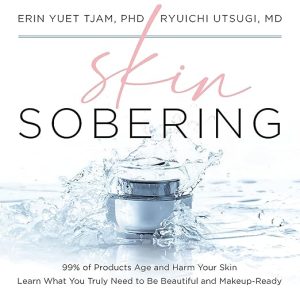
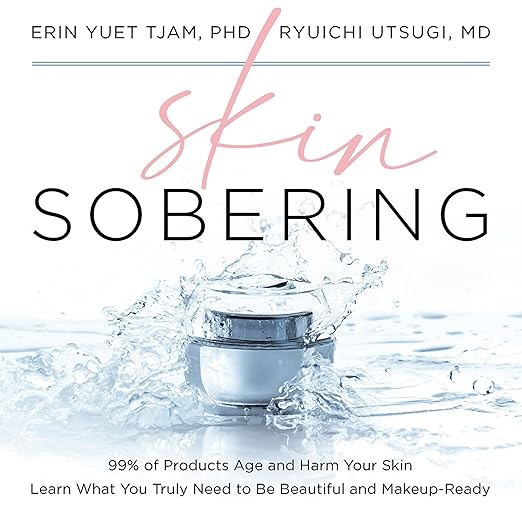
I finished the last hour of Skin Sobering on a Tuesday morning, standing in front of my bathroom sink looking at the six bottles I’d been reaching for every day for years. That is not a position I expected to be in when I started it. Erin Yuet Tjam and Dr. Ryuichi Utsugi have written a book that doesn’t tell you what to buy. It tells you that buying things may be the problem.
The premise is direct and deliberately provocative: the skincare products we use are not caring for our skin. They are masking it, and in many cases actively disturbing the skin’s natural metabolic processes. “Skin sobering” refers to the process of removing product dependency and allowing the skin to return to self-regulating function, in the way that someone sobering from alcohol allows the liver to resume its natural processing without the disruption of a constant exogenous chemical load. The analogy is deliberate and Tjam leans on it throughout.
The Science Beneath the Argument
What distinguishes Skin Sobering from the genre of natural beauty books that make similar claims is the evidentiary rigor. Tjam is a PhD scientist and Utsugi is a practicing anti-aging physician who has treated thousands of patients; their case is built on reviewed scientific studies and clinical observation rather than anecdote and wellness philosophy. When they argue that certain preservatives disrupt the skin microbiome, they explain the biochemical mechanism. When they argue that cleansers strip the skin’s natural acid mantle, they describe what the acid mantle is and what it does before they make the case against disrupting it.
Reviewer Lawrence Wong describes the biochemistry content as transformative and credits the book with changing their perspective entirely. Reviewer sbboca came in already using minimal products but still learned why things they were doing were causing inflammation they hadn’t connected to product use. That second response is more interesting: this book has something to say to people who thought they were already being careful.
Erin Yuet Tjam Reading Erin Yuet Tjam
Tjam’s self-narration is not optional here in any meaningful sense. The book is structured partly around the personal credibility of its authors: Tjam identifies herself in the subtitle as a “beauty-obsessed scientist,” which is a deliberate positioning. She is inside the beauty world she is critiquing, which gives her authority to critique it that a detached academic would not have. Hearing her voice deliver that critique, especially in the chapters where she describes her own history as a product consumer and the moment she began questioning the framework she’d been given, adds authenticity that a professional narrator would have had to manufacture.
At twelve hours and thirty-four minutes, the runtime matches the book’s ambition. Reviewer C. Beggs reports being four weeks into their product-free experiment by the time they wrote their review, which is the clearest possible signal that the book converts rather than merely informs.
What Acting on This Book Actually Involves
Skin Sobering asks for more than behavioral change; it asks for an epistemological shift in how you evaluate skincare information. Tjam and Utsugi devote substantial space to how the beauty industry creates perceived need through marketing, how regulatory frameworks fail to protect consumers from products that disrupt skin function, and how the cycle of product use creates the problems that more products are then sold to address. That structural critique, rather than the specific ingredient warnings, is the book’s most enduring contribution.
Reviewer C. Beggs describes being a minimalist before starting the book and still finding that their daily cleanser and toner were contributing to inflammation they hadn’t attributed to product use. The specificity of that example is useful: Skin Sobering is not just for heavy product users. It has something to say to anyone who uses anything on their face with regularity.
Who should listen: Anyone who has wondered whether their skincare routine is actually helping or has experienced chronic skin issues that don’t respond to more products. Listeners with a science background will appreciate the mechanism-level rigor; those without will find the explanations accessible.
Who should skip: Listeners looking for product recommendations or a protocol for improving their current routine rather than questioning it. This book’s endpoint is fewer products, not better ones.
Frequently Asked Questions
Does Skin Sobering tell you to use no products at all, or does it recommend a minimal protocol?
The argument tends toward doing significantly less, potentially nothing for some people, but Tjam and Utsugi distinguish between categories of product intervention. Some natural substances and minimal practices are discussed positively. The book’s endpoint is skin-led, not zero-product as an absolute rule.
How does this compare to other books that question commercial skincare, like Renegade Beauty by Nadine Artemis?
Skin Sobering is more scientifically grounded and less spiritually oriented than Renegade Beauty. Both argue for reducing product dependency, but Tjam and Utsugi build their case from clinical evidence and biochemistry rather than nature philosophy. Listeners interested in the science will find Skin Sobering more rigorous; those drawn to holistic wellness frameworks may prefer Artemis.
Is the 12-hour runtime padded, or does it maintain substantive content throughout?
Reviewers consistently describe it as information-dense rather than repetitive. The runtime reflects the scope of the argument: chemistry of products, clinical case evidence, regulatory analysis, industry marketing mechanisms, and the practical protocol for reducing product dependency. Each section earns its place.
Does Tjam’s background as a scientist affect how accessible the technical content is?
Yes, positively. She is, by her own description, beauty-obsessed, not purely academic, which means she writes for the consumer audience she was part of rather than a scientific one. Reviewer C. Beggs, not a scientist, found it well-written and easy to follow. The technical depth is real but not exclusionary.