Quick Take
- Narration: Lloyd James delivers the dense, research-heavy material with clarity and pace, he keeps the academic citations from feeling like a lecture, though the 20-hour runtime will test listeners who prefer shorter nonfiction.
- Themes: Persuasion psychology, ethical influence, defense against manipulation
- Mood: Methodical and illuminating, occasionally unsettling
- Verdict: The new edition’s seventh principle, Unity, adds genuine value over earlier versions, making this worth the time even for those who read the original.
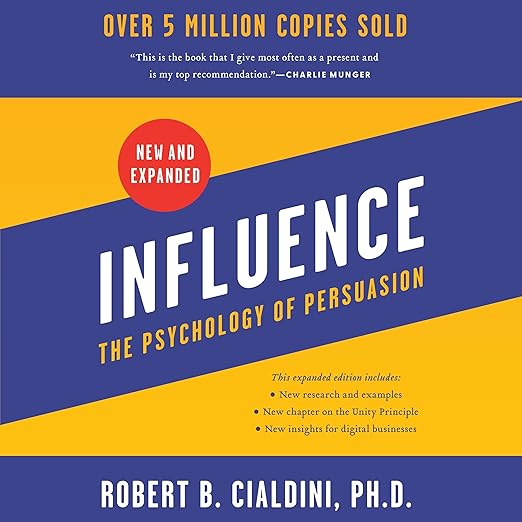
I first encountered Cialdini’s original Influence in a second-hand copy during graduate school, its spine cracked and margins annotated by whoever owned it before me. I thought I knew it well enough. Then I listened to this 2021 revised edition on a week of evening walks, and I was surprised by how much the new material shifts the book’s emphasis. The addition of Unity as a seventh principle of persuasion is not a footnote, it reframes several chapters in ways that feel immediately relevant to how social media and group identity actually function today.
At twenty hours and forty-three minutes, this is a substantial listen. Lloyd James narrates, and he brings a measured authority to the material that suits Cialdini’s academic-but-accessible register. The concern, noted by some listeners, that Cialdini himself does not narrate is fair, there is always something specific about hearing an author perform their own conviction. But James reads with enough intelligence that the content is never flattened.
Our Take on Influence
Cialdini’s core thesis has not changed since 1984: human beings are susceptible to a small set of psychological triggers that cause automatic compliance, and understanding these triggers both makes you more persuasive and makes you harder to manipulate. What the new edition does is ground each principle in more contemporary research and more contemporary examples, the digital economy, social media platforms, online retail, so that the book feels actively current rather than like a period piece.
The six original principles are well documented elsewhere: Reciprocation, Commitment and Consistency, Social Proof, Liking, Authority, and Scarcity. The new seventh principle, Unity, concerns shared identity, the sense that the person attempting to influence you is part of the same tribe. Cialdini argues this is qualitatively different from simple liking, because it activates something closer to kinship psychology. This addition alone makes the revised edition worth picking up even if you read the original.
Why Listen to Influence
The format works particularly well for a book structured around case studies and stories. Each principle is illustrated through multiple real-world scenarios, advertising campaigns, door-to-door sales tactics, social experiments, and the narrative flow of audio lets these accumulate naturally without the visual interruption of chapter breaks and pull quotes. Reviewer C. Critchfield notes the book’s ability to illuminate the click-whirr subconscious responses that govern compliance, and this phrase captures something true: hearing the examples rather than reading them makes the automatic quality of these responses feel more visceral.
Reviewer Joseph Michael Cardon compared it favorably to Seth Godin’s Tribes, noting the structured idea progression and the care with which each argument is sourced. That comparison is useful: where Godin operates through inspiration and provocation, Cialdini operates through evidence. Both approaches have their uses, and this one is better suited to listeners who want to understand the mechanism rather than just feel the call to action.
What to Watch For in Influence
The chapter on Social Proof deserves particular attention in the audio format, because Cialdini’s examples now include digital phenomena, follower counts, star ratings, algorithmic amplification, that did not exist in earlier editions. Listening while scrolling through a social media feed would be a genuinely useful exercise.
The supplemental PDF mentioned in the product description adds reference charts and visual summaries. If you are listening on Audible without access to the PDF, you may want to take occasional notes during the principle definitions, as the structured framework is easy to lose track of across a long runtime.
Who Should Listen to Influence
This is essential listening for anyone working in marketing, sales, product design, or organizational management, but Cialdini’s consistent ethical framing makes it equally valuable for people who simply want to understand when they are being influenced and how to push back. Listeners who found Malcolm Gladwell’s Blink or Daniel Kahneman’s Thinking, Fast and Slow useful will find the conceptual territory familiar, though Cialdini’s focus is narrower and more practically applicable.
Those who want a short, punchy listen should look elsewhere, this is a dense, careful work that rewards sustained attention over several sessions rather than a single sitting.
Frequently Asked Questions
How does this 2021 revised edition differ from the original 1984 Influence?
The main addition is a seventh principle called Unity, which describes shared identity and group belonging as a distinct mechanism of persuasion separate from simple liking. The existing six principles are also updated with new research and contemporary examples from digital marketing and social media that were absent from earlier editions.
Is Lloyd James a good fit for this material, or should I seek out a version narrated by Cialdini himself?
James is a competent and clear narrator who handles the academic material well. Cialdini does not narrate this edition. If hearing the author’s own voice matters to you, note that Cialdini has narrated some of his other works, but for this edition James is the narrator of record and performs the job capably.
At over 20 hours, is this best listened to in one long stretch or across multiple sessions?
Multiple sessions work better. Each chapter covers a distinct principle with its own case studies, making natural stopping points every few hours. Listeners who try to absorb all seven principles in a marathon session report that the later chapters blur together. Two to three hours per day over a week or so lets the examples and frameworks settle.
Does the book cover how to defend against manipulation, or is it primarily a how-to for persuaders?
Both. Cialdini explicitly frames the book as a defense guide as well as a persuasion guide. Each principle chapter ends with a section on how to recognize when it is being used against you and how to interrupt the automatic compliance response. This dual framing is one of the book’s most useful features.