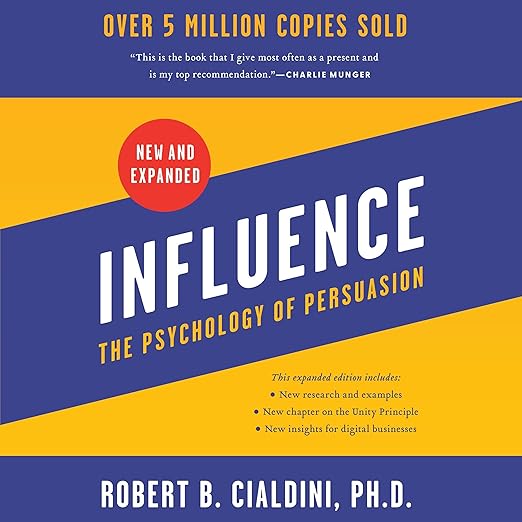
Robert Cialdini narrating his own audiobook is not a vanity choice. Over the course of twenty hours and forty-three minutes, you spend time with someone who has devoted thirty-five years to thinking about persuasion with the rigor of a scientist and the instincts of a storyteller, and the combination produces a listening experience that is dense with content but never dry. Influence, New and Expanded is the updated version of a book that had already sold over five million copies, and it arrives with enough new material to justify a full listen even for those who know the original well.
Cialdini's framework, the Universal Principles of Influence, has been circulating in business and marketing culture for decades, to the point where many listeners will arrive already familiar with Reciprocation, Commitment and Consistency, Social Proof, Liking, Authority, and Scarcity as named concepts. What the expanded edition provides is a seventh principle, Unity, and new research woven throughout the existing framework that updates and sharpens the original case.
Unity is the most interesting addition: Cialdini defines it as the sense of shared identity that activates compliance in ways that go beyond mere liking. Where liking involves finding someone pleasant, unity involves feeling that you belong to the same group. The distinction matters practically, and the audiobook gives it enough space to feel like a genuine extension of the theory rather than a bolted-on addition. Reviewer C. Critchfield, who returned to the book after losing an earlier copy, noted that Cialdini does an exceptional job of outlining the "click whirr" subconscious mechanisms people carry and how others exploit them. That phrase captures what makes the book valuable for two different kinds of listener: those who want to use these principles, and those who want to defend against them. Cialdini is explicit that understanding influence is as important for protection as for application, and he addresses ethical use throughout rather than relegating it to a postscript.
What Stands Out
The audiobook has a supplemental PDF companion, which matters for a book that uses visual examples and structured summaries at the end of each chapter. Listeners who want to engage with those materials will need to access the PDF separately, but the core argument transfers completely to audio. Cialdini's narration is clear and methodical, organized to follow the chapter structure his research has always used: principle, mechanism, examples from research and real life, ethical implications.
At twenty hours and forty-three minutes, this is a substantial audiobook, but the structure means it can be consumed in sections without losing the thread. What distinguishes this from shorter summaries or business podcasts covering the same material is the depth of the evidentiary base. Cialdini's three-year field study on what leads people to change is described with enough methodological detail that listeners who care about how the science actually works will find the evidence credible rather than merely illustrative. Reviewer Joseph Michael Cardon, comparing it favorably to other marketing theory books, noted that "every story or study mentioned is" properly substantiated, which in the world of business bestsellers is not something you can take for granted. Reviewer RABINDRA PRASAD SRIVASTAVA highlighted the well-structured chapters and the use of modern company examples, confirming that Cialdini has updated the illustrative material effectively alongside the theoretical extensions.
Weak Spots in Influence, New and Expanded
The audiobook's primary limitation is one of form rather than content. Cialdini is a skilled narrator, but his delivery is that of a professor who has taught this material hundreds of times: polished, pedagogical, occasionally a little over-explained for listeners who move quickly through frameworks. If you are someone who annotates and flips back through pages, you will miss that option here. The companion PDF partially addresses this, but it cannot substitute for the experience of working through a dense text with a pencil in hand.
The book is also primarily oriented toward individual decision-making contexts: sales, negotiation, fundraising, consumer behavior. Listeners looking for application in organizational change, political persuasion, or large-scale behavior change will find the principles applicable but the examples somewhat narrowly drawn. These are minor limitations in a book that otherwise delivers systematic, evidence-based insight into why human beings comply, defer, and decide the way they do.
One of the audiobook's more interesting structural choices is how Cialdini addresses the gap between knowing the principles and defending against them. Simply being aware that someone is deploying Social Proof or Scarcity does not fully immunize you against their effect, because many of these responses operate at a level that conscious awareness does not fully reach. Cialdini acknowledges this directly, which is intellectually honest and practically important: the book is not a magic shield but a set of tools for increasing your resistance and your own persuasive effectiveness simultaneously.
Best Suited For
Anyone who communicates for a living, whether in sales, marketing, management, fundraising, or public relations, will find the framework here systematically more useful than generic communication advice. Those who have read earlier editions and want to encounter the Unity principle and updated research in full should consider the audiobook format specifically because Cialdini's own narration conveys the enthusiasm of someone returning to material he still finds alive and evolving. Listeners skeptical of persuasion books as inherently manipulative will find the ethical framing more sustained than most, though they will need to engage with the counterargument on its own terms rather than expecting it to be fully resolved.
Does the audiobook version of Influence, New and Expanded include all the new content from the expanded edition, or is it abridged?
The audiobook is the full expanded edition, running at twenty hours and forty-three minutes. It includes the seventh principle of Unity, new research throughout the existing chapters, and updated real-world examples. A supplemental PDF companion accompanies the audiobook for visual elements and chapter summaries.
Is this audiobook worth listening to if you already know the original Influence well?
The seventh principle, Unity, is a genuine conceptual extension rather than a minor update, and the new research woven through the existing chapters adds enough substance to justify the full runtime. If the original's six principles are deeply familiar to you, the expanded edition offers meaningful new material rather than a simple refresh.
How does Cialdini handle the ethics of persuasion in this audiobook, given that the principles can be used manipulatively?
Cialdini addresses ethical application throughout the audiobook rather than treating it as an afterthought. The framework is explicitly presented as equally useful for defense against manipulation as for persuasion. He argues that understanding the principles is the best protection against those who would use them unethically.
At over 20 hours, is the audiobook paced in a way that allows it to be consumed in sections, or does it require sustained attention from start to finish?
The book is organized chapter by chapter around each principle, which means each section can stand alone once you have the foundational framework from the opening chapters. Most listeners will find it suits a segmented approach, whether by commute, gym session, or focused listening block, without losing coherence.