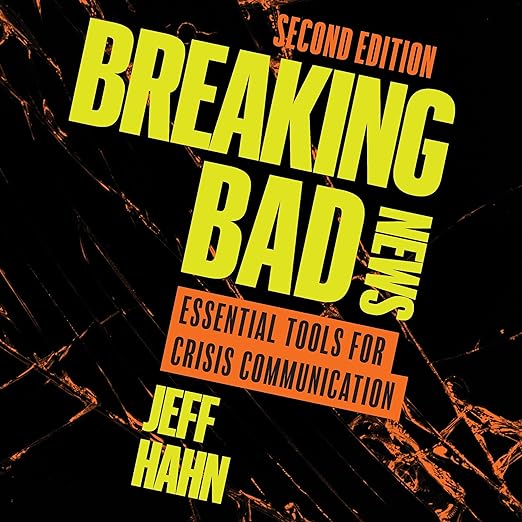
Breaking Bad News earns its five-star rating by doing something most crisis communications books fail to accomplish: it is genuinely useful the moment you actually need it, not three months after you finished it and are trying to remember what the framework was while someone is waiting for a statement. Jeff Hahn narrates his own audiobook across 5 hours and 47 minutes, and the self-narration is the right choice because this book's authority comes from Hahn's voice as a practitioner, someone who has been in the room when the crisis call came in, rather than from any abstract framework he assembled from a distance.
Compressed Knowledge From Someone Who Was in the Room
Hahn spent thirty years in crisis communications before writing this book, and that experience is present on every page in ways that no amount of secondary research can replicate. He is not offering theory developed from a distance. He is offering the compressed practical knowledge of someone who has watched intelligent, well-intentioned people make the same avoidable mistakes under pressure, and who has learned, often through those failures, what actually works in the first hours of a reputational crisis versus what looks good in a workshop slide deck or a pre-crisis planning document.
The book's focus on the first crucial hours is a deliberate and intelligent scope limitation. Hahn is not trying to write a comprehensive crisis management manual covering every phase from initial incident through long-term reputation rebuild. He is trying to help the person who just got the call and has to respond before the next news cycle closes, before the social media narrative solidifies, before the story gets written by people who do not have the benefit of the organization's perspective. That specificity makes the book more useful, not less comprehensive in any way that matters for its intended audience.
At a perfect 5.0 rating, this audiobook has found an audience that recognizes what Hahn accomplished. The score is remarkable enough to be worth examining: in a genre where experienced professionals often find fault with oversimplification, Hahn has written something that practitioners at multiple levels of experience consistently endorse.
A Decision Architecture for an Active Crisis
The second edition adds a dozen new case studies drawn from the energy, food and beverage, and airline sectors. These additions strengthen the book's most practically valuable element: showing not just what the framework recommends in the abstract but how it plays out across different industry contexts and different types of reputational threat. The case studies are not illustrative decoration. They are the mechanism by which Hahn demonstrates that his model is adaptable across situations rather than calibrated only for a specific type of crisis.
Hahn narrating his own work means the war stories land with the authority of firsthand account. When he describes a situation where a client's instinct to stay quiet in the first hours made a manageable crisis into a catastrophic and months-long ordeal, you hear the frustration of someone who watched it happen and was unable to change the decision. This is not a textbook author making a rhetorical point about the cost of delay; it is a practitioner accounting for his own experience under conditions that matter.
The framework itself is cleanly designed and, more importantly, memorable under pressure. It is not a checklist, which becomes useless when the situation does not match the checklist's assumptions. It is a decision architecture: a set of questions that orient you toward the right actions in the right sequence under the specific cognitive and emotional conditions of an active crisis, when your attention is fractured and your instincts may be pointing in exactly the wrong direction. Hahn spends time explaining why the framework is structured as it is, which makes it considerably more durable than systems that give you steps without reasoning.
The tagline, when the spaghetti hits the fan this is your rapid response resource, is accurate as a description and as a positioning statement. This is not a book for reading in a quiet moment to think about crisis preparedness in the abstract. It is a resource to have absorbed before the call comes, so that when it does, the framework is available to you without requiring you to remember where you put the book.
Narrow in Time, Broad in Industry Application
Listeners looking for deep treatment of long-term reputation management, stakeholder communication beyond the initial response window, or sector-specific regulatory compliance considerations will need to supplement this book. Hahn is explicit about his chosen scope, but it is worth knowing that even at nearly 6 hours, the focus remains deliberately narrow in time even as it is broad in industry application.
The book's tone is confident to the point of occasionally feeling declarative about matters where experienced communications professionals might reasonably hold different views. Hahn has earned his convictions through three decades of practice, but listeners who carry their own significant crisis communications backgrounds may find some of his framings more contestable than the delivery suggests. This is a book that reflects one expert's very strong point of view, not a survey of the field.
Some of the second-edition case studies are introduced briefly enough that the specific lessons they are meant to illustrate require the listener to do some inference. More extended case treatment in these sections would have strengthened the new material.
Not an Audiobook You Shelve After One Listen
Communications professionals, PR practitioners, executives who carry reputational risk for their organizations, legal teams involved in crisis response, and anyone who has ever been in the position of managing information flow during an organizational crisis will find this audiobook immediately and practically applicable. The runtime is appropriate for this audience: short enough to finish before a Monday morning call, long enough to deliver a complete and memorable framework rather than a summary.
The five-star rating is the listener community's verdict, and it reflects what Hahn achieved: a book that earns the confidence it projects. This is not an audiobook you listen to for intellectual pleasure and then shelve. It is a resource you keep in rotation, returning to specific sections as different scenarios require. That is the highest compliment you can pay a practical professional audiobook, and Breaking Bad News deserves it fully.
Is this audiobook relevant if I already work in crisis communications?
Yes. Experienced practitioners will find Hahn's framework useful as a calibration tool and the second-edition case studies from energy, food and beverage, and airline sectors directly applicable.
How does the second edition of this audiobook differ from the first?
The second edition adds a dozen new case studies from energy, food and beverage, and airline sectors, expanding the demonstration that the core framework adapts across different industry contexts and crisis types.