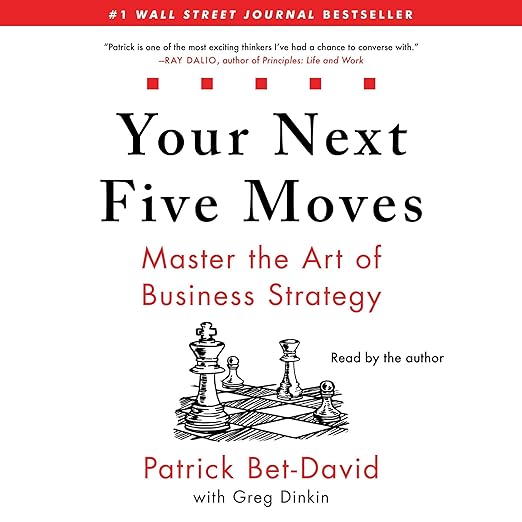
Chess metaphors in business books usually stop at the metaphor. Patrick Bet-David runs his the whole way. The claim is that entrepreneurs and grandmasters share one skill, the ability to look at the position in front of them and see five moves ahead, and the audiobook is organized as five categories of decision rather than as chapters of advice. Whether the structure holds depends on how much you trust the voice delivering it, and that voice belongs to the author.
Dalio and Tracy Sit in the Book as Blurbs
Five moves, and none of them is a tactic. Clarity about what you want and who you want to be. Strategy for the war room and the board room. Growth tactics for good conditions and bad. Team-building anchored in values. Then power plays and the application of leverage. That ordering is the actual argument: know yourself before you strategize, strategize before you scale, and treat leverage as the last move rather than the first one you reach for. Chess does one useful thing most business metaphors cannot manage, which is to make the cost of a move visible, since every piece committed somewhere is unavailable everywhere else.
Authority comes from a specific place and the description states it upfront. Bet-David built Valuetainment, which the copy calls the number one YouTube channel for entrepreneurs, and the book draws on that alongside a personal rise to chief executive. Two endorsements sit in the copy, from Ray Dalio and Brian Tracy, quoted as blurbs rather than as contributors, which is worth remembering when a name on a page starts to look like a co-signature.
Eight hours and six minutes of this went out from Simon and Schuster Audio in August 2020, with the author reading his own material. Self-narration suits the argument, because a book about decision-making from somebody who argues for a living on camera would sound like its author whoever held the microphone. What arrives is the author's own framing, applied to a structured case rather than to a video.
Sam N. Calls Patrick a Great Narrator
Sam N. filed the most informative response on this page in March 2021, and the only one that addresses this edition directly. That account owns the audio and the hardcover, judges both good, states plainly that "Patrick is a great narrator", and mentions two further audiobooks by the same author. Somebody who bought the same book twice and then went looking for more is offering a serious endorsement, whatever else you make of the enthusiasm.
Clarity is the section that justifies the purchase. Most business books assume you already know what you want and sell a method for getting it. This one starts by arguing that most people cannot answer the first question, and treats self-knowledge as a competitive input rather than as personal development. Everything downstream, the values-based hiring, the leverage material, depends on having answered it honestly first. The distinction drawn inside the second category is the sharpest single idea in the book. A war room is where you decide under pressure on incomplete information, a boardroom is where you defend a decision already taken, and treating those as one skill is how capable operators come unstuck.
TheWildBoy's response, posted on the day the book published in August 2020, is a five-star account written as a before-and-after: a list of things its writer would have laughed at five years earlier, followed by the company, the reading habit and the early mornings that arrived instead. Take it as testimony about the author's wider output rather than as a verdict on this recording, but it does show who the material reaches.
Just Seven Ratings Sit Above This Page
Seven ratings sit above this page. Not seventy, not seven hundred. For a title from a major audio publisher, attached to a channel the description calls the largest of its kind for entrepreneurs, that figure is too small to carry meaning, and the 4.7 average resting on it would move sharply the moment two people arrived tomorrow with a different view.
Provenance is stranger still. Three of the five were filed from outside the United States, one from Germany in August 2025, one from Canada in May 2025, and one from Brazil in April 2025 written entirely in Portuguese. An English-language listing displaying a review most of its buyers cannot read is a small failure of presentation, and it means the readable sample is smaller than the count suggests.
Three Reviews Filed From Outside the United States
The content caution is familiar for the category. The book is confident, the examples come largely from one career, and the leverage material assumes a reader with something to leverage. None of that is concealed, since the description promises power plays and the war room in as many words, so a listener who wants a gentler frame for building a company should read the five categories carefully before buying. The chess frame has a limit worth naming as well: a grandmaster sees five moves ahead because the board is finite and the rules hold still, and business is neither of those things.
Worth the Time Even When the Register Isn't Yours
Founders and operators partway into something are the natural audience: far enough in to have hit the wall the description names, not so far in that a structural rethink is impossible. Ali's May 2025 response, filed from Canada, offers the broad version of the recommendation without qualification, which is what an enthusiastic listener sounds like once a framework has clicked into place. The book's own stated triggers make useful self-selection criteria: hitting a wall, losing the fire, or hunting for something structural to change. If none of those describes where you are, the material will read as interesting rather than as urgent.
Case studies from outside the author's own orbit do not appear, since the copy is explicit that the principles come from one career. Chess frames irritate some readers, and this one runs the full length rather than appearing once in an introduction. And anybody hoping for tactical detail on a specific industry should go looking for a specific book instead.
The strongest thing here is the ordering. Clarity, then strategy, then growth, then team, then leverage, with the fashionable material placed deliberately last, is a more disciplined sequence than most business audio manages. Whether the delivery suits you is a separate question, and a sample answers it inside ninety seconds, which is less than most buyers spend reading the description. The framework is worth the time even when the register is not entirely yours, and the clarity chapter alone will outlast whatever you currently believe about your own goals.
Key Details
- Voice: A self-read business book, so the register is the author's public one; a sample settles within a minute whether it suits you.
- Big ideas: strategic thinking in five categories, self-knowledge before strategy, values-based hiring, leverage and power plays
- Atmosphere: Confident, combative, systematic
- Worth it?: A disciplined framework for founders who have hit a wall, held together by a chess frame that mostly earns its keep.
Does Patrick Bet-David narrate the audiobook himself?
Yes. The listing credits him as both author and reader across eight hours and six minutes from Simon and Schuster Audio. One five-star response that owns the hardcover too praises the reading directly and mentions enjoying two more of his recordings, which is the only assessment of the performance anywhere on the page.
Why does this audiobook page carry only seven ratings for a well-known business book?
No explanation appears, and the figure deserves attention before the 4.7 persuades anybody. Seven votes cannot establish a consensus, and three responses arrived from storefronts outside the United States. Treat the number as a fragment of the audience rather than as a verdict delivered by it.