Quick Take
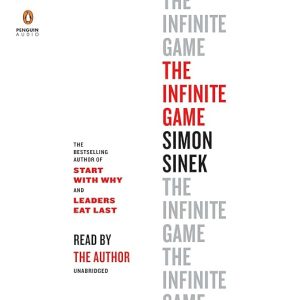
- Read by: Simon Sinek self-narrates with the measured conviction of a seasoned speaker, which suits the material well, though his pacing can feel deliberate to the point of slow in the middle sections.
- At its heart: infinite vs. finite mindset, purpose-driven leadership, institutional longevity
- Vibe: Expansive and philosophical, with the occasional jolt of corporate case study energy
- Short version: Sinek's framework is genuinely clarifying for anyone wrestling with what it means to build something that outlasts the quarterly cycle.
Sinek's core argument arrived in my listening rotation at a moment when I had been watching the fallout from a company that had won every short-term battle and lost the entire war. The Infinite Game audiobook landed differently because of that context, it was less abstract theory and more a diagnosis of something I had witnessed in real time. When Simon Sinek argues that most leaders are playing finite games inside systems that have no finish line, the idea clicks with an almost uncomfortable precision. Six hours and fifty-six minutes later, I had pages of notes and a revised mental model for evaluating every organization I would ever work with or for.
Sinek narrates the book himself, which matters more than it might seem. His delivery is measured, deliberate, and carries the weight of someone who has spent years speaking these ideas in front of live audiences. He pauses where the pauses belong. Occasionally the pace dips into the contemplative and you feel the pull to skip ahead, but staying with it rewards you, because the transitions between concepts build on each other in ways that rush-listening would flatten.
Sinek Credits Carse for the Framework Itself
The organizing principle of the book, that finite games have fixed rules, defined endpoints, and identifiable winners, while infinite games have evolving players, changeable rules, and no declared victor, is not original to Sinek. He credits philosopher James Carse explicitly, which is worth noting because Sinek's contribution is in application, not invention. What he does with the framework is make it legible and actionable for business practitioners who would never pick up an academic philosophy text.
The five practices Sinek identifies for infinite-minded leaders, having a Just Cause, building trusting teams, studying worthy rivals, preparing for existential flexibility, and demonstrating the courage to lead, form a coherent structure for the second half of the book. Not all five are equally developed. The Just Cause section, which leans on the contrast between Apple under Steve Jobs and the version of Apple that briefly flirted with maximizing quarterly revenue, is the strongest. The worthy rival section, by contrast, feels thinner, and a sharper comparison of a second pair of organizations would have helped it land.
Reviewers note that Sinek brings a genuinely contrarian perspective, and that observation is accurate. His critique of shareholder primacy is not framed in political terms but in terms of institutional self-destruction, a framing that tends to reach audiences who would disengage from a more overtly ideological argument. That is a real skill.
Sinek's Aphoristic Prose Suits the Spoken Word
The audio format suits this book well. Sinek's prose style is conversational and aphoristic, built for the spoken word rather than for annotation. You can follow the logic while driving or walking without losing the thread, which is not true of all business books in this space. The ideas accumulate as he speaks, and the rhythm of his delivery reinforces the message in a way that a silent reading does not quite replicate.
The book will resonate most with people at inflection points, founders deciding whether to sell, executives navigating board pressure, mid-career professionals questioning whether the ladder they have been climbing leads somewhere meaningful. The Infinite Game gives those listeners a vocabulary for a dissatisfaction they may already feel but have not been able to articulate. That is what Sinek does best: he names things that people already half-know and gives them a frame to act on.
The case studies draw from companies and events that most listeners will already have background on, Apple, Kodak, Microsoft under Ballmer versus Nadella, the Vietnam War as a study in finite-game thinking applied to an infinite conflict. The familiarity lowers the barrier to entry but occasionally makes the examples feel like ammunition gathered to prove a point already made, rather than genuine discovery. For listeners who have read widely in business literature, some of this territory will feel familiar. For those newer to this kind of thinking, it will feel revelatory.
Occasionally a Hammer for Which Everything Is a Nail
The book's weakest moments come when the framework strains to absorb every phenomenon it encounters. Not every corporate failure is a failure of finite thinking, and Sinek's model occasionally becomes a hammer for which everything is a nail. If you go in with some critical distance and treat the framework as a useful lens rather than a complete theory of organizations, you will get considerably more from it.
The section on ethical fading, the process by which people convince themselves that small moral compromises are acceptable, is one of the book's surprise contributions. It comes late but feels like the most practically useful material in the entire six hours. If you find your attention drifting anywhere in the middle, stay for this part.
Listeners coming from a social science background will notice that Sinek's evidence is often illustrative rather than rigorous. He builds cases from narrative examples rather than empirical data. Whether that bothers you depends on what you want from a business book. If you want pattern recognition and a persuasive argument, the book delivers. If you want controlled studies and effect sizes, it does not claim to be that kind of work.
Readers Who Appreciated Start With Why Continue Here
This audiobook is well suited to founders, executives, managers, and anyone who has felt the dissonance between what their organization says it stands for and what its incentive structures actually reward. It is also a natural fit for readers who appreciated Start With Why and want to follow Sinek's thinking into more explicitly strategic territory.
Listeners who prefer dense, citation-heavy business nonfiction may find the storytelling-first approach unsatisfying. And anyone already fluent in James Carse or organizational theory will find the intellectual scaffolding familiar, even if the application is clear.
Do I need to have read Start With Why before listening to this audiobook?
No prior Sinek reading is required. The Infinite Game stands on its own, though listeners familiar with his earlier work will notice how the Just Cause concept extends and refines his thinking about purpose-driven organizations.
Is Simon Sinek a strong narrator for this audiobook?
He is practiced and confident, as you would expect from a professional speaker. His pacing is deliberate, some listeners find it authoritative, others find it slow in the middle third. At just under seven hours, it remains a manageable listen.