- Narration: Janina Edwards is the only credited reader for a book built from three separate careers, so the panel arrives as one voice.
- Themes: Corporate power dynamics, unconscious bias and microaggressions, mentorship across generations, self-care as strategy
- Mood: Warm and candid, the tone of a senior colleague with the door closed
- Verdict: Short enough to revisit at every career stage, sharpest for Black women in corporate roles and genuinely useful well outside that.
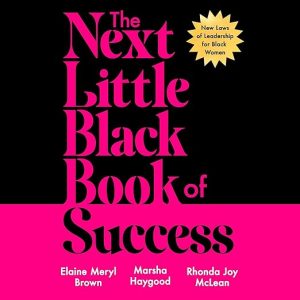
Somebody senior pulls you aside after a meeting and tells you the thing nobody put in the handbook. That transaction is what this book exists to reproduce, and the audiobook format suits it well: three executives who call themselves mentors in your pocket, read aloud in a little under four hours by Janina Edwards. Random House Audio issued it in January 2026 as an updated edition of a 2009 title that a whole generation of professionals passed around in hard copy.
Two of Three Authors Missing From the Byline
Three executives wrote this, not one. Elaine Meryl Brown, Marsha Haygood and Rhonda Joy McLean pooled what they learned playing, and eventually winning, the power game in corporate America before leaving it to become entrepreneurs, authors, public speakers and community leaders. That last detail matters more than it sounds. Advice from people still inside the system reads very differently from advice by people who used the system, got what they came for, and then walked out to build something of their own.
Only one of those three names appears on the listing. Elaine Meryl Brown carries the byline alone, while Haygood and McLean turn up in the description and in every review that engages with the content. Whether that omission is a catalog error or a formatting decision, it has consequences: a search by co-author will never reach this page, and the book's organizing premise, three mentors rather than one, stays invisible until you read past the title.
Coverage has been updated hard for the current decade. The 2009 original became a fixture on desks; this edition adds unconscious bias and microaggressions, managing a workforce spread across time zones, returning to an office after years of remote work, and self-care treated as a professional requirement rather than an indulgence. The remote-work material alone justifies a revision, since that upheaval arrived long after the first book and permanently changed what mentoring at a distance has to mean.
Janina Edwards Voices All Three, No Signal
Angelique Electra, a reviewer who describes decades spent navigating corporate life and a long attachment to the original, makes the sharpest case for this edition. That five-star review argues the book earns its title because it is not simply an update but a deeper, more mature reckoning with what professional and personal success actually requires over time, and it credits the authors with addressing the lived realities of Black women in corporate careers rather than women in general. That distinction is the whole reason the book exists.
One reader handles all three authors. Janina Edwards is the sole credited performer for a book assembled from three separate corporate histories, which is a defensible production choice for advice literature and a small loss for a title whose premise is a panel. Nothing in the description explains how the text signals which mentor is speaking at any given moment, so the handoffs between them are something to listen for rather than something you can see coming.
Under four hours makes this a single-sitting book, and the brevity is a feature rather than a shortcut. Career advice bloats faster than almost any category, and a title that gets from the first job to the executive floor in the length of a flight has clearly made hard choices about what needs saying. It also stays re-listenable, which matters for a book meant to be revisited at different career stages instead of finished once and shelved.
A Reviewer Discloses Knowing Marsha Haygood Personally
Judith Briles opens a five-star review by disclosing what most reviewers would quietly leave out: advance knowledge of the book through many conversations with Marsha Haygood. The praise that follows is warm and specific, calling the title long overdue and a goldmine for every woman in the workplace. Take the disclosure at face value and read the review as informed enthusiasm rather than a cold assessment. It remains useful, particularly on the question of who the book serves beyond its stated audience.
Seven ratings, a straight 5.0, and three written reviews all posted inside the first three weeks after release. That is what an early pool looks like: the people who were waiting for this specific book got to it first, and nobody who bought it casually has weighed in yet. It is not a statistically meaningful score, and treating it as one would mislead in either direction. Check the page again in six months if you want an average that has been tested by strangers.
Audience breadth is where the copy overreaches. The description addresses college students, entry-level employees, senior executives and global leaders across every industry, a range no book of this length can serve equally well. A student and a senior vice president need entirely different things from a chapter on microaggressions, and only one of them has the standing to act on what they hear. Read it instead as a book written from the top of a career, most valuable to anyone who can already see the next rung and needs to know what waits on it.
Check the Byline Before Assuming Who Wrote This
Naming its own audience is something the book does plainly: Black women building careers inside large organizations, and especially anyone who read the 2009 edition and wants to know what the intervening years changed. MovieLoverinNYC's five-star review describes truths that take years to learn, shared with love and deep caring, which is precisely the register the authors are working in. Anyone who mentors younger colleagues will also find it useful as scaffolding for conversations they are already having badly.
Not the right pick if you want tactics with numbers attached: negotiation scripts, compensation benchmarks, promotion timelines. The wisdom here is relational and hard-won rather than procedural. It suits nobody hoping to sidestep the subject of race at work, since bias and microaggressions sit at the center rather than in a chapter to be endured. And anyone expecting to hear three distinct voices in rotation should reset that expectation now.
Mentorship is the rarest thing in a corporate career and the hardest to arrange deliberately, which is what lifts the pocket-mentor framing above a marketing line. Three women who reached the top of large organizations and then left to build their own describe what they wish somebody had told them, compressed into a single sitting. Judge the edition on that, rather than on seven early ratings, and check the byline before you assume you know how many people wrote it.
Is this audiobook a new edition or a separate book from The Little Black Book of Success?
It is an updated edition of the 2009 original, not a sequel with new material bolted on. The revision adds unconscious bias and microaggressions, managing global teams, the return to offices after remote work, and self-care. The publisher describes the result as optimized for a culturally and politically complex present, which is a larger claim than a refresh.
Does the audiobook work for listeners outside its stated audience?
Yes, with a caveat. The description widens the frame to corporate professionals across all industries, from college students to global leaders, while the authors write from one specific vantage point. That specificity is the book's strength, so expect to read across an experience rather than see your own mirrored back.