Quick Take
- Narration: Brian Holsopple delivers a measured academic read that suits the material, clear and unhurried through dense legal and historical argument without becoming soporific.
- Themes: Institutional independence versus democratic accountability, the gap between legal theory and institutional reality, the evolution of central banking
- Mood: Dense but illuminating, written for curious non-specialists who are willing to do some work
- Verdict: The clearest legal and institutional account of the Federal Reserve available in audio, more law school than economics seminar, but rewarding for readers who want to understand the structure rather than just the headlines.
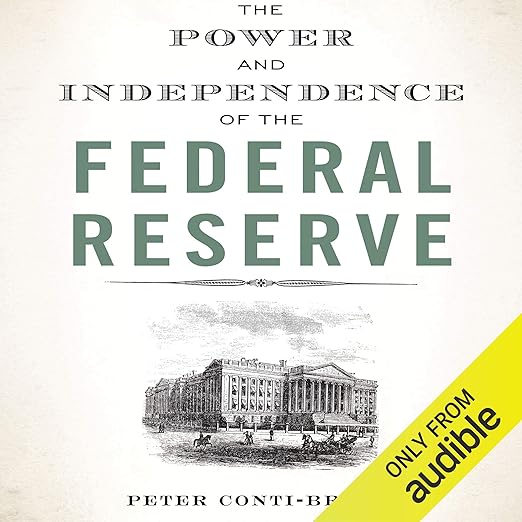
I came to this one after a sustained period of reading about monetary policy, books like Roger Lowenstein’s America’s Bank and Ben Bernanke’s memoir, and finding that most accounts of the Federal Reserve either treat its legal structure as assumed background or skip it entirely in favor of narrative drama. Peter Conti-Brown’s book fills that gap directly, and it turned out to be the book I had been looking for without knowing I was looking for it.
Conti-Brown is a legal scholar and financial historian, not an economist, and that distinction matters enormously for what kind of book this is. He’s not interested in whether the Fed’s monetary decisions were correct. He’s interested in who actually makes those decisions, what authority they derive from, what accountability structures exist or fail to exist, and how those structures have evolved since the Federal Reserve Act of 1913.
Our Take on The Power and Independence of the Federal Reserve
The central argument is quietly destabilizing for anyone who has absorbed the conventional narrative about Fed independence. That narrative holds that the Fed is, and should be, independent of political pressure, and that this independence is both legally established and operationally real. Conti-Brown challenges both claims. He shows that the legal basis for Fed independence is considerably murkier than the conventional account suggests, and that the actual distribution of power within the institution, among the Chair, the Board of Governors, the regional Federal Reserve Banks, and external actors including the Treasury and Congress, is far more complex and contested than the technocratic image implies.
Reviewer Mehrsa, who appears to have professional expertise in the area, calls this the most informative and readable explanation of the Federal Reserve available. That’s a strong claim, but it holds up. The book is genuinely accessible to non-specialists, one reviewer explicitly describes himself as having little background in law, banking, or economics and finding the book illuminating. That accessibility is an achievement for material this technically layered.
Why Listen to The Power and Independence of the Federal Reserve
At ten hours and forty minutes, this is a substantial listen, but it’s structured to earn that length. Conti-Brown builds his argument carefully, using historical examples from the Fed’s actual operations to ground his legal analysis. The Federal Reserve Act of 1913 gets real examination. The ways that subsequent Congresses, presidents, and Fed Chairs have redefined the institution’s power and scope are traced through specific episodes rather than summarized abstractly.
Brian Holsopple’s narration suits the material well. He reads at a deliberate pace that gives the legal and historical argument room to register, without the kind of flatness that can make academic content difficult to absorb on audio. This is not exciting narration, but exciting narration would be wrong for this material. What you get is a reliable, clear performance that keeps the listener oriented through complex institutional terrain.
What to Watch For in The Power and Independence of the Federal Reserve
One reviewer, who went in expecting a narrative history of the Fed’s major decisions, found the legal focus frustrating. That’s a legitimate response to a book that is genuinely more interested in constitutional and institutional questions than in the drama of monetary policy choices. Conti-Brown is not writing about whether Paul Volcker was right to crush inflation with high interest rates in 1981. He’s writing about the legal structure that allowed Volcker to make that choice with limited oversight.
Listeners with economics backgrounds who are already familiar with the Fed’s policy history may find the legal material the most valuable contribution but may also find the policy history coverage thin. The book is more useful as an institutional anatomy than as a monetary policy education.
Who Should Listen to The Power and Independence of the Federal Reserve
Listeners who want to understand why the Federal Reserve is structured the way it is, not just what it does. This is particularly valuable for anyone following current debates about central bank independence, political pressure on the Fed, or the adequacy of congressional oversight of financial institutions. Prior knowledge of economics is not required, but patience with legal and historical argument is. Skip it if you’re looking for crisis narrative or policy drama, this is institutional anatomy, and it’s excellent at being that.
Frequently Asked Questions
Do you need a background in economics or law to understand this audiobook?
No. Multiple reviewers without such backgrounds specifically note that Conti-Brown writes clearly enough for general readers. The legal concepts are explained rather than assumed. Economics knowledge helps but is not required.
What specifically does Conti-Brown mean by challenging the idea of Fed independence?
He argues that the legal basis for Fed independence is murkier than conventional accounts suggest, and that actual power within the institution is distributed across the Chair, Board of Governors, regional Federal Reserve Banks, and external actors in ways that complicate the clean technocratic image. Independence, he shows, is as much a political construction as a legal one.
Is this a good choice for someone who wants to understand recent debates about political pressure on the Federal Reserve?
Yes, directly so. Conti-Brown’s analysis of the relationship between the Fed, the Treasury, and the executive branch is precisely the framework needed to evaluate those debates with more than surface-level understanding.
How does Brian Holsopple’s narration handle the density of the legal and institutional argument?
With consistent clarity and appropriate pacing. He reads at a measured pace that gives complex material room to register. The narration is not stylistically distinctive, but that restraint is correct for the subject matter, clarity of delivery matters more than performance here.