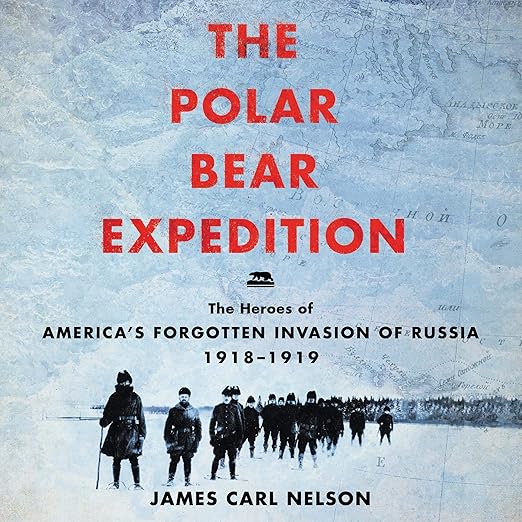
Quick Take
- Narration: Johnny Heller handles the material with the steady authority it requires, managing both the tactical granularity and the human cost without losing the listener in detail.
- Themes: Forgotten American military history, Cold War origins, endurance against impossible conditions
- Mood: Haunting and precisely researched, with an undercurrent of historical irony
- Verdict: One of those rare military histories that leaves you genuinely astonished that this episode has gone largely untaught, and grateful someone finally wrote it properly.
I finished The Polar Bear Expedition on a cold November evening, and the timing felt appropriate in a way I had not planned. James Carl Nelson is telling the story of approximately five thousand soldiers who went to fight in a war and ended up, through a cascade of political miscalculation, fighting a completely different war in a completely different country under conditions that most of them could not have imagined when they boarded their transport. The temperature details alone, machine guns made inoperable by subzero cold, sentries suffering frostbite while watching for nearly invisible Bolshevik soldiers in white uniforms, stay with you after the listen ends.
The American North Russia Expeditionary Force, the 339th Infantry Regiment, mostly recruited from Michigan, sailed for Europe in August 1918 expecting the Western Front. They got Archangel, Russia, more than a thousand miles northeast of Moscow, dropped into the chaos of the Russian Civil War with orders to fight the Red Army and support anti-Bolshevik forces. The Great War ended in November 1918. American troops kept fighting until July 1919. More than two hundred died.
Our Take on The Polar Bear Expedition
The book’s central achievement is making readers understand why this happened without quite being able to explain it. One reviewer, who read the book specifically to answer that question, concluded that the best explanation was that it seemed like the right thing to do at the time, which is the kind of historical verdict that contains an entire argument about foreign intervention without spelling it out. Nelson does not moralize. He documents. The strategic rationale for the expedition, to reopen the Eastern Front against Germany and support the Whites in the civil war, was already dissolving before the first American boots hit the ground, and Nelson lets the absurdity of that emerge from the chronology rather than editorializing it.
At the tactical level, this book is exceptional. Nelson works at close range, tracing specific platoon movements, individual soldiers’ names, and the precise conditions of pitched winter battles fought by men who were not supposed to be there. The Michigan connection matters more than it might seem: these were specific communities, specific regiments, specific families. The monument that still stands in Michigan, a massive marble polar bear guarding a soldier’s grave, makes sense as an endpoint only because Nelson has established the human particularity of the people it commemorates.
Why Listen to The Polar Bear Expedition
The episode’s afterlife is one of the book’s most affecting elements. A decade after the withdrawal, veterans returned to Russia to recover the remains of fallen comrades and bring them home to Michigan. That act of repatriation, undertaken in full diplomatic tension with a Soviet government that had been the enemy, required a level of personal resolve that Nelson frames as the final chapter of the expedition’s story rather than a footnote. It changes the emotional weight of what precedes it.
Johnny Heller is the right narrator for this material. His voice carries the measured gravity that a largely unknown military history requires without pushing the sentiment too hard. He handles the tactical passages, which involve considerable reference to dates, place names, and unit designations, without losing clarity, and he manages the more personal passages about individual soldiers with appropriate restraint. One reviewer noted the book can be difficult to follow in its tactical density, and that is fair; this is detailed military history, not simplified popular narrative. Heller’s pacing helps, but listeners who want a quick overview rather than a granular account should know what they are committing to.
What to Watch For in The Polar Bear Expedition
The book operates at the tactical and personal level throughout. What it does less of, as one reviewer accurately noted, is provide sustained operational or strategic analysis of the expedition’s broader significance. Why did the Allied powers think this was viable? What were the long-term consequences for US-Soviet relations? Nelson touches on these questions but does not make them his primary concern. Readers wanting that larger framing may need to supplement with additional reading. The book’s strength is its granularity, and that granularity comes at the cost of some altitude.
Who Should Listen to The Polar Bear Expedition
Military history readers who value primary source proximity and human detail over strategic synthesis will find this exactly calibrated to their interests. Listeners who came to it knowing nothing about the episode, several reviewers were completely unaware this had happened before picking it up, will feel the disorientation of discovery throughout, which is an experience worth having. Those wanting a brisk, context-rich overview should look elsewhere. This is a book that trusts its readers to keep up with the operational detail, and the payoff is a deeply specific portrait of a genuinely forgotten chapter of American history.
Frequently Asked Questions
Is prior knowledge of World War I or the Russian Civil War necessary to follow this account?
Basic familiarity with WWI helps orient the opening chapters, and knowing that a Russian Civil War was underway between the Reds and Whites provides useful context. Nelson provides enough background that a reader without deep knowledge can follow, but a general sense of the 1918 European situation makes the absurdity of the expedition’s premise land more fully.
Does Johnny Heller’s narration handle the tactical complexity of the battle descriptions clearly?
Yes, with the caveat that this is genuinely dense tactical history. Heller’s pacing helps manage the volume of place names, dates, and unit designations, but listeners should expect a more demanding listen than narrative-driven popular history. The detail is part of the book’s value, not a flaw to be narrated around.
What is the connection between the Polar Bear Expedition and the monument that still exists in Michigan?
The monument commemorates the soldiers of the 339th Infantry Regiment, most of whom came from Michigan. The massive marble polar bear was erected to honor their service. Nelson uses this monument as both bookend and emotional anchor, and the story of how veterans returned to Soviet Russia to retrieve fallen comrades adds a final chapter to the expedition’s human cost.
Does Nelson take a political position on whether the intervention was justified?
No. Nelson documents rather than editorializes, and he allows the strategic incoherence of the expedition to emerge from the chronology rather than arguing it explicitly. The book’s neutrality is deliberate and functions as part of its historical argument: the Polar Bears were casualties of decisions made above their level that were already questionable before they were executed.