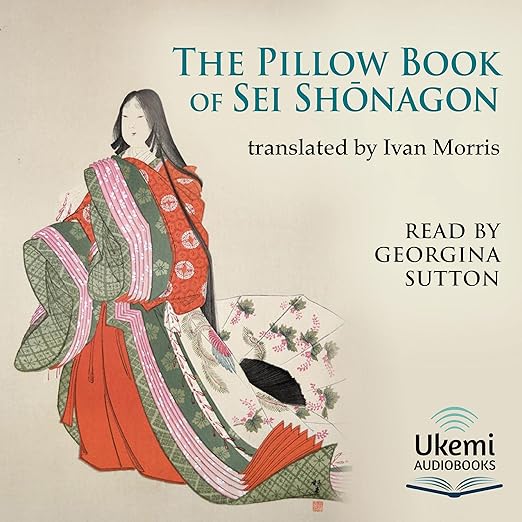
Sei Shonagon calls a court official named Masahiro a laughing stock and wonders aloud what it must be like for his parents and friends, and that single catty, perfectly preserved aside tells you almost everything you need to know about why this audiobook still works a thousand years after it was written. This is Heian-era Japan's most gossipy, most observant surviving voice, a lady-in-waiting recording court life with the wit and precision of someone who clearly knew she was being watched right back. Georgina Sutton narrates just over eleven hours of a text built from more than three hundred and twenty individual entries, ranging from single-line lists to extended narrative accounts of specific political incidents.
This Edition Uses Ivan Morris's Unabridged Translation
Sei Shonagon served the Empress Sadako around the turn of the eleventh century, keeping these personal notes across roughly a decade, and the book's genuine literary rivalry with Lady Murasaki, author of The Tale of Genji, gives the material an extra layer of context for anyone interested in the era. Where Genji fictionalizes Heian court life, this is the same world observed directly and often unflatteringly by someone actually living inside it. Entries carry their own headings, things like Birds, Trees, and the wonderfully specific Unreliable Things, and that structural variety, brief aside followed by extended narrative followed by simple list, is exactly the kind of material that lives or dies on a narrator's ability to shift rhythm without losing the reader's footing.
This particular audio edition uses Ivan Morris's translation, credited in the synopsis as the first unabridged English version of the text, distinct from Arthur Waley's better-known but abridged classic rendering. Worth flagging directly: at least one review attached to this listing references Meredith McKinney's separate, later translation instead, a reminder that this is a text with several distinct English editions in wide circulation, and that the specific translation actually used shapes the reading experience more than it might for a more straightforward contemporary book.
Literary historians often credit this book as the founding work of zuihitsu, a Japanese genre name that translates roughly to follow the brush, loosely connected personal essays and observations without a strict narrative throughline. That genre would go on to have a long life in Japanese letters well beyond Sei Shonagon's own era, which gives this recording a kind of foundational weight beyond its immediate content: listeners are hearing an early, fully realized example of a literary form that shaped centuries of writing that followed it.
An Acquaintance Assumed This Was Antique Erotica
What makes Sutton's narration genuinely well suited to this material is the sheer range of registers packed into a single collection. Reflections on royal ceremony sit next to sharp social observation, extended court gossip sits next to brief, almost haiku-like descriptive lists, and the book moves between all of it without warning or transition. A reviewer identified as Autumnbreeze 3000 puts it well, asking how a life lived a thousand years ago can feel this recent, and noting that Sei Shonagon's notes read as though one of us had written them down ourselves, aside from a few culturally specific details that mark the gap in time.
Another listener, Jax, pushes back directly against a common misconception about the title itself, describing an acquaintance's surprised assumption that a book called The Pillow Book must be antique erotica. It is not. Pillow books were personal notebooks kept close at hand, often literally near where one slept, for jotting down private observations, and the title refers to that intimate, informal format rather than to any romantic content. That misunderstanding is common enough that it is worth addressing directly for anyone approaching the title cold.
From the Masahiro Aside to the Wet-Nurse Entry
Even the exact meaning of the title remains genuinely debated among scholars of the period, with some interpretations pointing toward a private bedside notebook and others toward something closer to a reference volume kept within arm's reach for a court lady's daily use, further evidence of how much interpretive richness sits inside what looks, on the surface, like a simple household object.
The contrast between Sei Shonagon's sharpest, funniest observations and her genuinely tender ones is part of what keeps the book from reading as one note. Alongside entries like the Masahiro aside, dismissing a court official as a laughing stock, sit entries like the one devoted to one of the Empress's wet-nurses, which the synopsis specifically highlights as reflecting a more considerate, warmer side of her personality. That range, catty in one entry and quietly compassionate in the next, produces exactly the kind of emotional whiplash a lesser narrator might flatten out, and Sutton's steady handling of both registers is where her performance earns real credit.
Sutton's Reading Cannot Substitute for Footnotes
The episodic, list-heavy structure means this is not a book built for uninterrupted narrative momentum, and listeners expecting a continuous story arc across eleven hours should adjust expectations toward something closer to an intimate, occasionally disjointed diary read aloud. Some entries run only a sentence or two, which can make the listening rhythm feel choppy compared to a conventional memoir, even though that choppiness is faithful to the original text's own construction.
The cultural and historical distance is real, and some entries assume familiarity with Heian court ranks, seasonal customs, and specific historical figures that a modern Western listener will not automatically recognize. Sutton's reading stays clear and well-paced throughout, but no narrator can fully substitute for the footnotes a print edition would offer, so listeners deeply unfamiliar with the period may want to pair this with even a little outside context before diving in.
Some listeners coming to this expecting something closer to The Tale of Genji's sustained fictional narrative may need an adjustment period, since this book operates on an entirely different structural logic, accumulation of fragments rather than plotted scenes building toward resolution. Once that shift in expectation happens, though, the format's actual pleasures, the wit, the specificity, the sense of a genuine person's mind captured directly across a millennium, tend to land more easily.
Closer to Eavesdropping Than to Reading a Memoir
Readers of classical literature, students of Japanese history, or anyone who enjoyed The Tale of Genji and wants the sharper, more direct voice standing just outside that novel's fiction will find this a genuinely rewarding listen, one of relatively few Heian-era primary texts widely available in unabridged English audio form at all.
Listeners who enjoy other fragmentary or list-based literary forms, commonplace books, aphorism collections, or even modern social media in its more observational moods, may find Sei Shonagon's format feels surprisingly contemporary despite its ancient origins, a diary voice built from small, sharp observations rather than sustained narrative argument.
Anyone hoping for a plotted narrative with a beginning, middle, and end should look elsewhere in the classical canon first. This is closer to eavesdropping on a thousand-year-old diary than reading a structured memoir, rewarding patience and a willingness to sit with fragments rather than demanding a payoff. Listeners who enjoy that kind of intimate, unstructured historical voice will likely find themselves returning to specific entries long after finishing the full listen.
- Performance: Georgina Sutton shifts fluidly between catty court gossip, ceremonial reflection, and terse list entries across a text that constantly changes register.
- What it covers: Heian court life, feminine wit and observation, the texture of daily aristocratic ritual
- Feel: Sharp, intimate, unexpectedly funny
- Our call: An essential listen for classical literature fans, best approached as fragments to savor rather than a plotted memoir.
Questions Listeners Ask
Is this audiobook a novel, or is it a real historical document?
It is a real historical text, a personal notebook kept by an actual Heian-era court lady around the turn of the eleventh century, not a work of fiction.
Is this audiobook structured as a continuous story?
No, it is built from more than 320 individual entries ranging from single-line lists to longer narrative passages, closer to a diary than a plotted memoir.