Quick Take
- Narration: Dan Cashman reads with warm, unhurried pacing that suits the meditative rhythm of Carhart’s prose, his tone feels like a quiet Friday evening in a Parisian atelier.
- Themes: Passion reclaimed, the secret city beneath the city, the culture of craft
- Mood: Warm and unhurried, like a glass of wine in a room full of old wood
- Verdict: A beautifully specific portrait of Paris and the obsessive pull of a recovered passion, best appreciated by listeners who enjoy narrative nonfiction that moves on its own quiet terms.
I came to this one late on a Sunday in February, wrapped in a blanket with no particular agenda. I had been bouncing between thrillers and I needed something slower, something that didn’t want anything from me. The Piano Shop on the Left Bank turned out to be exactly that, but it also turned out to be considerably more interesting than its modest premise suggested.
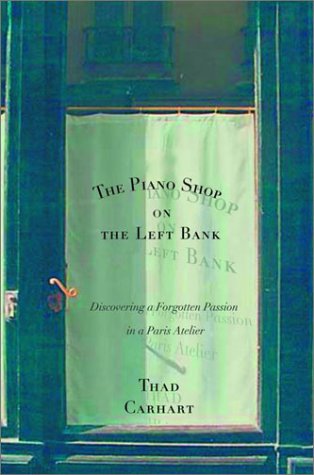
Thad Carhart, an American living in Paris, walks past a demure little shopfront in his neighborhood and cannot get inside. That’s the whole setup. The piano atelier run by a man named Luc turns away strangers with the kind of quiet indifference that only Paris perfects. What follows is a book about what happens after the door finally opens, and about why a writer with no particular musical training found himself there in the first place.
Our Take on The Piano Shop on the Left Bank
What Carhart has written is genuinely difficult to categorize, and that difficulty is part of its charm. It is simultaneously a memoir of obsession, a cultural history of the piano, a love letter to a specific arrondissement, and a meditation on what happens when a dormant passion reasserts itself in middle age. Luc walks Carhart through instruments that span centuries, an ancient pianoforte that may once have belonged to Beethoven, hulking concert grands, modest uprights with voices that far exceed their size. The book’s knowledge is worn lightly, delivered through conversation rather than lecture, which is exactly as it should be.
What I didn’t expect was how much the book made me think about physical skill and the culture of craft. Carhart is not a pianist by profession, and his return to the instrument is tentative, even embarrassing at first. The shop becomes a community space in the truest sense, professors, pipefitters, amateur players gathered on Friday evenings over wine, talking about music and life in equal measure. It’s an image of Paris almost nobody outside Paris gets to see.
Why Listen to The Piano Shop on the Left Bank
Dan Cashman’s narration is a good match for the material. His voice has a certain cultivated calm that complements Carhart’s prose without trying to compete with it. The book moves slowly by design, Carhart is describing a world where slowness is a value, where a craftsman spends months restoring a single instrument, and Cashman trusts that rhythm. There are no theatrical flourishes. The result is a listening experience that feels almost like sitting in that room yourself.
Carhart’s literary background shows in the writing. He is good at the telling anecdote and not overly fond of his own insights, which is a rare and welcome combination. The section where he finally plays his own piano for the first time in years, in his apartment at night so as not to disturb the neighbors, is genuinely moving without being manipulative.
What to Watch For in The Piano Shop on the Left Bank
Listeners expecting a conventional travel memoir will find this book slightly elusive. The Paris on these pages is not the Paris of guidebooks or even of literary tourism. There are no famous monuments, no celebrity cafes. The neighborhood Carhart inhabits is specific but unnamed in any touristic sense; it exists as a felt geography, defined by the route from his apartment to Desforges Pianos. That exclusivity is part of the point, Carhart is writing about the Paris that exists behind closed doors, but it means the book offers very little for readers who want orientation.
The history of the piano, which surfaces in extended digressions throughout, is genuinely interesting but occasionally pulls the narrative to a standstill. Carhart is fascinated by the instrument’s engineering, the felt hammers, the iron frames, the precise mechanics of how a key becomes a sound, and he wants you to share that fascination. For some listeners this will be the best part of the book. Others may find it slower going.
Who Should Listen to The Piano Shop on the Left Bank
This is an ideal listen for anyone who has ever let a creative passion go quiet for years and wondered whether it could come back. It will also reward listeners who enjoy books about cities as living organisms, the way neighborhoods develop their own personality, their own gatekeeping rituals, their own informal institutions. Fans of writers like Adam Gopnik or Peter Mayle will find something familiar here, though Carhart is less performatively charming than either.
If you need propulsive plotting or a book that covers significant narrative ground in nine hours, this is not it. The Piano Shop on the Left Bank is a book for Sunday afternoons and long train rides, the kind of listening experience that doesn’t so much end as gradually, pleasantly stop.
Frequently Asked Questions
Do I need to know anything about music or piano to enjoy this audiobook?
No musical background is required. Carhart himself is a returning amateur, and he explains the history and mechanics of the piano in accessible, conversational terms throughout. The book is as much about Paris and recovered passion as it is about the instrument itself.
Is this a travel audiobook or a memoir?
It is genuinely both. Carhart writes about a specific Paris neighborhood with the attentiveness of a travel writer, but the emotional core of the book is his personal rediscovery of piano playing after a long gap. The two strands are inseparable.
How does Dan Cashman handle the French words and names scattered through the narration?
Cashman handles the French vocabulary with natural ease, not exaggerated, not stumbling. The French names and place references are integrated smoothly, which suits a book that treats Paris as a lived environment rather than an exotic backdrop.
Is this audiobook suitable for listeners who have never been to Paris and have no connection to the city?
Yes, though readers with some familiarity with Paris or French culture may get an extra layer of pleasure from it. The book’s appeal is ultimately about the experience of discovering a hidden community within a city, a dynamic that translates well regardless of your connection to Paris specifically.