Quick Take
- Narration: No narrator credit is listed for this edition – an unusual metadata gap for a 17-hour title. Sample the audio before committing to verify production quality and narrator fit.
- Themes: Maori and Pakeha as co-shapers of a nation, colonization reconsidered without the standard victim narrative, the compressed speed of New Zealand’s political development
- Mood: Authoritative and measured – the definitive national history, not a popular introduction
- Verdict: Michael King’s magisterial history is the standard single-volume reference for a reason, but the uncredited narrator deserves scrutiny before you invest 17 hours.
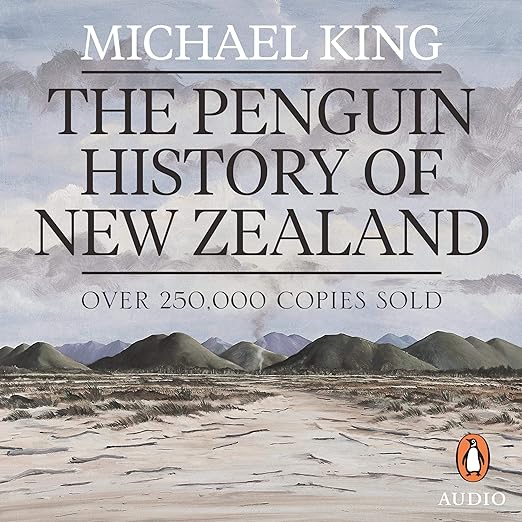
There are books that earn the word definitive and then spend years defending it, and there are books that simply become the benchmark everyone else must acknowledge when they write on the same subject. Michael King’s Penguin History of New Zealand is firmly in the second category. Published in 2003 and awarded both the Montana New Zealand Book Award and the Nielsen Bookdata Booksellers’ Choice Award for Best of the Best in 2011, it has remained the unchallenged single-volume reference on the country’s history for over two decades. That is a remarkable record for a book that covers geological history in its first chapter and arrives at the twenty-first century in its last.
I spent part of a long Wellington weekend with the audiobook version a couple of years ago, working through it in the evenings after days spent in the city itself, and the experience of listening to New Zealand’s history while standing in New Zealand’s capital – looking at the Beehive, walking the waterfront, hearing Maori spoken in the street – gave the book a texture it might not have had at my desk in Paris. King writes history that is alive to landscape, to the specific geography that shaped the Polynesian societies he describes, to the relationship between the land and the political decisions made about it. Geography is not backdrop in this book; it is argument.
The Revisionist Case King Makes Quietly
King’s most significant intellectual move is his rehabilitation of complexity around colonization. He argues – carefully, with evidence, without cheerleading – that British motives in colonizing New Zealand were more humane than the colonial ventures happening simultaneously in other parts of the empire, and that Maori were not passive victims of contact but active, adaptive agents who selectively accepted what Western technology and culture offered while maintaining core elements of their own societies. This is a revisionist position relative to the dominant scholarly framing of the 1980s and 1990s, and King makes it with scholarly care rather than political point-scoring.
The distinction he draws between Maori and Pakeha not as binary opposites but as co-creators of a single national culture is one of the book’s most sustained and useful arguments. New Zealand, in King’s account, is the product of both rather than of one imposing itself on the other. Whether you find this persuasive will depend partly on what you bring to the question, but King earns his position through the accumulation of historical evidence rather than assertion.
Seventeen Hours Without a Named Narrator
The significant practical issue with this audiobook edition is the absence of any credited narrator in the metadata. For a 17-hour text by New Zealand’s most important single-volume historian, this is a real gap. The reviews that exist for this edition describe the text as comprehensive and well-written – which it undeniably is – but none of them specifically evaluate the narration. This suggests they may have been written by print readers or by listeners who did not think to distinguish between the book’s quality and its audio production quality. I would strongly recommend sampling the audio before purchasing. A book of this scope, covering linguistic history, Maori oral tradition, colonial politics, and twentieth-century geopolitics, needs a narrator who can sustain authority and clarity across a long runtime.
The Speed of New Zealand History, and Why It Matters
One of the book’s most striking observations appears early: New Zealand was the last country in the world to be discovered and settled by humans, and also the first to introduce full democracy. The gap between those two events compressed into roughly a century and a half what other nations took millennia to develop. King uses this compression as an explanatory device throughout – the speed of New Zealand’s transformation, and the consequent intensity of its conflicts, is part of what makes the country’s history simultaneously unusual and legible as an argument about what human societies do under pressure. It is a genuinely useful frame, and it gives the book a structural coherence that single-country histories sometimes lack.
Who the Audience Is
This is not an introductory text. Its 17-hour runtime and its commitment to comprehensive coverage make it more useful as a thorough grounding than as an accessible entry point for casual curiosity. Readers who want a shorter introduction before a trip, or who want the pleasures of a more popular history, will find other options better suited to those needs. For anyone who wants to understand New Zealand’s history at depth – the Maori political structures before European contact, the Treaty of Waitangi and its contested interpretations, the twentieth-century economic and social transformations – King is where you start and often where you end. The fact that he died in a car accident in 2004, the year after this book was published, gives it an additional weight: it is the final statement of the historian who spent his career earning the right to write it.
Frequently Asked Questions
Who narrates this audiobook, and is the narration quality reliable?
No narrator is credited in the available metadata, which is an unusual gap for a 17-hour professional audiobook. This is worth investigating before purchase – sample the audio directly on your preferred platform to verify the narrator’s suitability for dense historical nonfiction.
Does King present Maori history sympathetically, or does the book default to a Pakeha perspective?
King explicitly structures the book as a bicultural history. He argues against the ‘fatal impact’ model of colonization – the idea that Maori were passive victims – and instead presents them as active, adaptive agents who shaped their own engagement with Western contact. His position is revisionist relative to some earlier scholarship, and he develops it through historical evidence rather than sentiment.
Is this book appropriate for someone with no prior knowledge of New Zealand history?
It is comprehensive rather than introductory. The depth and 17-hour runtime assume a reader willing to commit seriously to the subject. For a first approach, a shorter accessible history might serve better as an entry point; King works best as a thorough grounding rather than a quick orientation.
Has the scholarship in this book been superseded since it was published in 2003?
Specialist scholarship has continued to develop, particularly around Treaty interpretation and Maori political history. But as a single-volume synthesis, King remains the standard reference, and its reputation has only solidified in the years since publication. The 2011 Booksellers’ Best of the Best recognition came eight years after publication, which speaks to its durability.