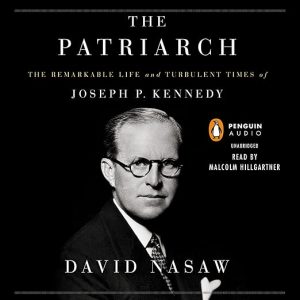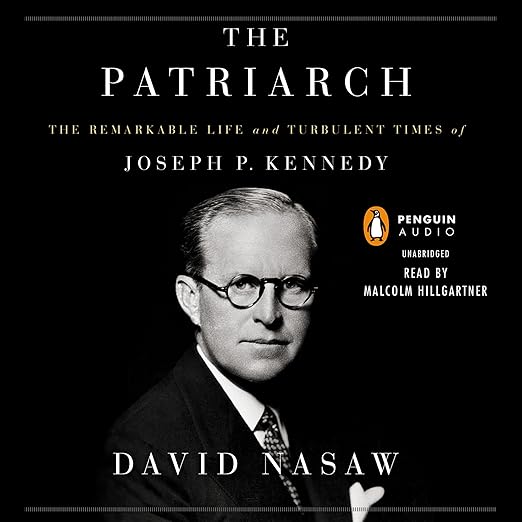
Joseph P. Kennedy spent decades building a family that would define American political ambition for the rest of the 20th century, and he watched much of that ambition pay off and then shatter during his own lifetime. David Nasaw's biography The Patriarch, narrated by Malcolm Hillgartner and available as an audiobook running nearly 31 hours, draws on never-before-published materials from archives on three continents and interviews with Kennedy family members. Nasaw worked as Joseph Kennedy's official biographer with unprecedented access to private papers and correspondence, and that access changes what the book is able to say about a life that has been heavily mythologized in both directions.
Nasaw's great achievement here is objectivity without blandness. One reviewer described the book as offering "an objective recounting of the life and times of J.P. Kennedy" that shows "how this Irish Catholic from North Boston, an outsider in the WASP social and financial world, made his way to wealth and prominence through his intelligence." Another noted the book's lack of sensationalism as a specific strength - Nasaw is willing to report what the documentary record shows about Kennedy's business dealings, his time as U.S. Ambassador to Britain, and his complicated relationship with isolationism in the lead-up to World War II without either excusing or amplifying.
The New York Times review quoted in the synopsis - describing the book as "riveting" and "hard to put down" - is not wrong, but it undersells how much of the book is devoted to financial and political machinery rather than dramatic episodes. One reviewer noted skimming parts dealing with business activities, and that is an honest warning: this is comprehensive biography, not selective portrait. The chapters on Kennedy's involvement in the booms and busts of the 1920s and 1930s, his relationship with Roosevelt during the New Deal era, and his diplomatic performance during the years leading to World War II are all substantive and detailed. Listeners who want the Kennedy drama without the context will find this audiobook asks more of them than they may be expecting.
The academic reviewer who described Nasaw as having made "a great contribution to academic biography" while simultaneously providing "the public with a very readable story" is capturing something real about the book's unusual achievement. It does not sacrifice rigor for readability, nor does it sacrifice readability for rigor. That balance is rare in biographical writing of this scale.
Hillgartner Keeps FDR and Churchill Distinct for 30 Hours
Hillgartner's narration is one of the determining factors in whether a 30-hour biography works or becomes an endurance exercise. He holds the material with appropriate gravity without letting the weight collapse into dreariness, and he navigates the large cast of historical figures - FDR, Churchill, the Kennedy children across their various careers - with enough differentiation to keep the cast legible over the long runtime. The audio format serves a biography of this scope in a specific way: the cumulative rhythm of Kennedy's rise, setbacks, social climbing, diplomatic failures, and eventual witnessing of his own son's presidency builds across the hours in a way that is genuinely harder to sustain in print.
The book's central irony - that Kennedy spent his life acquiring power to protect and advance his family, and that family was then destroyed by the consequences of the very power he secured - lands more powerfully for having been experienced across 30 hours than it would from a summary. The scale of the audio commitment is, in this case, the scale of the argument. You understand why Kennedy made each decision in its moment, and that accumulated understanding makes the eventual disasters more painful precisely because they were so preventable.
Refusing the Caricature of the Ambassador Years
The most significant section, both historically and psychologically, covers Kennedy's tenure as U.S. Ambassador to Britain from 1938 to 1940. This is the period that has most damaged Kennedy's historical reputation, and Nasaw handles it with the same archival discipline he applies to the rest of the book - not rehabilitating Kennedy, but refusing the caricature that has substituted for analysis in most popular accounts. Nasaw works carefully through the archival record of Kennedy's pessimism about Britain's ability to resist Germany and his increasingly fraught relationship with Roosevelt, who was receiving contradictory intelligence from his ambassador and from other sources. This is where the book makes its most substantive contribution to the historical record - not exposing Kennedy as a villain, which is the easier narrative, but showing a man whose intelligence and pragmatism produced genuinely disastrous judgment in a specific historical context. The sections on Kennedy's relationship with his son John during the 1960 campaign, and the image of the patriarch sitting feet away from the inaugural address, represent the biography's most resonant material.
This Is Joseph's Story, the Sons Come Later
Listeners with a sustained interest in 20th-century American political history - or in the question of how immigrant families navigate and are shaped by the institutions they try to enter and eventually transform - will find this audiobook deeply rewarding across its full length., the Kennedy family, or the sociology of immigrant ambition and class exclusion will find this audiobook deeply rewarding across its full length. Students of the New Deal era, World War II diplomacy, or the Cold War domestic landscape will encounter Kennedy at each of these moments in ways that illuminate the broader history. Listeners who want a Kennedy biography focused primarily on John, Robert, or the assassination narratives will need to supplement with other works - this is Joseph's story, and the sons appear primarily in relation to what the father built. At nearly 31 hours, this demands committed listeners who are prepared to engage with financial and political detail as well as family drama.
The Short Version
- Performance: Malcolm Hillgartner handles a 30-hour biographical account with stamina and tonal control - his delivery suits the book's serious, academic-but-accessible register without becoming monotonous.
- What it covers: American political dynasty, immigrant ambition, the corruptions of power and prestige
- Feel: Substantial and measured, with the weight of a genuinely researched life
- Our call: David Nasaw's biography of Joseph P. Kennedy is the audiobook to reach for if you want to understand the Kennedy century without the mythology.
Frequently Asked Questions
Does this audiobook cover the Kennedy assassinations?
The book covers Joseph Kennedy's life through the assassination of President Kennedy in 1963, which the patriarch himself survived. The focus throughout is on Joseph's perspective and motivations rather than on the events surrounding the assassination itself.
At nearly 31 hours, is this audiobook best listened to straight through or in shorter sessions?
The book's chronological structure works well in either mode. Because Nasaw organizes the narrative around distinct historical periods - the business years, the Hollywood years, the ambassadorial years, the family political years - natural stopping points occur at chapter and section breaks. Most listeners will find a chapter-by-chapter approach sustainable over several weeks.