Quick Take
- Narration: Julian Elfer reads Trungpa’s lecture transcripts with appropriate restraint, clear and unobtrusive, which is exactly what dense philosophical content requires.
- Themes: Mindfulness practice, ego dissolution, the paradox of effortful non-effort
- Mood: Quiet, demanding, and occasionally disorienting in the best way
- Verdict: For listeners with some meditation background who want genuine philosophical depth rather than wellness reassurance, this is one of the more honest introductory texts available.
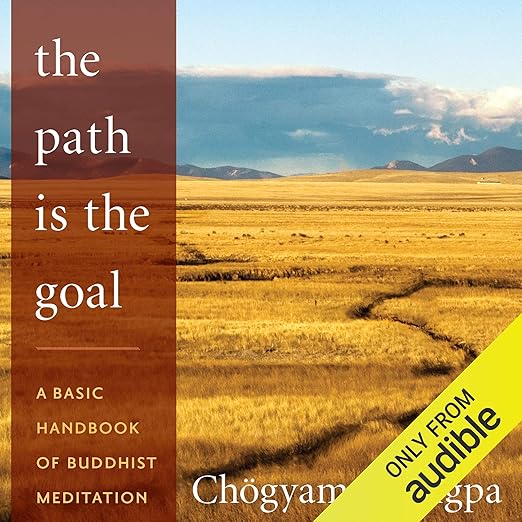
I came to Chogyam Trungpa through Cutting Through Spiritual Materialism, years before I thought much about audiobooks as a format for this kind of material. When I listened to The Path Is The Goal on a slow morning before my desk had any other demands on it, coffee still cooling, no notifications, I noticed something I had not expected: the lecture format, which is what this text originally was, works better aloud than on a page. The student questions that punctuate the teaching ground the abstract in a way that reading alone does not always achieve.
Trungpa gave these teachings across a three-day seminar, and the transcript form means you are not reading a composed argument but following a living conversation. That distinction matters more for this material than it would for most books. Meditation instruction that emerges from exchange has a different quality than instruction written from behind a desk, and Julian Elfer’s reading preserves that quality by staying out of the way of the content.
Our Take on The Path Is The Goal
The central idea, that the practice of meditation is not a means toward enlightenment but is itself the expression of enlightenment, is one of those paradoxes that sounds like a fortune cookie until Trungpa actually unpacks it. What he is arguing, carefully and with reference to specific technical aspects of sitting practice, is that the ambition to use meditation as a tool defeats the openness that meditation is supposed to cultivate. One reviewer described it as busting many myths about practice, and that framing is accurate. Trungpa is not gentle about the ways practitioners turn meditation into another project of the ego.
The progression from mindfulness through what Trungpa calls contrived awareness to genuine insight is laid out here with more precision than you typically find in popular meditation writing. He is teaching from within a tradition, Tibetan Buddhism, specifically the Kagyu lineage, and the depth of that tradition is present in the text without being inaccessible to Western readers. One reviewer specifically noted how relatable Trungpa is for Western audiences, and that has always been part of what made his work influential when it first appeared.
Why Listen to The Path Is The Goal
At three hours and twenty-nine minutes, this is not a long listen, but it is a dense one. The value of the audio format here is exactly what one reviewer identified: the back-and-forth with students provides context that a purely didactic text cannot. When a student asks a clarifying question, the answer often illuminates the preceding ten minutes of teaching in a way that a footnote or endnote never quite manages. Elfer reads the student voices with enough differentiation to keep the dialogue clear without performing it.
This is also, frankly, a better entry point into Trungpa’s work than Cutting Through Spiritual Materialism for listeners new to his voice, because the lecture format is more accessible than his longer composed works. The ideas are the same lineage; the density is lower. One reviewer who had never encountered Trungpa recommended having at least some prior exposure to meditation before starting, and I think that is right, the book rewards listeners who have at least sat down and tried.
What to Watch For in This Teaching
Trungpa does not offer easy comfort. A reviewer described the book as challenging but worth the effort, and that preparation is useful to carry in. The teaching explicitly frames meditation as requiring courage, not because sitting is physically demanding but because honest self-observation is genuinely difficult. Listeners who approach this hoping for a relaxation guide will find themselves reading something considerably more demanding than that.
The psychological stage set metaphor, which Trungpa uses to describe the habitual structures we impose on experience, recurs throughout the teaching and rewards attention across multiple listenings. This is a short text that does not exhaust itself in a single pass. Several reviewers mentioned returning to it, and I understand the impulse.
Who Should Listen to The Path Is The Goal
Listeners with some existing meditation practice, even a modest one, will get the most from this. Complete beginners may find the technical references to mindfulness stages slightly opaque without context. Those already familiar with Trungpa’s broader work will find this a useful companion to Cutting Through Spiritual Materialism. Anyone looking for contemporary wellness Buddhism should look elsewhere; this is older, more demanding, and considerably more rewarding for it.
Frequently Asked Questions
Is this appropriate for someone who has never meditated before?
It can work as a starting point, but reviewers and the content itself suggest some prior exposure helps. Trungpa references specific aspects of sitting practice, posture, breath, the nature of arising thoughts, that will be more meaningful if you have at least tried meditation a few times.
How does Julian Elfer handle the student dialogue sections?
Elfer differentiates the student voices enough to keep the exchange clear without theatrical performance. The reading stays understated throughout, which serves the material well, this is not a text that benefits from dramatic narration.
Is this the same content as Trungpa’s book Cutting Through Spiritual Materialism?
No, they are separate works. The Path Is The Goal is more focused specifically on meditation technique and philosophy, originating from a three-day seminar. Cutting Through Spiritual Materialism is a longer, broader work. Several reviewers recommend reading both.
At under three and a half hours, does this feel complete or like an excerpt?
It feels complete. The seminar transcript covers the arc of mindfulness teaching from basic instruction through more advanced concepts, with student questions filling gaps that a shorter text might leave open. Short but substantive.