Quick Take
- Narration: Ken Kliban reads with academic steadiness, competent and clear, though the performance does not elevate the material beyond the page.
- Themes: Decision fatigue, maximizers vs. satisficers, the psychology of abundance
- Mood: Intellectually engaging but occasionally circular, like a good seminar that runs a little long
- Verdict: An ideas book that holds up better as a conversation starter than as a practical self-help guide, though the central argument remains genuinely useful.
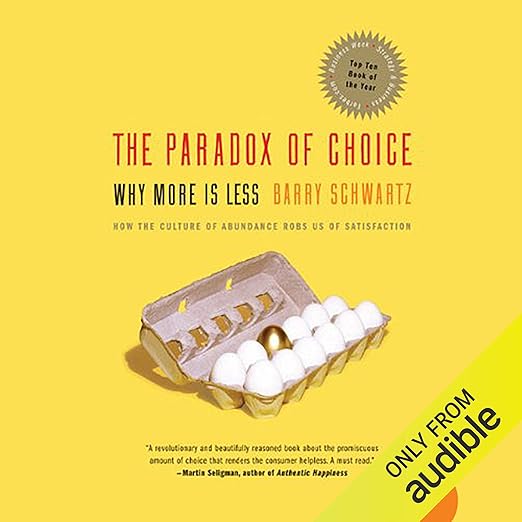
I remember reading a version of Barry Schwartz’s core argument years before I encountered this book, in a magazine article, maybe, or a TED talk. That prior exposure is actually part of what makes this listen interesting. The Paradox of Choice was published in 2004, before the discourse around decision fatigue and cognitive overload became genuinely mainstream, and hearing it now reveals both how influential it became and where its limitations lie.
The premise is not complicated: more choice does not reliably produce more satisfaction. The mechanisms Schwartz identifies are well-supported by behavioral psychology research from the time, and he is a gifted explainer of academic concepts. The question, as with any ideas book that has been in circulation for two decades, is whether the audiobook still earns the time investment when so many of its insights have filtered into popular culture.
Our Take on The Paradox of Choice
Schwartz builds his argument around a distinction that is genuinely useful once you absorb it: the difference between maximizers and satisficers. Maximizers seek the best possible option in every decision, which sounds like a rational strategy but turns out to be psychologically expensive. Satisficers are willing to accept an option that meets their criteria rather than exhausting every alternative. Schwartz argues convincingly that satisficers are, on average, happier, because they are not perpetually wondering whether a different choice would have been better. Reviewer Janet Boyer, writing from 2004, captures the immediate appeal of this framing by connecting it to the overwhelming experience of shopping for something as ordinary as a dryer. That mundane example is Schwartz’s greatest rhetorical strength. He consistently grounds abstract psychology in the texture of daily consumer life.
Reviewer Dhanima gives the book four and a half stars and describes it as a fantastic essay on how the culture of abundance robs us of satisfaction in life, and that is a fair summary. The satisfaction-depression link, the counterintuitive finding that limitless options can lead to clinical depression rather than liberation, is the book’s most striking and durable claim.
Why Listen to The Paradox of Choice
The audiobook earns its runtime in the middle sections, where Schwartz unpacks the mechanisms behind choice overload with the careful precision of someone who has thought deeply about the research. His treatment of opportunity cost, of regret anticipation, and of the way high expectations undermine satisfaction even when a choice turns out to be objectively good, is cogent and well-organized. For listeners who have encountered the headline version of this argument without engaging with the underlying mechanisms, the full treatment is worth the seven hours. Ken Kliban’s narration is clean and appropriate. He reads Schwartz’s academic prose without stumbling or artificially dramatizing it.
What to Watch For in The Paradox of Choice
A minority reviewer found the book condescending and unhelpful, noting that by page fifty they felt more like a tool of consumer culture than an empowered decision-maker. That critique has some merit. Schwartz’s writing can occasionally slide into a register that feels less like illumination and more like a diagnosis. The practical advice sections are also thinner than the analytical ones. The book is stronger at explaining why choice overload is a problem than at offering tools to navigate it. For a social psychology text published in 2004, the research base has also been subject to subsequent scrutiny, including the famous jam study whose replicability has been questioned. Listeners who are familiar with these debates may find the empirical foundation less solid than it appeared when the book first appeared.
Who Should Listen to The Paradox of Choice
Listeners who enjoy ideas-driven social science writing and have not yet engaged deeply with the behavioral economics literature on decision-making will find this accessible and thought-provoking. Anyone who has experienced decision paralysis in consumer contexts or professional life and wants a vocabulary for what is happening will find the maximizer/satisficer framework genuinely useful. Listeners who have already read Kahneman’s Thinking, Fast and Slow or similar behavioral economics titles may find significant overlap in the territory. Those seeking a practical guide to better decision-making should manage expectations. This is primarily a diagnostic book, not a prescriptive one.
Frequently Asked Questions
Has the research in The Paradox of Choice held up since it was published in 2004?
Some of the foundational studies Schwartz cites, including the famous jam experiment, have faced replication challenges in subsequent research. The core argument about choice overload remains influential and debated, but listeners should approach the empirical claims with the awareness that the research landscape has evolved since the book was written.
Is this similar to Thinking, Fast and Slow or Predictably Irrational in terms of content?
There is significant overlap with both. All three titles draw on behavioral psychology to explain why humans make predictable cognitive errors. The Paradox of Choice is narrower in focus, centering specifically on choice abundance, while Kahneman and Ariely address broader decision-making biases. If you have read those, you will find familiar territory here.
Does the book offer practical strategies for managing choice overload, or is it primarily analytical?
Schwartz does include some prescriptive suggestions in the later chapters, including advice about choosing when to satisfice versus maximize, and strategies for reducing regret. However, the analytical sections are substantially stronger than the prescriptive ones. This is not a self-help manual.
How does narrator Ken Kliban handle the more academic sections of the book?
Kliban reads steadily and clearly without inserting interpretive weight that the material does not call for. He is a serviceable narrator for a social science text, though listeners accustomed to more expressive performances may find the delivery flat. The clarity is more important than the expressiveness here.