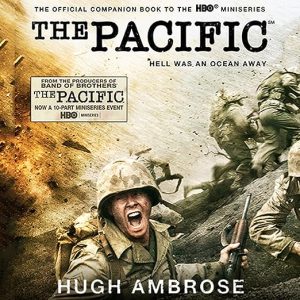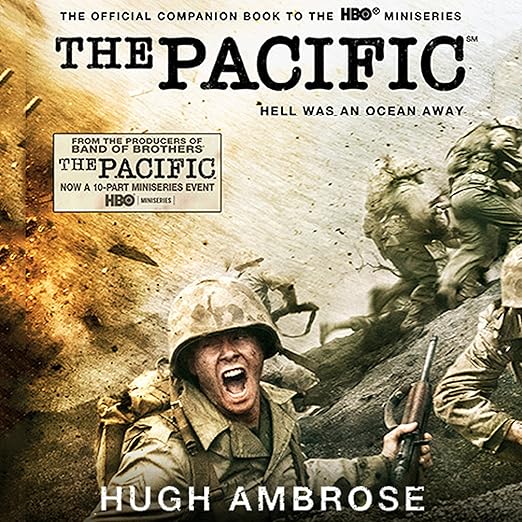
Five men connected mostly by happenstance carry this audiobook across nearly four years of the Pacific war, from America's retreat out of China in late 1941 through General MacArthur's landing on the Japanese mainland in August 1945. Hugh Ambrose's official companion book to HBO's Emmy-winning miniseries follows these five real service members through Bataan, Midway, Guadalcanal, the Marianas Turkey Shoot, Peleliu, Iwo Jima, and Okinawa, tracing individual human experience across roughly the entire island-hopping campaign rather than staying at the level of grand strategy.
The Review
One thing worth clarifying immediately, since it comes up in the book's own reviews: this stands as its own researched work rather than a novelization of the HBO scripts. Reviewer Robert S Cook makes this point directly, noting the book represents research 'not used by the movie' and shouldn't be judged as a tie-in product riding the show's coattails. Read that way, on its own terms, it holds up as a genuinely researched multi-strand oral and archival history.
A family connection is worth knowing about too, though it occasionally causes confusion, including among this book's own reviewers. Hugh Ambrose is the son of historian Stephen Ambrose, the far better-known author of Band of Brothers, the source material for HBO's earlier WWII miniseries. The Pacific continues that same father-to-son, book-to-HBO-adaptation lineage, and at least one attached review conflates the two men's names directly, worth clearing up before you go looking for Stephen Ambrose's other WWII titles expecting more from this specific author.
The book's scope means it functions almost as five interlocking biographies rather than a single unified narrative; listeners should expect the connective tissue between the five men's stories to come more from shared historical chronology, they're all moving through the same unfolding campaign, than from any direct personal connection between them.
The five men themselves span a deliberately wide range of roles and backgrounds, not just five interchangeable infantrymen; that variety, different service branches, different specific campaigns, different eventual fates, is what lets the book cover the Pacific theater's genuine geographic and tactical range without reducing the war to a single generic combat narrative repeated five times.
Mike Chamberlain narrates nearly twenty-four hours of material spanning five separate personal storylines and several major campaigns, and that kind of scale calls for exactly the skill he's shown elsewhere on long-form narrative nonfiction: attentive intelligence that handles transitions between research and personal narrative smoothly, with pacing that keeps a double-digit runtime from ever feeling like a slog. That matters enormously here, since the book is structurally demanding, five separate men's stories interwoven rather than told in strict sequence.
Reviewer John A. Sullivan, who listened while watching the HBO series concurrently, praises the book's rich detail and how easy the narrative is to follow despite covering Marines in the air and on the ground across five separate island campaigns. That's real testimony to how well the audio format handles material that could easily become disorienting in less careful hands, five names, five arcs, one overlapping war.
Chamberlain's steadiness proves especially valuable during the book's most harrowing stretches, Peleliu's coral ridges, Iwo Jima's black-sand beaches, where a narrator prone to overdramatizing combat could easily tip genuinely difficult material into something closer to spectacle. Instead the delivery stays measured even as the events themselves grow more brutal, letting the specific, documented human detail do the emotional work rather than vocal performance.
Chamberlain's handling of technical military terminology, unit designations, aircraft and ship names, geographic detail across dozens of unfamiliar Pacific island names, matters enormously for a runtime this long; imprecise or inconsistent pronunciation compounds across nearly twenty-four hours in a way it wouldn't in a shorter book.
That same steadiness helps Chamberlain manage the book's inevitable tonal shifts between combat sequences and quieter homefront or hospital-recovery passages, keeping both registers grounded in the same measured authority rather than artificially amping up the drama of one and underplaying the other.
Before You Commit to The Pacific
At just under twenty-four hours, this is a genuinely major commitment, longer than most single-subject war histories, and reviewer Tom Weikert offers a useful calibration: the writing itself isn't 'a literary masterpiece,' in his words, but that's not really the point of a book like this. What it delivers instead is scope and specificity across an enormous campaign, and listeners should go in expecting solid, functional narrative nonfiction rather than lyrical prose.
Given the subject matter, sustained combat across multiple brutal Pacific campaigns, expect genuinely heavy content delivered across a long runtime, closer to the atmosphere of Band of Brothers than a lighter military-history overview. The five-man structure means loss, when it comes, lands with real specific weight rather than abstract casualty statistics, which is exactly the intended effect but worth knowing before committing to nearly a full day of listening.
Because The Pacific represents Hugh Ambrose's most widely read work, distinct from his father's much larger WWII bibliography, listeners specifically drawn to this book should know his other writing credits are comparatively limited; this is very much the entry point to seek out first rather than one title among many.
Listeners balancing this against a tighter single-subject alternative should weigh the tradeoff honestly: nearly twenty-four hours buys genuine breadth across the entire Pacific campaign, but a shorter, single-battle-focused history would deliver more sustained depth on any one specific engagement than this book's necessarily distributed attention allows.
One more practical note: given the runtime, many listeners split this across multiple weeks rather than a single sustained binge, and the book's five-strand structure actually supports that approach well, since each return to a specific man's story after a gap functions almost like picking up a distinct, self-contained thread rather than losing a single continuous narrative's momentum.
Who It's For
This suits serious WWII history listeners first, especially anyone who watched the HBO miniseries and wants the fuller, more specific research behind it, plus fans of Band of Brothers looking for its natural companion piece covering the war's other major theater. The five-strand structure rewards listeners willing to track multiple names and timelines across a genuinely long runtime.
Listeners who appreciated the granular, multi-perspective structure of other major Pacific-theater war histories, or Laura Hillenbrand's Unbroken for its single-POV intensity, will recognize a complementary approach here, just spread across five storylines instead of one.
Skip it if you're looking for a tight single-subject biography or a shorter overview of the Pacific theater; this book's five-man structure and near-24-hour length are built for depth over accessibility. Listeners hoping for Stephen Ambrose's specific prose style should also know this is his son's work, distinct in voice even within the same family's WWII-history tradition.
The Short Version
- Narrator: Mike Chamberlain sustains nearly 24 hours across five interwoven storylines with attentive, measured pacing that never tips into overdramatized spectacle.
- Subjects: The Pacific theater of WWII, five interwoven personal war stories, the human cost behind an island-hopping campaign.
- Tone: Weighty and immersive, grounded in documented specific detail rather than sweeping narrative.
- Bottom line: A genuinely substantial companion history that stands on its own research, best for serious WWII listeners ready for a five-strand, near-24-hour commitment.