Quick Take
- Narration: Lisa Miller reads with the instructional clarity this workbook material requires, maintaining steady pacing through exercises without losing the listener.
- Themes: ADHD task initiation, executive function in high-stress environments, burnout prevention for neurodivergent professionals
- Mood: Structured, precise, and reassuringly clinical
- Verdict: A genuinely distinctive ADHD workbook that addresses task initiation specifically rather than general productivity, the surgical framing is earned rather than cosmetic.
I have spent a meaningful portion of my adult life reading about productivity and attention. I have shelves of the material, and most of it lives there decoratively. The problem with the genre, as anyone with ADHD can tell you, is that the advice assumes the very capacity it is trying to build: that you can initiate tasks reliably enough to implement systems that help you initiate tasks. The circularity is invisible from the outside. From the inside, it is the whole problem.
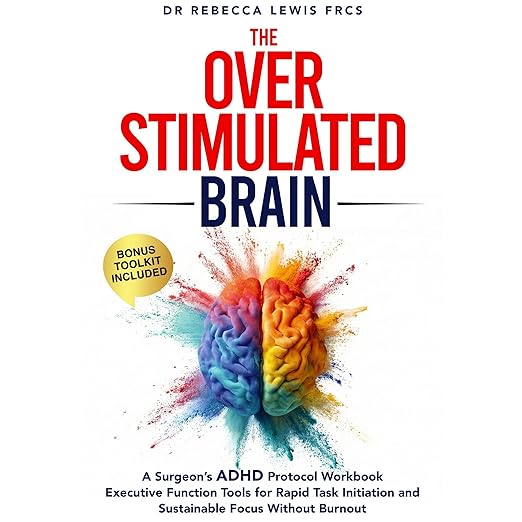
The Overstimulated Brain arrives with a premise that is specific enough to be interesting: the central obstacle for high-achieving adults with ADHD is not a lack of knowledge, motivation, or intelligence. It is a biological bottleneck at the task initiation phase, the moment between knowing you need to do something and actually beginning it. Dr. Rebecca Lewis frames this through the lens of surgical performance, where focus is not optional and where the protocols have to work in high-stimulus environments, not ideal ones.
Why the Surgeon’s Frame Is Load-Bearing
The clinical framing is more than marketing. The argument is structural: surgeons operate under conditions of sustained high stress, high sensory input, and high stakes where the standard ADHD advice of creating a calm, distraction-free environment is entirely inapplicable. The protocols in this book are designed for environments that cannot be controlled, which, for most adults, is closer to the actual conditions of professional life than the advice that assumes you have a dedicated quiet office and two uninterrupted morning hours.
The concept of the wall of awful, the accumulated emotional and psychological resistance that makes starting a difficult or previously avoided task feel physically impossible, is introduced early and anchors the book’s practical framework. Reviewers describe this framing as the most immediately clarifying thing the book offers: it names something that ADHD adults have experienced without being able to articulate, and naming it is the first step toward addressing it.
The ADHD Protocol Workbook in Audio Form
This is one of the cases where the workbook subtitle warrants honest attention. The book is described as an ADHD protocol workbook, and that category carries genuine limitations in audio format. The interactive exercises, the Rapid Task Initiation Framework, the Dopamine Management Strategies, the executive function toolkits, are described clearly enough to understand and implement, but they are not fillable worksheets in audio form. They are protocols that require active engagement on the listener’s part to convert from instruction to practice.
Lisa Miller reads with the instructional clarity that workbook content requires. She does not rush through the exercises or condense the step-by-step sections, which is the right call. At 2 hours and 50 minutes, the runtime is short enough that listeners can re-engage with specific sections on subsequent listens. This is a book that rewards return visits to particular protocols rather than a single straight-through listen.
The Sensory Redline Concept and What It Adds
The most distinctive contribution of this book within the ADHD genre is the concept of the Sensory Redline, the threshold beyond which sensory input overwhelms the executive function system, causing a shutdown that looks from the outside like procrastination but is actually a nervous system protective response. The protocol for identifying where your personal Redline sits, and for building an early warning system that allows you to redirect before you hit it, is more practically specific than the general advice to recognize when you are overwhelmed. Knowing that overwhelm is coming three steps before it arrives is the difference between prevention and recovery.
Reviewers describe this as the book they had been waiting for within the ADHD genre, and the specificity of the task initiation focus is genuinely rare in a category that often treats ADHD as a general condition rather than a precise set of functional bottlenecks. The Overstimulated Series promises additional volumes, and if this first entry is representative, the series will be worth tracking.
Caveats and Audience
At under 3 hours, this is a focused guide rather than a comprehensive ADHD resource. It does not cover the social and relational dimensions of ADHD, the specific challenges of ADHD in women, or the complex intersection of ADHD with other presentations. The book presents protocols as developed by a surgeon practitioner rather than by a research team with controlled trial evidence, and listeners should calibrate their expectations accordingly. Listen if you are a high-achieving adult with ADHD who has already read the standard titles and found them helpful but incomplete, particularly if task initiation rather than general organization is your central challenge. Skip if you are newly diagnosed and looking for a comprehensive introduction: this book assumes familiarity with the basic framework and goes directly to one specific problem within it.
Frequently Asked Questions
Is the book useful for people who suspect they have ADHD but have not been formally diagnosed?
The protocols are designed around the functional challenges of task initiation and executive function, which are relevant whether or not you have a formal diagnosis. However, the book presents a specific neurological framework that is more precise if you already know your own ADHD profile. Undiagnosed listeners may find it valuable but will likely benefit from formal evaluation as a complement.
What is the wall of awful and why do reviewers keep mentioning it?
It is a concept that describes the accumulated emotional resistance to beginning a task that has been avoided, dreaded, or previously failed at. The book builds its Rapid Task Initiation Framework specifically to address this phenomenon, which is why reviewers who experience it describe the book as the first resource that has named their specific problem accurately.
At under 3 hours, is this book substantive enough to be worth the listen?
The runtime is short because the scope is narrow: this is a focused guide to task initiation and sensory management, not a comprehensive ADHD overview. Reviewers consistently rate it highly despite the length, which suggests the material is dense rather than thin. The ideal use is as a precise supplement to broader ADHD resources rather than a standalone guide.
Does this book work for ADHD presentations that include inattentive type rather than primarily hyperactive?
The task initiation bottleneck that the book addresses is common across ADHD presentations, including primarily inattentive type. The sensory overload framing maps well onto inattentive presentations where cognitive overwhelm is a central feature. The book does not differentiate extensively between presentations, treating the executive function challenges as common to the broader ADHD experience.