Quick Take
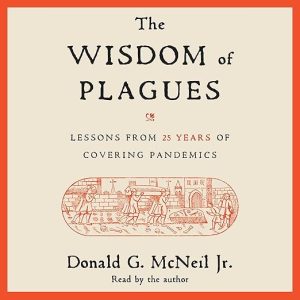
- Narration: Donald G. McNeil Jr. narrates his own book with the authority of someone who has spent 25 years in the field, his self-narration carries the weight of direct testimony rather than performed distance.
- Themes: Pandemic psychology, governmental failure, the politics of public health response
- Mood: Rigorous and unsentimental, McNeil writes from exhausted clarity rather than outrage, which makes the critique land harder
- Verdict: One of the most substantive books on pandemic preparedness written from inside the reporting, and McNeil’s self-narration makes it feel like a private briefing from the most informed person in the room.
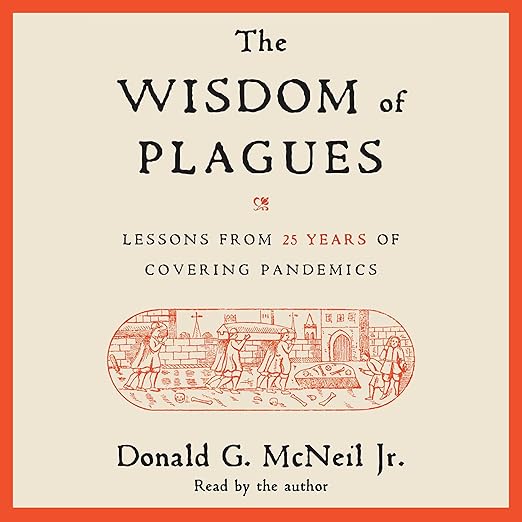
I finished The Wisdom of Plagues on a long Sunday drive through early spring, with the windows cracked and McNeil’s measured, slightly hoarse voice filling the car. There is something about listening to a person narrate their own life’s work that changes the register entirely. He is not performing objectivity. He is reporting what he saw, and after twenty-five years covering outbreaks in over sixty countries, what he saw was a consistent, demoralizing pattern: small case-clusters that should have been contained, destroyed by the same combination of political cowardice, public denial, and bad incentives. Again and again.
McNeil is the New York Times journalist who covered public health for a quarter-century, appeared regularly on The Daily during COVID-19’s early months, and helped position the Times to win the 2021 Pulitzer Gold Medal for Public Service. His voice was, for a period in early 2020, one of the few in mainstream media that was telling people the unvarnished truth about what was coming. He understood the risk earlier than most because he had seen the failure mode before, in SARS, in Ebola, in H1N1, in diseases that never made it to a global stage but easily could have.
The Anatomy of How Outbreaks Become Pandemics
The book’s central intellectual contribution is not the virology, McNeil understands the biology of infectious disease, but that is not where his expertise is irreplaceable. What he offers that most science reporters cannot is a deep understanding of the psychology of outbreak escalation: why people refuse to believe they are at risk, why they reject protective measures, how weak leaders get mired in denial at precisely the moment when decisive action matters most.
He traces this pattern across dozens of episodes. Reviewer John Buchanan notes that the book snaps you back step by step through the COVID chronology, including McNeil’s early January 2020 co-authored Times piece that identified the Wuhan virus as potentially serious, months before most major outlets took it seriously. The book is organized around the structural conditions that allow denial to persist: money-hungry entrepreneurs, power-hungry populists, citizens unwilling to make minor sacrifices for collective benefit. McNeil names these forces without euphemism, which is what reviewer BDSNorthCarolina appreciates when they describe his documentation of political science overriding medical science.
The Stone-Hearted Prescriptions
McNeil writes in the book that by the time he wrote his last New York Times stories, he had not lost his compassion but had grown far more stone-hearted about how governments should react. This is the emotional and intellectual center of the book. The prescriptions he offers in the final sections are not soft consensus recommendations. They are the conclusions of someone who has watched enough preventable deaths to have run out of patience for politically convenient half-measures.
Peter Piot, MD, co-discoverer of Ebola, describes this as must-reading for preparing better for the next unavoidable epidemic. Lena Wen, MD, calls it one of the most enlightening books on public health. The Economist quotes frame it as a ferocious fusillade against disease and humanity’s self-defeating impulses. These are not blurb exaggerations. The book earns those descriptors through the accumulated weight of documented failure rather than rhetorical performance.
Self-Narration as a Feature of This Audiobook
McNeil’s narration is not polished in the studio-professional sense. His delivery is direct and slightly unvarnished, exactly as you would expect from a print journalist who spent his career filing copy rather than performing it. What it communicates, across ten hours of listening, is genuine authority. When he describes early Ebola response in West Africa, you hear a person who was there. When he describes the incentive structures that prevented early COVID intervention, you hear a person who has spent years thinking about exactly this problem. A professional narrator could have delivered the text more fluidly. They could not have delivered it with this particular weight.
Who Should Listen / Who Should Skip
Listen if you want the most informed, ground-level account of pandemic psychology and governmental failure written from inside the reporting, and if you can sit with an author who has grown genuinely impatient with the excuses that have accompanied every major outbreak response in recent decades.
Be aware that McNeil left the Times under difficult circumstances, and some readers bring that context to his authority claims. The book engages with science and public health rather than that episode, but listeners who know the background may find it relevant to their assessment of his perspective.
Frequently Asked Questions
Does Donald McNeil Jr. narrate The Wisdom of Plagues himself, and does it affect the listening experience?
Yes, McNeil narrates his own book. His self-narration carries the authority of direct field experience, 25 years covering outbreaks in over 60 countries, that a professional narrator cannot replicate. The delivery is less polished than studio narration but more credible, like a private briefing from someone who was actually there.
Is The Wisdom of Plagues primarily about COVID-19 or does it cover broader pandemic history?
The book ranges across McNeil’s 25-year career covering outbreaks worldwide, using COVID-19 as a through-line and culminating example. He covers SARS, Ebola, H1N1, and dozens of other outbreak episodes to build his argument about the consistent failure patterns that allow small clusters to become catastrophes.
What specific prescriptions does McNeil offer for improving pandemic preparedness?
McNeil’s final sections offer what he describes as stone-hearted prescriptive advice shaped by having witnessed enough preventable deaths to run out of patience for politically convenient half-measures. He addresses government response protocols, public communication, the role of science in policy, and the structural incentives that consistently obstruct effective early response.
How does The Wisdom of Plagues compare to academic public health literature on pandemic preparedness?
McNeil’s contribution is explicitly journalistic rather than academic, his expertise is in outbreak psychology, political failure, and media communication rather than in epidemiological modeling or vaccine development. He fills a gap that academic literature typically does not address: the human behavioral and political dimensions of why outbreaks become pandemics despite available knowledge.