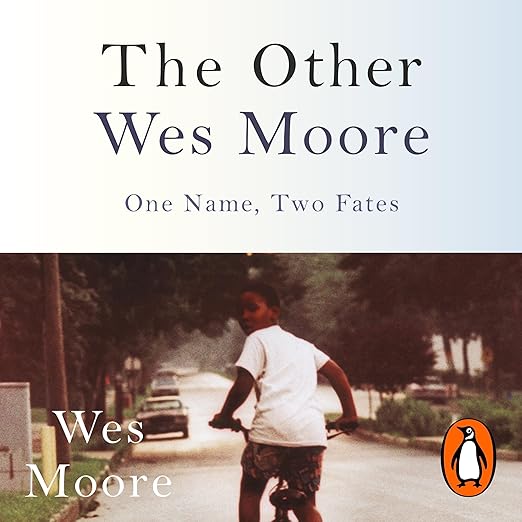
At a Glance
- Read by: Wes Moore narrates both his own story and the other Wes Moore's with the same investment, a choice that is structurally essential rather than a nice bonus.
- At its heart: Fate versus choice, fatherlessness and mentorship, criminal justice and opportunity
- Vibe: Sober, reflective, quietly urgent
- Short version: A tightly constructed dual biography whose self-narration genuinely changes how the comparison lands; recommended especially for book clubs and classroom listening.
Wes Moore's decision to narrate both Wes Moores himself, his own story and the incarcerated man who shares his name, is the single choice that makes this audiobook work as more than a well-meaning morality tale. A hired narrator reading both threads with equal professional remove would have let listeners quietly sort the two men into 'the one who made it' and 'the one who didn't' from the first chapter. Moore's own voice, carrying both narratives, refuses that shortcut and forces the comparison to stay uncomfortable the whole way through.
Written and narrated by Wes Moore, this 6-hour-and-8-minute audiobook holds 4.6 out of 5 from 3,350 ratings, a strong response for a memoir built on such a specific, almost accidental premise: a 2000 Baltimore Sun article about a Rhodes Scholar named Wes Moore ran alongside coverage of a botched armed robbery involving a suspect of the same name. That coincidence, not a planned writing project, is where the book began, and the audiobook format lets listeners hear Moore work through his own astonishment at the parallel in something close to real time.
The Title Refuses to Pick a Real Wes Moore
The book's structure, alternating between Moore's own path through fatherlessness, street corners, and eventual redirection toward the Rhodes Scholarship and White House Fellowship, and the other Wes Moore's parallel path toward a life sentence without parole, is doing genuine argumentative work rather than simply organizing two life stories side by side. Every chapter break asks the same implicit question: at which specific fork did these two nearly identical starting points diverge, and how much of that fork was choice versus circumstance versus sheer luck. Moore never fully answers it, which is the right call; a tidy answer would betray the book's own honesty.
The correspondence-and-prison-visits origin, years of letters exchanged with a stranger serving life for felony murder, gives the book a reported, almost documentary backbone underneath its memoir voice. Moore is not speculating about the other Wes Moore's inner life from a safe distance; he built the material through direct, sustained contact, which shows in how specifically and non-judgmentally the other man's chapters are rendered. That reporting instinct keeps the book from tipping into either poverty tourism or easy uplift, the two failure modes this kind of dual narrative most often falls into.
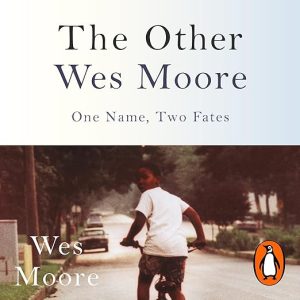
The book's title itself does quiet work too. Naming the other man 'the other Wes Moore' rather than assigning him a more distancing label keeps the parallel structure honest from the cover onward. Nothing about the framing invites a listener to see one man as the real Wes Moore and the other as a footnote, and that even-handedness in the title carries through into how the audiobook actually divides its running time between the two stories.
One Voice Refuses to Signal Who to Root For
Self-narration is the book's defining audio asset, and the reasoning is specific rather than a generic author-reads-own-work bonus. Because Moore reads both threads in his own voice, the listener cannot outsource emotional distance to a narrator's performance choices, cannot let a hired reader's subtly different tone for the other Wes Moore signal who to root for. The discomfort of hearing the same voice narrate a Rhodes Scholarship and a murder conviction with the same investment in both men's humanity is the entire point, and it only works with the author himself at the microphone.
The cultural reception the book earned lands with real weight in audio specifically. George Clooney's line, 'Spectacular. Wes Moore is a proper leader,' and Oprah Winfrey's description of walking away from conversations with Moore with 'a new perspective,' both appear in the book's own framing material, and hearing Moore narrate his own story after those endorsements adds a layer the print edition cannot replicate quite the same way: the audiobook becomes the direct encounter those public figures are describing, not just a report of Moore's story at one remove.
The Baltimore setting itself does real work across the book, not as backdrop but as a third character. Both Wes Moores grew up in neighborhoods shaped by the same disinvestment, the same over-policing, the same narrow set of visible paths forward, and Moore is careful never to let his own eventual success read as proof that the neighborhood's problems were exaggerated. If anything, the narrower the gap between the two men's early circumstances turns out to be, the harder the book's central argument about the role of small interventions, a mentor, a military school placement, a single adult who stepped in at the right moment, actually lands.
Well-Trodden but Well-Earned Territory to Revisit
At six hours and eight minutes, this is a genuinely compact audiobook for a dual biography covering two full lives, which means Moore prioritizes narrative momentum over exhaustive policy analysis. Listeners hoping for a deep statistical or sociological treatment of the systemic forces at play, sentencing disparities, education funding, concentrated poverty, will get those themes gestured at through story rather than argued at length with data. That is a legitimate stylistic choice for a memoir-driven book, but it is worth knowing going in if a heavier policy focus is what you actually want.
The book's fame, it has spent years on school and book club reading lists, means many listeners will already know its basic premise and possibly its ending before pressing play. That familiarity does not erase the audiobook's value: Moore's own voice narrating the material is a genuinely different experience than reading it cold in a classroom years ago, but anyone expecting a completely fresh discovery should recalibrate: this is revisiting well-trodden, well-earned territory rather than uncovering something obscure.
Sample a Few Minutes Before Committing to Self-Narration
Readers of narrative nonfiction built around a single organizing coincidence or comparison will find the structure here immediately satisfying, as will anyone specifically interested in criminal justice, opportunity, and the role of chance in outcomes for young Black men in cities like Baltimore. Book clubs and classroom listening groups remain a natural fit, since the compact runtime and clear thematic questions, what separates one path from another, translate easily into discussion. Listeners who value hearing an author narrate their own high-stakes material, rather than a professional performer at a remove, will find Moore's reading a genuine reason to choose the audiobook over the print edition.
Skip this one if you specifically want rigorous policy analysis or original statistical research into criminal justice reform; this book gestures at those systems through two lives rather than arguing them directly with data. It is also not the pick if you are looking for a story you have not encountered in some form before, given how widely it has circulated through schools and reading programs over the years. And if narrated memoirs generally do not work for you, if you find author self-narration distracting rather than additive, the six-hour commitment here is still built entirely around that choice, so it is worth sampling a few minutes before committing.
A Few Questions About The Other Wes Moore
Does Wes Moore narrate both his own story and the other Wes Moore's in this audiobook?
Yes. Moore reads both threads himself rather than handing the material to a professional narrator, which keeps listeners from unconsciously favoring one man's story over the other through a narrator's tonal choices.
Is The Other Wes Moore audiobook based on real letters and prison visits?
Yes. The book grew out of years of correspondence and prison visits Moore conducted with the other Wes Moore after learning about the coincidence from a 2000 Baltimore Sun article.