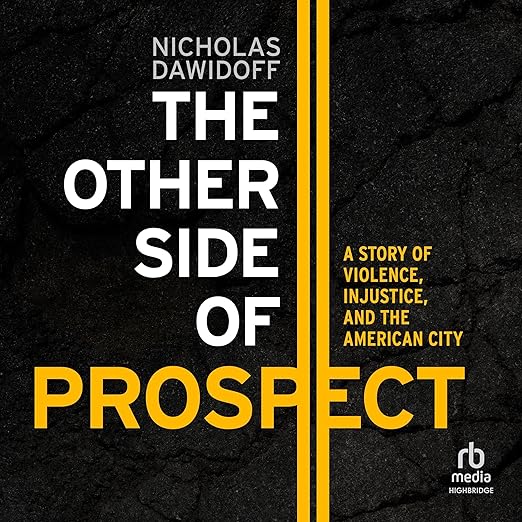
Quick Take
- Narration: Diontae Black delivers a measured, authoritative performance that honors the gravity of the material without over-dramatizing it.
- Themes: wrongful conviction, deindustrialization and economic inequality, mass incarceration and reentry
- Mood: Weighty and immersive, with the slow burn of long-form investigative journalism
- Verdict: Dawidoff’s eight years of reporting produce a landmark work of American social nonfiction that earns its length and then some.
I came to The Other Side of Prospect on a gray Tuesday afternoon, initially drawn in by the wrongful conviction angle. What I did not expect was to spend the next seventeen hours absorbed in something far more sprawling: a portrait of an American city, a neighborhood, and a system that failed the people it was supposed to protect. Nicholas Dawidoff, a New Haven native, spent eight years on this story. That commitment shows in every sentence, and it shows in the kind of access and depth that no shorter timeline could have produced.
The book opens with a single act of violence: a retired grandfather, Pete Fields, shot point-blank one summer evening in 2006. A hasty investigation followed. Sixteen-year-old Bobby was sentenced to thirty-eight years in prison. Dawidoff does not rush past this injustice. He reconstructs it carefully, tracing the lives of three men: the victim, the likely actual murderer Major, and Bobby, whose innocence cost him years of his youth at the hands of a justice system that moved fast and looked hard at the wrong person.
Our Take on The Other Side of Prospect
This is one of those rare nonfiction works that refuses to be just one thing. One reviewer called it five books in one, and that description is accurate. Dawidoff weaves together the history of New Haven’s Newhallville neighborhood, the rise and collapse of the Winchester rifle company that once gave the community its economic backbone, the Great Migration that brought Bobby’s family and others north from South Carolina in search of opportunity, and the slow devastation of deindustrialization. The wrongful conviction is the spine of the book, but the flesh around it is a full social and economic history of what happened to an American community when the jobs disappeared and the guns stayed. The proximity of Yale University to the neighborhood, steps away and worlds apart, is a through-line Dawidoff never lets you forget.
Why Listen to The Other Side of Prospect
Narrator Diontae Black brings the right weight to this material. His pacing is deliberate without being slow, and he handles the legal and sociological passages with the same quiet authority as the more personal scenes. At seventeen and a half hours, this is a substantial listen, but it never drags. Dawidoff’s prose has a novelist’s instinct for scene and detail, and one reviewer noted it reads like a novel but with real people. Black serves that prose well, never over-performing it. The emotional core of the book, Bobby’s reentry into society after his exoneration, lands as hard as it should because Black has built toward it with patience across the preceding hours.
What to Watch For in The Other Side of Prospect
Do not go in expecting a simple wrongful-conviction narrative with a clean resolution. Bobby does get out. But Dawidoff is honest about what freedom looks like after years inside: the struggle to reconnect with family, the weight of lost time, the gap between legal exoneration and psychological recovery. The book also does not sensationalize Major or the violence in Newhallville. It contextualizes them, which is harder and more uncomfortable. If you want a story that lets you feel righteous without feeling implicated, this is not it. One reviewer described the book as making remarkable characters accessible while keeping the legal and social issues legible, and that balance is precisely what Dawidoff achieves across 450 pages of original source material now rendered in this audio form.
Who Should Listen to The Other Side of Prospect
Readers who found themselves gripped by works like Bryan Stevenson’s Just Mercy or Matthew Desmond’s Evicted will recognize this book’s ambitions and find them fully realized. It is also essential listening for anyone trying to understand mass incarceration not as an abstraction but as something that happens to specific people in specific places for specific, often preventable reasons. Those looking for a lighter listen should look elsewhere. This is dense, demanding, and worth every minute of the commitment it asks for.
Frequently Asked Questions
Do I need to know anything about New Haven before listening to The Other Side of Prospect?
No prior knowledge is needed. Dawidoff builds the history of New Haven and its Newhallville neighborhood from the ground up, making the context accessible to any listener.
Is The Other Side of Prospect primarily a legal thriller or a work of social history?
It is squarely social history. The wrongful conviction of Bobby is central, but the book spends equal energy on the Winchester company’s collapse, the Great Migration, and the systemic forces that shaped the neighborhood’s trajectory.
How graphic is the violence in The Other Side of Prospect?
The opening shooting of Pete Fields is described plainly rather than graphically. Dawidoff is not interested in sensationalism. His focus is on causes and consequences, not the act itself.
Does the book cover what happened to Bobby after his release from prison?
Yes. Dawidoff follows Bobby’s reentry into society in detail, including the psychological and social challenges of rebuilding a life after wrongful imprisonment. It is among the most affecting parts of the audiobook.