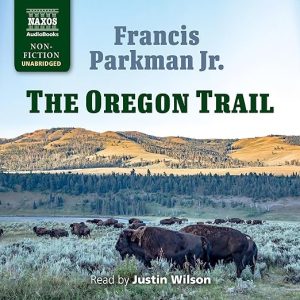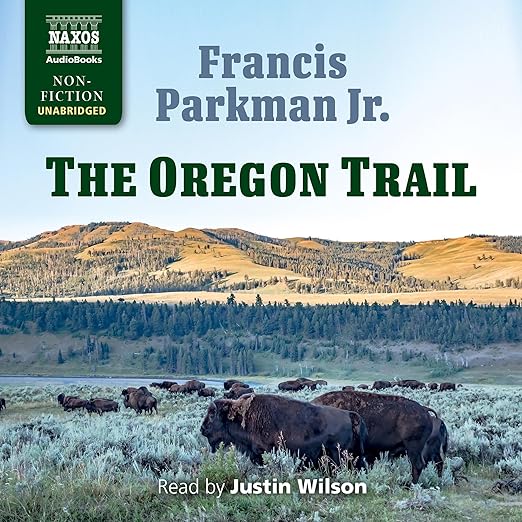
Francis Parkman wrote The Oregon Trail at 23, riding over two thousand miles of horseback across the American West in 1846, living among the Dakota, tracking buffalo herds across the Great Plains, and producing a first-person account that remains one of the most vivid primary documents of the pre-settlement frontier. Justin Wilson narrates this audiobook edition of Parkman's classic at 13 hours and 6 minutes, long enough for the full scope of the journey, from the Missouri River outposts through the shadow of the Rockies, to unfold at the pace the material demands. Parkman is one of the 19th century's most significant American historians, and this early account, written before he became an established figure, carries a rawness that his later, more formally composed historical works do not.
The book's title is somewhat misleading, as multiple reviewers have noted. Parkman was not documenting the Oregon Trail as a phenomenon or following its route systematically. He was a young Boston Brahmin pursuing adventure and scholarship in roughly equal measure, and his path was shaped more by his interest in the Dakota than by emigrant traffic. The title, attached to the work in later editions, can set false expectations, and listeners who come to the audio expecting a systematic account of wagon train culture will find something considerably more personal and ethnographic instead.
Parkman's prose is the central challenge and the central reward of this audiobook. He writes with an acute observational eye and a naturally engaging narrative sense, as the synopsis rightly notes, but he also writes from a position of inherited privilege and racial hierarchy that colors every encounter with Native American subjects. Reviewer Ethan Jewett put this tension precisely: "Francis Parkman's contempt for the native people he lived with and his attempt to shoot every animal in sight make this book hard to read. But his writing is" compelling enough to keep going. Wilson's narration does not editorialize on this tension, which is the appropriate choice for an audiobook of historical material. The listener must bring their own critical frame.
The buffalo hunt sequences are the passages where Parkman's prose most fully comes alive, and Wilson delivers them with a physicality that suits the material. The Dakota sections are the most historically significant, as Parkman captures details of tribal life, social structure, ceremony, and daily practice that are difficult to find in other contemporaneous first-person accounts. His ethnographic observations are valuable precisely because they predate the large-scale disruption of settlement, even though they are filtered through a perspective that modern readers will find frequently troubling. That combination of documentary value and ideological limitation defines the experience of reading historical primary sources, and this audiobook makes no attempt to resolve the tension.
What Works
The audio format is particularly well-suited to Parkman's travel writing because the prose is driven by movement and observation rather than argument or analysis. Listening to the account of his journey through the Rockies, across the Great Plains, and through the Indian encampments has an immediacy that the eye occasionally skips past on the page. Wilson keeps the momentum through the passages that reviewer RiverTraveler described as "tedious at times," the slower descriptive sections where Parkman catalogs landscape with the thoroughness of a committed naturalist, and the overall 13-hour runtime benefits from that narration sustaining interest through the book's less dramatic stretches.
The historical context Parkman's journey provides is irreplaceable. He was writing about a world on the literal brink of transformation, a phrase the synopsis uses accurately, and the specificity of what he records, the populations he encountered, the routes, the weather patterns, the social dynamics of the frontier outposts, has the value of a snapshot taken just before everything changed. Reviewer "reader" captured this: "I enjoyed it because of the glimpse into an America that is gone now." That elegiac quality is real, and audio listening, which moves through the account at roughly the pace of experience rather than scanning, amplifies it.
Weak Spots in The Oregon Trail
Parkman's condescension toward Native American subjects is not incidental or occasional; it is woven through the text as an expression of his era's dominant assumptions. Listeners who engage with the book as an artifact of 1846 Boston intellectual culture will find it revealing about the colonial ideology that accompanied westward expansion. Listeners who expect balanced or respectful cultural portraiture will be repeatedly frustrated. The audiobook format, in which there is no paratextual apparatus of footnotes or editorial introductions, places the interpretive burden entirely on the listener's own historical knowledge.
The prose style, described by reviewer RiverTraveler as "written in an old style of story-telling," requires some adjustment from listeners accustomed to contemporary narrative nonfiction. Parkman's sentences are long and formally structured, and Wilson's narration honors that structure rather than modernizing it through delivery. The audiobook is approximately 13 hours of 19th-century prose read straight, and listeners who struggle with formal prose styles may find the experience more demanding than a modern adventure narrative of comparable length would be.
Who It's For
This audiobook rewards listeners with genuine interest in American frontier history, particularly those curious about what the pre-settlement West looked and felt like from the perspective of someone who was actually there. It is an essential primary source for anyone studying 19th-century American expansion, the Dakota people's way of life before systematic disruption, or the history of western travel writing. Listeners should approach it prepared to engage critically with Parkman's perspective rather than accepting his framing wholesale. Those looking for a balanced multicultural history of the Oregon Trail era will need supplementary reading. Justin Wilson's narration makes the formal prose accessible across the full runtime, and the book's documentary value justifies the 13-hour commitment for historically motivated listeners.
- Narration: Justin Wilson handles Parkman's 19th-century prose with appropriate gravity, though the formal register of the original text can create distance during the more action-driven buffalo hunt sequences.
- Themes: Westward expansion, Dakota tribal life, the American frontier before settlement
- Mood: Vivid and morally complex, historically charged
- Verdict: Francis Parkman's 1846 account of life among the Dakota and across the Great Plains remains a primary document of American frontier history, but listeners should approach it as a record of its time, including the author's prejudices, rather than as a balanced cultural portrait.
Frequently Asked Questions
Is this audiobook actually about the Oregon Trail, or is the title misleading?
The title is somewhat misleading by contemporary standards. Parkman was not documenting the Oregon Trail systematically or following emigrant routes in detail. He was a 23-year-old Bostonian pursuing adventure and ethnographic observation in the American West in 1846, living among the Dakota and traveling across the Great Plains and toward the Rockies. The 'Oregon Trail' title was attached to later editions. Listeners expecting a comprehensive history of the wagon trail migration will find a far more personal and episodic account.
How does this audiobook handle Parkman's documented prejudice against Native Americans?
The audiobook presents Parkman's original text without editorial intervention. Justin Wilson's narration does not add commentary or framing around the passages where Parkman's colonial attitudes toward the Dakota and other Native peoples are explicit. Listeners must bring their own historical critical frame to the material. Multiple reviews acknowledge this tension directly, noting that the book's documentary value and its ideological limitations coexist and cannot be separated.
Is this audiobook appropriate for listeners unfamiliar with 19th-century American history?
Listeners can follow the journey without prior historical knowledge, since Parkman's account is experiential rather than analytical. However, contextual knowledge about the era of westward expansion, the Dakota people's situation in 1846, and the subsequent history of settlement makes the account significantly richer and more legible in its ideological dimensions. Without that context, some of Parkman's assumptions and observations may be puzzling rather than legible as products of their time.
At 13 hours, does the audiobook maintain momentum across its full runtime?
The momentum varies. The buffalo hunt sequences and the Dakota encampment sections are the most vivid and drive the listening experience most effectively. The more purely descriptive landscape passages, which reflect Parkman's naturalist training, can feel slower. Reviewer RiverTraveler described it as 'tedious at times, yet with many interesting events,' which is an accurate characterization of how the material is distributed across the 13-hour runtime.