Quick Take
- Narration: Kyle Tait reads with a clarity and measured confidence that suits the book’s analytical material, handling the denser quantitative passages without losing listener engagement.
- Themes: Market contrarianism, cognitive bias in investing, using public information as a genuine edge
- Mood: Rigorous and occasionally combative, with the productive confidence of someone who has spent decades proving conventional wisdom wrong
- Verdict: A serious investing framework that rewards patient engagement, though listeners unwilling to sit with complexity will find seventeen hours a demanding ask.
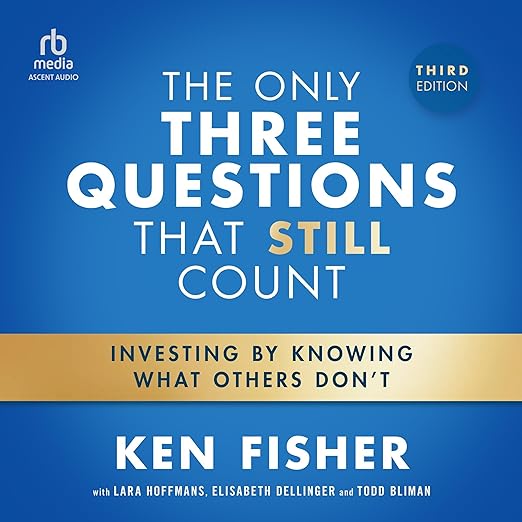
I am not an investor in the professional sense, but I have spent enough time reading financial journalism and covering market-adjacent topics to know when a book is actually saying something and when it is performing the appearance of insight. Ken Fisher’s The Only Three Questions That Still Count, now in its third edition narrated by Kyle Tait, is doing the former. It is also, at seventeen hours and seven minutes with a hundred-plus visual exhibits referenced throughout, genuinely demanding.
Fisher is a polarizing figure in financial media, known for his contrarian positions and for a confidence in his own methods that some find compelling and others find exhausting. The book reflects both qualities completely.
Our Take on The Only Three Questions That Still Count
The book’s core argument is epistemological before it is financial: most investors consistently lose to the market because they believe things that are not true, or because they know things that everyone else also knows and therefore cannot act on profitably. Fisher’s three questions are a framework for identifying what is actually knowable, what is falsifiably true rather than merely widely believed, and what you can deduce that others cannot from the same publicly available information. This sounds deceptively simple until Fisher begins applying it to specific market assumptions that have persisted for decades, showing the data that contradicts them.
Reviewer hecklerpix described this as not a summer read but probably a most important one in choppy investment waters, and that calibration is exactly right. This is a book that asks you to work. The third edition updates the examples and visual support for the current market environment, including the interconnected global dynamics that Fisher sees as increasingly central to investment strategy.
Why Listen to The Only Three Questions That Still Count
Kyle Tait’s narration handles the book’s analytical density with genuine skill. Financial content is genuinely hard to narrate well: the numbers, the charts described verbally, the logical chains that require a particular cadence to remain comprehensible in audio form. Tait maintains the thread through Fisher’s denser arguments without the kind of mechanical delivery that makes complex nonfiction audiobooks feel like being read a textbook. The pacing is measured enough to let the arguments register without becoming slow.
The book also benefits from Fisher’s willingness to name specific beliefs he considers wrong and explain why. This is different from the mode of most investment books that are careful to hedge every claim into meaninglessness. Fisher makes falsifiable arguments and provides the data he used to reach his conclusions. Readers can disagree with those conclusions while appreciating the intellectual honesty of presenting them in a form that could in principle be refuted.
What to Watch For in The Only Three Questions That Still Count
The visual content is a real limitation in audio. Fisher explicitly notes that the audiobook includes a downloadable PDF with over a hundred charts and graphs, and for a book that is fundamentally about how to read market data correctly, those visuals are not supplementary, they are central. Listening without access to the PDF means you will be following verbal descriptions of visual arguments, which works reasonably well for some sections and less well for others. This is an audiobook that benefits substantially from having the PDF open alongside.
Fisher’s confidence is a feature to some listeners and a drawback to others. Reviewer Jim P noted you will read things you do not hear from other financial advisors, which is true, but Fisher’s certainty about his own methods can slide from authoritative into dismissive of alternative views. If you find that register energizing, the book will feel like exactly the intellectual challenge it intends to be. If you find it off-putting, seventeen hours is a long time to spend with a voice that does not often say it is uncertain.
Who Should Listen to The Only Three Questions That Still Count
Best suited for investors who have a working knowledge of market fundamentals and want a more rigorous framework for thinking about where conventional wisdom leads them astray. Also valuable for anyone drawn to the epistemology of prediction and the cognitive biases that affect financial decision-making. Less accessible to beginning investors who would benefit from more foundational content first. Download the PDF before you start listening; you will need it.
Frequently Asked Questions
Is the third edition significantly different from earlier editions, or is it primarily updated examples?
The third edition updates the visual content and market examples to reflect more recent conditions and the increasingly globalized investment landscape Fisher sees as central to current strategy. The core three-question framework remains unchanged.
Does the audiobook work without the companion PDF, or is the visual content essential?
The book references over a hundred charts and graphs. The audio descriptions of those visuals are generally clear, but for the sections where Fisher is making data-driven arguments against conventional wisdom, having the PDF open alongside significantly improves comprehension.
How technical is the content? Does it assume professional investment knowledge?
Fisher assumes familiarity with basic investment concepts, equity markets, and portfolio thinking. He explains more advanced concepts as he introduces them, but complete beginners to investing would find parts of the framework difficult to evaluate without more foundational knowledge.
Does Kyle Tait’s narration handle the quantitative material effectively?
Yes. Tait manages the numbers and logical sequences without the flat mechanical quality that often affects financial audiobooks. He maintains enough inflection to signal which parts of an argument Fisher considers most important.