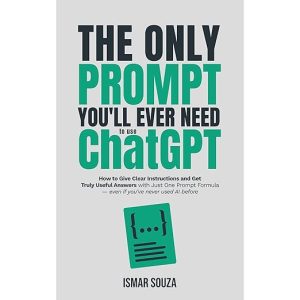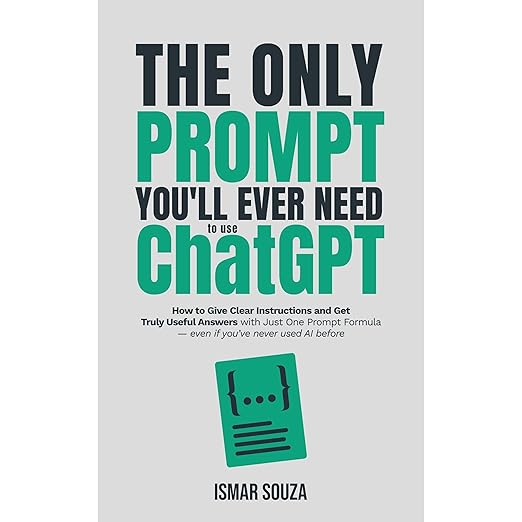
One single prompt is the entire pitch of this audiobook, and Ismar Souza spends just over an hour making the case that most people fail with ChatGPT not because the tool is weak but because they never learned to ask it anything properly. Souza, described in the synopsis as the author of more than 30 books on learning, productivity, and digital business, narrows an overwhelming topic, prompt engineering, down to one reusable structure he compares to a 'Swiss Army knife,' a single format flexible enough to generate text, plans, summaries, and strategy on demand.
Asking Versus Guiding Changes Everything Here
The synopsis lists out what the single-prompt framework is meant to unlock: turning a shallow AI answer into something more useful, fixing the most common invisible mistake that makes ChatGPT feel dumb, and teaching the model your own writing style rather than settling for generic output. What distinguishes this from a lot of prompt-engineering content online is the explicit warning against copying prompts wholesale from other people, the book argues that borrowed prompts without understanding why they work leave users more confused, not less.
Virtual Voice, AI-generated narration, reads the material here, and for a structured, list-driven instructional guide like this one, that pairing is more tolerable than it would be for anything requiring emotional warmth. The content is procedural rather than confessional, which plays to the format's strengths.
The synopsis draws its own sharp distinction between asking and guiding, arguing that the difference changes everything about how a conversation with AI actually unfolds. That is a genuinely useful reframe for beginners who tend to treat ChatGPT like a search engine, typing a single question and expecting a complete answer, rather than treating it as an ongoing exchange that improves with direction.
The synopsis pitches this as accessible even to listeners who know nothing about prompting going in, a meaningful claim given how much AI content assumes some technical familiarity already. Whether that promise holds depends on execution, but the underlying ambition, a genuinely zero-prerequisite entry point, is worth crediting even before judging results.
Remembering Your Style in Under Two Minutes
The single-prompt promise is a real differentiator in a crowded field of AI how-to content. Rather than handing listeners a library of situational prompts to memorize for different tasks, emails, summaries, content plans, Souza's pitch is a durable, one-time investment in learning how to think about prompting itself, a distinction the synopsis makes explicitly when it separates AI-generated content from AI-assisted content and positions the second as the actual professional skill worth developing.
Souza's broader catalog, dozens of prior titles spanning similar practical, how-to territory per the synopsis, suggests someone who has built a career distilling complex topics into compact, usable formats. That track record is a reasonable stand-in for reviewer feedback given how few ratings this specific title has accumulated so far.
The synopsis is explicit that the book is 'not a collection of pre-made commands or magic formulas,' positioning itself instead as a map for thinking clearly and crafting instructions rather than a list to copy and paste. That distinction matters in a crowded market of prompt-dump content, since Souza's actual promise is a transferable skill rather than situational scripts that stop working the moment ChatGPT's behavior shifts.
One specific promise stands out for its practical value: a step-by-step approach to teaching the AI your own writing style, even for listeners who feel they do not have a distinctive one. That kind of personalization is where a lot of generic AI output complaints actually originate, and addressing it directly is a smart choice for a beginner-focused book.
One specific, concrete promise stands out from the marketing-heavy bullet list: a feature described as letting ChatGPT remember a user's way of thinking, activated in under two minutes. Concrete, time-boxed claims like this are easier to verify against actual use than vaguer promises elsewhere in the pitch, worth noting as a point in the book's favor. Clarity itself gets framed as a superpower in the synopsis's own language, a slightly grandiose claim for what is ultimately a communication skill, but the underlying point, that vague requests produce vague AI output, holds up regardless of the marketing register around it.
AI Narrating a Book About Guiding AI
At 1 hour and 7 minutes, this is closer to a single extended lesson than a comprehensive course, and that scale matches the book's own premise: if the promise is one master prompt rather than a sprawling curriculum, a short runtime is the honest length for that claim rather than a red flag. No written reviews are attached to this listing yet, so approach the 5.0 rating, drawn from only three ratings, as an early and thin signal rather than a settled reputation.
Worth naming plainly: ChatGPT's interface and specific features change quickly, and any guide tied to a fast-moving AI tool risks specific details aging faster than its underlying thinking. The prompt-structure framework itself is built to be more durable than any single screenshot-era tip would be.
A mild irony sits underneath the whole package: a book teaching listeners to guide artificial intelligence more effectively is itself narrated by artificial intelligence rather than a human voice. It does not undermine the content, which stays clear and instructional throughout, but listeners sensitive to that kind of thematic mismatch should know it going in.
At just over an hour, the audiobook also makes an implicit argument about respecting a listener's time: rather than padding a simple, teachable idea into a multi-hour course the way some AI-education content does, Souza commits to the length the actual content earns, and that restraint is itself a small piece of evidence for the book's own advice about clarity over padding.
Beginners Overwhelmed by Conflicting Prompt Advice
ChatGPT beginners who feel overwhelmed by conflicting prompt advice online, and anyone who wants one reliable, reusable framework rather than a growing pile of single-use prompts to keep track of, are exactly who Souza is writing for. Listeners who write, sell, teach, or study, the synopsis's own framing, are named directly as the intended audience regardless of technical background.
Prompt-engineering veterans, or anyone wanting deep technical or API-level instruction rather than a single practical framework, will likely find this too introductory. As a single-lesson-length audiobook, it is a starting point, not a comprehensive reference.
The synopsis frames its intended audience deliberately broadly rather than narrowing to one professional niche, suggesting the underlying approach is built to generalize rather than serve one narrow use case like marketing copy or academic writing alone.
- Performance: Virtual Voice's AI narration suits this list-driven, procedural format better than it would suit more emotionally driven content.
- What it covers: Prompt engineering fundamentals, one reusable framework over memorized prompts, practical ChatGPT literacy
- Feel: Direct and instructional, pitched as a quick, practical fix rather than a deep dive
- Our call: A solid, low-commitment primer for ChatGPT beginners, not a resource for listeners already comfortable with prompt engineering.