At a Glance
- Narrator: Elisabeth Rodgers brings controlled restraint to Maude Julien's account, a deliberate choice that mirrors the author's own survival strategy and divides listener opinion.
- Subjects: Psychological abuse, isolation, the inner life as sanctuary, survival through imagination
- Tone: Harrowing and slow-burning, with unexpected tenderness in the margins
- Bottom line: An extraordinarily difficult memoir rendered with clinical precision, admire its architecture even when the emotional distance unsettles you.
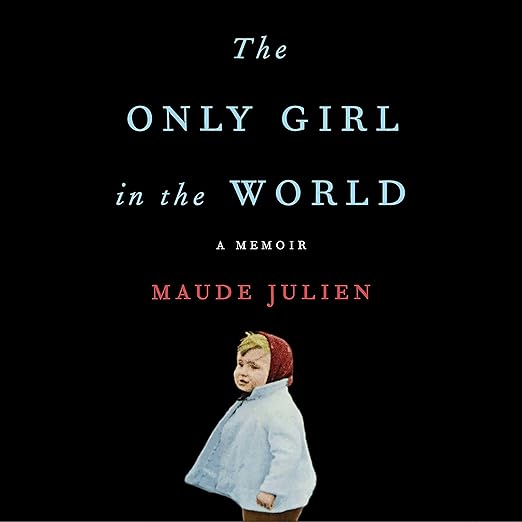
I listened to The Only Girl in the World over two evenings, and the silence between sessions felt meaningful, the kind of pause a book earns when it refuses to give you an easy place to breathe. Maude Julien's memoir, translated from French and narrated by Elisabeth Rodgers, describes a childhood so deliberately constructed around cruelty and isolation that it reads, in places, like a psychological case study. Which is not accidental: Julien became a therapist, and the clinical register of her telling is part of what she is offering.
The facts of her upbringing have drawn comparisons to Room and The Glass Castle, and those comparisons are apt in the sense that all three books describe childhoods defined by radical confinement. But Julien's situation had a distinctive ideological architecture. Her parents were not simply abusive; they were systematic. They believed they had a sacred mission to produce the ultimate survivor, a child who could hold an electric fence for minutes without flinching, who could sit motionless in a rat-infested cellar through the night while bells sewn to her clothing would betray any movement. The methodology was deliberate, the brutality purposeful. That purposefulness makes it, in some ways, harder to metabolize than random violence.
What Maude Julien Delivers
What the synopsis correctly identifies as the book's heart is Julien's inner life. Her parents could control her environment with near-total thoroughness, but they could not colonize the interior space she built through secret reading, through her relationships with the animals on the estate, through a stubborn, quiet compassion that she nurtured precisely because they forbade it as weakness. One reviewer described the book as illuminating "glimmers of hope and life in a childhood that was very dark," noting that what gave Julien sustenance, literature, animals, music, the natural world, are the same things that sustain many people in difficult circumstances. That universality is one of the memoir's quieter achievements.
The narration by Elisabeth Rodgers has divided listeners in interesting ways. Some find her measured tone inappropriate to material of such extremity; they want more affect, more audible horror. Others, including a therapist among the reviewers who works with teenagers from troubled homes, found the flatness purposeful, a register that mirrors Julien's own dissociation as a survival mechanism. I lean toward the second reading. A narrator weeping through this material would have felt like an imposition. Julien earned the right to tell her story in her own emotional temperature.
At seven hours and forty minutes, the audiobook is long enough to let you inhabit Julien's world rather than simply observe it. The pacing is deliberate, which suits the subject: her childhood moved slowly, punctuated by tests rather than events. One reviewer described being unable to put it down despite the darkness, finishing it in what felt like a single sitting. Another, who read it for a book club, predicted it would generate strong discussion, and that seems right. The book raises questions about the limits of parental authority, the mechanisms of cult-like family systems, and the sources of resilience that are genuinely worth arguing about in a group.
Where Maude Julien Loses Some Ground
A skeptical reviewer raised a legitimate question about the precision of Julien's childhood memories, noting that small children rarely retain the level of detail this memoir presents. The reviewer acknowledged the possibility that a co-writer helped reconstruct the narrative from later conversations and adult understanding layered over fragmentary childhood recollection. That caveat is worth holding in mind, not as a reason to dismiss the book, but as a reminder that memoir is always a reconstruction, and one filtered through the author's subsequent therapeutic training and professional lens. The horror described is documented and credible; the specific texture of any given scene is an artful reconstruction.
Who Should Pick Up The Only Girl in the World
Readers drawn to survivor memoirs, particularly those that foreground psychological insight over dramatic catharsis, will find this rewarding. Therapists, social workers, and others who work with trauma survivors have specifically noted its professional usefulness. Listeners who need their difficult reads to resolve triumphantly or who are particularly sensitive to descriptions of child abuse should approach with caution, the graphic content is significant. Those who prefer high emotional expressiveness in narration may also find Rodgers' restraint a barrier.