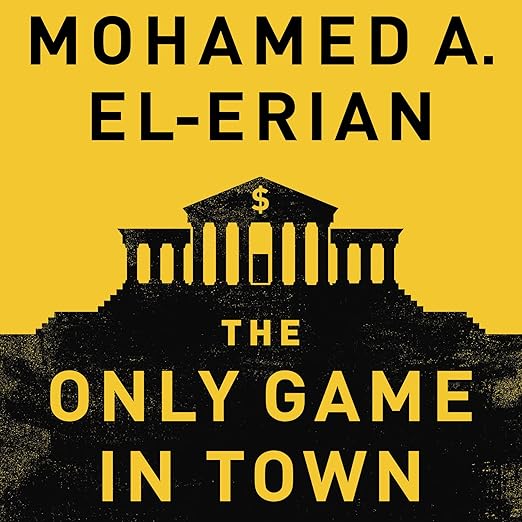
I returned to this one on a commute that went longer than expected, which turned out to be the right circumstance. The Only Game in Town is not a book that rewards distracted listening. Mohamed El-Erian writes with the precision of someone who has spent decades inside the financial machinery he is describing, and Dan Woren's narration reflects that register: measured, clear, and expecting you to follow. If you are prepared to pay attention, this is one of the more substantive economics audiobooks you will find, and the fact that it remains instructive nearly a decade after its 2016 publication is a testament to the quality of its core argument.
El-Erian's central thesis is straightforward, even if the evidence he marshals to support it is not. In the wake of the 2008 global financial crisis, central banks became the primary economic policy actors not because they were best suited to the role, but because everyone else abdicated. Governments failed to enact structural reforms. Fiscal policy was paralyzed by political dysfunction. Central banks had tools, used them aggressively, and in doing so prevented catastrophe. But they also created dependencies and distortions that they lacked the capacity to unwind on their own. The book argues that a policy handoff, from monetary experimentation to coordinated economic strategy, was not merely desirable but essential if the global economy was to avoid cycling back into crisis.
El-Erian introduces what he calls a T-junction: the global economy is approaching a fork where one path leads to reformed growth and durable stability, and the other to disorder. What makes this framework compelling rather than generic is the specificity of his diagnosis. He does not simply gesture at inequality and sluggish growth. He identifies the mechanisms through which central bank unconventional policies, particularly quantitative easing, created asset price inflation that benefited the wealthy while leaving the real economy structurally unchanged. The bifurcation between financial markets performing well and the underlying economy performing poorly is a phenomenon that has only become more legible in the years since publication. Listeners who have followed post-pandemic monetary policy will find his arguments strikingly applicable to conditions he could not have anticipated when writing.
Investors Wanting a Forecast Will Be Disappointed
One reviewer notes with some frustration that El-Erian does not supply a clear forecast for the global economy's future trajectory. This is accurate, and it is a conscious choice rather than an evasion. El-Erian is explicit about why he resists prediction: the outcome at the T-junction depends on political will and institutional cooperation that he cannot model with confidence. He gives readers tools to understand the landscape and identify the signposts that will indicate which path is being taken. This is intellectually honest but can feel unsatisfying. Listeners who come wanting to know what to do with their portfolios next quarter will be disappointed. Those who want to understand how the system works and why it works that way will find this indispensable. The book explicitly targets investors, policymakers, and engaged citizens rather than casual readers seeking reassurance.
Woren Stays Out of the Material's Way
Economic writing at this level presents a specific challenge for audio. El-Erian uses concepts and terms that require context to land properly, and Woren navigates this without oversimplifying or under-investing. His pacing allows for the processing time the material requires. He does not dramatize what is already dramatic by implication. The result is professional and functional, though it rarely becomes the kind of narration that makes you forget you are listening to an audiobook. The material carries the weight here, and Woren's job is essentially to stay out of its way, which he does competently. At over nine hours, the sustained attention required is real, but the argument justifies it.
Free for Audible Members, It Rewards Listening Time
Listeners with existing familiarity with macroeconomics, central banking, or financial markets will get the most from this. Those coming in without that background will find certain chapters demanding, though El-Erian writes more accessibly than many economists. The book was recommended by Time as the one economic book you must read now, a framing that gestures at its breadth of ambition. That ambition is earned. What The Only Game in Town does is locate the reader accurately within the economic forces shaping their lives, which is worth nine hours of close attention. Available as a free audiobook for Audible members, the investment is in listening time rather than cost. El-Erian is also careful to distinguish between the short-term and long-term consequences of central bank policy, a distinction that matters enormously for both individual investors and policymakers. His argument that the tools central banks used to prevent the 2008 catastrophe are not the same tools needed to generate sustained growth is the book's most important insight, and it holds up across the years since publication. Whether you agree with his specific prescriptions or not, the diagnostic work he does here is the necessary foundation for any serious conversation about what comes next. The book's treatment of behavioral economics is also more integrated than you typically find in financial writing of this period. El-Erian draws on research in behavioral science to explain why individuals, institutions, and governments so often fail to make the structurally obvious choices even when the costs of inaction are visible and the alternatives are well-understood. This is not an afterthought or a popular-science garnish. It is a genuine part of his analytical framework, and it gives the prescriptive sections of the book considerably more depth than a purely institutional analysis would allow.
Does El-Erian provide actionable investment advice in this audiobook?
Not in the practical, portfolio-management sense. His purpose is diagnostic and structural. He builds a framework for understanding central bank influence on markets and economies, and invites readers to use that framework to make better-informed decisions. Specific investment prescriptions are largely absent.
Is this available as a free audiobook on Audible?
Yes, The Only Game in Town is currently listed as a free audiobook for Audible members. Check current availability on the Audible listing as membership benefits and title availability can change.