Quick Take
- Narration: N.W. Edwards reads with a professional, instruction-focused delivery appropriate for reference material; clear diction and measured pacing suit the tax subject matter without adding unnecessary warmth.
- Themes: Small business tax literacy, entity structure decisions, IRS compliance and record-keeping
- Mood: Practical and accessible, designed for clarity over depth
- Verdict: A competent orientation guide for small business owners who are genuinely new to tax concepts, though experienced operators will find the coverage more introductory than the title promises.
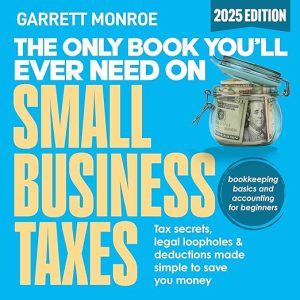
I will confess that the phrase the only book you'll ever need triggers something like professional skepticism in me when I encounter it on a book cover. It almost always means the book is either very good or very confident about being useful to a very specific kind of reader. In the case of Garrett Monroe's guide to small business taxes, the answer turns out to be closer to the latter. This is a solid entry-level resource. Whether it is the only resource you will ever need depends almost entirely on how complicated your business situation actually is.
I came to this one after a friend who had just launched a freelance consulting practice asked me if I knew anything good on the subject. She had no accounting background, no prior business experience, and was facing her first estimated quarterly tax payment with what I would charitably describe as strategic avoidance. Monroe's book, I thought, was worth recommending. It covers the major tax types, explains entity structures from sole proprietorships to S-corps and LLCs, addresses self-employment tax calculation, and provides a basic framework for record-keeping. For a first-time business owner trying to orient themselves before speaking with a CPA, it is genuinely useful.
Genuine Trade-Offs, a Promise the Runtime Can't Keep
Monroe's real achievement here is accessibility. Tax writing for general audiences tends to fall into one of two failure modes: so simplified that it gives dangerous impressions of certainty, or so hedged with caveats that it communicates nothing actionable. Monroe mostly avoids both. The explanations of income tax versus self-employment tax versus estimated quarterly payments are clear without being misleading, and the sections on business structure trade-offs, the tax advantages and disadvantages of LLCs, corporations, sole proprietorships, and partnerships, are useful precisely because Monroe presents them as decisions with genuine consequences rather than marketing the LLC as a magic solution.
The weakest part of the book is the areas where Monroe promises a level of comprehensiveness that the runtime cannot support. At under four hours, this is an orientation guide, not an exhaustive tax manual. One reviewer, who appreciated the general overview, noted they had been hoping for a checklist of what to do, when, and what forms to file and when. That listener is right that the book does not deliver that. What it delivers is the conceptual vocabulary to understand why those things matter, which is a different but still valuable thing.
Edwards Reads It Straight, No Tax Theatrics
N.W. Edwards reads this in a clear, professional style that prioritizes comprehension. For a subject where mishearing a figure or misunderstanding a term can have real consequences, the pacing is appropriately deliberate. There are no audio theatrics, no attempts to make tax law feel exciting. Edwards reads it like the reference material it is, and that suits the content.
The audio format is actually a reasonable choice for this subject for one specific reason: Monroe uses practical examples throughout, and hearing an explanatory example narrated is often more digestible than scanning a page of bullet points. The fictional small business scenarios he constructs to illustrate concepts do translate well to audio. The accompanying bonus materials, including the Small Business Tax Deduction Checklist and IRS Audit Survival Guide, are available as downloads with purchase, which compensates somewhat for the format limitations of audio when dealing with procedural content.
Mindfulness Hacks Aside, the Core Content Earns Attention
The tax landscape changes annually, and Monroe's 2025 edition designation is worth noting. Tax thresholds, contribution limits, and deduction rules shift with each legislative cycle and IRS guidance update. The conceptual framework Monroe provides has longevity; the specific numbers should always be verified against current IRS guidance or a qualified tax professional before you rely on them. This is true of every tax guide, but it is worth stating plainly for a book whose title implies it covers everything you will ever need.
The bonus materials included with purchase, six items ranging from the deduction checklist to what is described as Mindfulness Hacks for Entrepreneurs, vary considerably in direct relevance to the core subject. The core tax content is the reason to listen. The bonus bundle feels like conversion-funnel content added after the fact. None of it undermines the main text, but listeners should calibrate expectations accordingly.
Strong for First-Timers, Thin for Established Owners
This is a strong first listen for someone who has just started a business or is planning to, who has never dealt with estimated taxes or business deductions, and who wants a plain-language foundation before consulting with a professional. The reviews consistently note that Monroe succeeds at making a complex subject approachable, and for that audience that is exactly the right outcome.
Skip it if you already have a working relationship with an accountant and a basic understanding of business tax structures, if you are looking for advanced strategies around S-corp elections or depreciation schedules, or if you need state-specific guidance, which this does not provide. For tax planning beyond the introductory level, Monroe's book works best as a foundation, not a ceiling.