In Brief
- Voice: Charles Constant carries the sole credit across an eleven-hour text that braids a son's commentary into a father's war manuscript.
- Big ideas: Restored archival material, fathers and sons, the long difficulty of coming home from the Pacific.
- Atmosphere: Sober and domestic, with combat recollection surfacing inside family memory.
- Worth it?: A rewarding companion for anyone who already knows the original memoir, and a confusing entry point for anyone who does not.
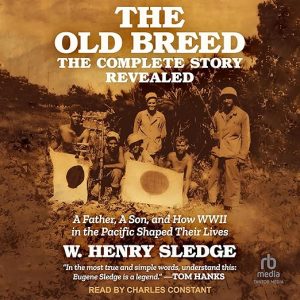
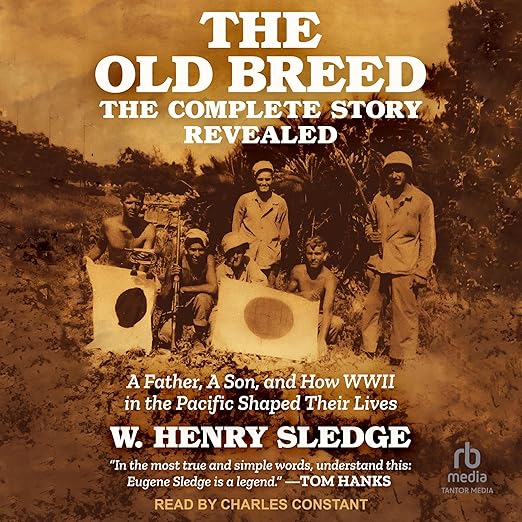
Seventy percent of a manuscript is an enormous amount to lose, and the figure is not mine. It belongs to Mike Barnett, a reviewer on this listing who reports that when "E.B. Sledge first found a publisher for his classic combat memoir" the house told him he would have to "cut out 70% of his 1,000 page manuscript". That claim is the entire commercial logic of this audiobook. W. Henry Sledge is the son, and what he has assembled runs eleven hours and seventeen minutes.
I want to be precise about the product on offer, because the packaging is grander than the contents. This is not a reissue of the father's book with the deleted pages stitched back in. By the publisher's own description it brings out "an abundance of new material from the original manuscript" while the son works "by interspersing his own personal anecdotes throughout", "sharing memories of conversations between father and son". Two texts, forty years apart, braided together and read by one credited voice.
One Credited Voice Signaling the Handoff Between Two Texts
That braiding is the interesting part and also the risky part. A restored passage from a young Marine in the Pacific and a recollection set down by a grown son decades later are not the same kind of writing, and they were never meant to sit side by side. Neal, whose notice arrived eleven days after release, describes the mechanism plainly: "Henry also injects his own words, thoughts and emotions into some of the passages within the book". That is a structural decision, not a stylistic flourish.
In print you would see the shift. A typographer would give the son a different face, or an indent, or a rule across the page. Audio has none of those tools. Charles Constant holds the single narration credit, which means one reader is responsible for signaling every handoff between a combat memoir drafted long ago and commentary written by a man remembering his father. Whether that separation lands is the first thing worth testing in a sample before committing eleven hours.
What the material itself offers is unusually specific. The description promises "an intimate look at a WWII veteran and his struggles to adapt to civilian life following the war", and that domestic aftermath is territory the father's own book could not cover. Neal calls the result "a very insightful and emotional look into what it was like" for a Marine Corps tour "that was otherwise not well known at all before now".
Hearing a Man Describe Combat, Then His Child
Restoration is the first argument, and it is a good one. Publishing history holds plenty of books cut for length and never restored because nobody thought to look, and most of those manuscripts stayed lost because the people who could have retrieved them had no reason to try. This one had a son with access to the papers and forty years to think about what was in them. Mike Barnett's framing is that "the publisher didn't realize what they had in hand, and the impact that it was going to have, especially from a first-time author". Hearing the recovered material is a small correction to a forty-year-old editorial decision.
Hearing both halves is the second argument. Family memoir about a difficult parent is its own genre, and it usually arrives without the parent's own testimony attached. Here both halves exist, which lets you hear a man describe combat and then hear his child describe what living with that man was like. Cindy, whose notice states "I served in the US Navy" and mentions uncles who served in WWII and Korea, calls the result "an emotional read", and the emotion that notice reports comes from the collision between the two voices rather than from either one alone.
A third argument is plain availability. The recording delivers material that would otherwise require tracking down an unpublished manuscript. R. Sample, writing in August 2025, allows that "we DO get more of the Old Breed", and that is an honest statement of what is on offer. More, not everything. The publisher promises "a flowing narrative", which is the right ambition for a book stitched from two sources four decades apart, and no reviewer on this page complains about the joins, even where the subtitle overreaches.
Five Perfect Scores Don't Make a Real Consensus
Start with the title, because R. Sample does. That same August notice objects that the book is "not exactly" what the subtitle claims, calling a genuinely complete account "an impossible task given the amount of material available". I think the objection is correct and worth flagging before purchase. A phrase like The Complete Story Revealed sets an expectation that no book assembled from a partial archive can meet, and buyers who take it literally will feel shorted.
Dependency is the larger caveat. All five readable notices position this title in relation to the father's memoir rather than as a freestanding work, and the shortest of them, signed njwau, recommends it as reading "following the Old Breed by his father". Come to this without the original in your head and a substantial share of the emotional payload will land unearned, since a restored passage only feels restored to someone who knows the shape of the hole it fills.
Then look at the numbers. Five notices, five perfect scores, and a listed average of 4.7 across 249 ratings. Subtract the visible five and the remaining 244 raters have to average somewhere near 4.64 to 4.74, which means the people who took the trouble to write are the most enthusiastic slice of the audience rather than a fair sample of it. Nothing improper about that, but five fives are not a consensus.
A Lifelong Interest in Military and WWII History
Readers who arrive already knowing the father's memoir are the obvious audience, and for them the case is close to automatic. So are people drawn to the quieter half of military history, the part that begins after the transport ships come home. Cindy's review is the useful model: uncles who served, a stint in the Navy, and what that notice calls a lifelong interest in military and WWII history. That listener will get a great deal from the post-war material, which is the half of this story the father never told.
Move more carefully if you want a combat narrative, since the son's commentary repeatedly pulls focus away from the Pacific and back toward the civilian life his father returned to. Move very carefully if you have never encountered the original memoir at all, because this recording assumes you have and never stops assuming it. Anyone hoping for a single self-contained account of the Pacific war should hear the father first and come back to the son afterward.
Frequently Asked Questions
Do I need the original memoir before starting this audiobook?
Practically speaking, yes. All five readable notices frame this title against the father's book rather than as a standalone, and one recommends it as reading that follows the original. The restored passages take their weight from knowing what was cut, so anyone coming in cold will find the emotional payoff muted.
Is this an expanded edition of Eugene Sledge's memoir or a separate book by his son?
A separate book, with W. Henry Sledge on the byline. The publisher's description says he brings in new material from his father's original manuscript and intersperses his own personal anecdotes throughout, so what you get is recovered passages plus a son's commentary rather than a straight restored text.
How does the audiobook handle the switch between the father's writing and the son's?
Charles Constant holds the sole narration credit across eleven hours and seventeen minutes, so one reader carries both registers with none of the typographic cues a printed page would supply. Neal's review notes that Henry injects his own words into some of the passages. Sample a chapter and see whether the seams read clearly for you.