Quick Take
- Narration: Saethon Williams reads with a respect for the material that suits Doug Scott’s understated personal style, though the historical sections can feel dense in audio format.
- Themes: Human endurance at extreme altitude, collaborative survival, the legacy of a notoriously unclimbed peak
- Mood: Methodical and quietly dramatic, with a survival account that earns its tension through understatement
- Verdict: An essential document for mountaineering readers, with a survival narrative that stands apart even when the historical first half requires patience.
I came to The Ogre having already listened to a run of high-altitude climbing accounts, most of them structured around a single dramatic event. The books I respond to most in that genre tend to be the ones where the writer does not reach for drama because the situation has more than enough of it already. Doug Scott, one of the most significant figures in British mountaineering history, is exactly that kind of writer. He climbs the same way he writes: with attention to the terrain and minimal interest in performing for an audience.
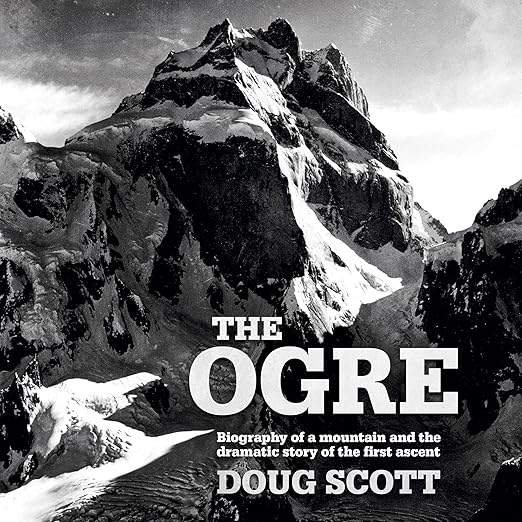
The Ogre, Baintha Brakk, sits in the Karakoram range at over 7,000 meters and has one of the most formidable records in the history of extreme mountaineering. When Scott and Chris Bonington made the first ascent in 1977, the mountain waited almost a quarter of a century for a second ascent, and another eleven years after that for a third. The rarity of those numbers tells you something about what the mountain actually demands. What Scott’s book documents is not just the climb but the descent, which became one of the most harrowing survival stories in the history of the sport.
The Two-Part Structure and Its Demands
The book is organized in two halves, and this structure is the main source of divided response among listeners. The first half is a detailed historical and geographical account of the Ogre, covering the mountain’s exploration, the various attempts before the 1977 expedition, and the geology and culture of the surrounding Karakoram. Scott has done meticulous archival research here, drawing on diaries, letters, and materials that had not previously been published. The work is serious and in places genuinely illuminating about how the mountaineering world in the 1970s understood the challenges of the Karakoram.
Some listeners find this first half rich context. Others find it dense and difficult to track in audio format. One reviewer candidly said the first forty-five percent of the book bounces too quickly between new names and chronologies to follow comfortably, and that is a real limitation of the audio medium for this kind of material. Maps, diagrams, and a clear timeline help enormously in print. Without them, the pre-climb history can feel like names arriving without anchoring.
What is not in question is the second half. Scott’s account of the first ascent with Bonington, the catastrophic minutes after the summit when he broke both legs during a rappelling accident, and the week-long descent that followed is one of the most quietly extraordinary survival narratives in mountaineering literature. Scott crawled for days through extreme altitude on two broken legs. Bonington was dealing with broken ribs. The support climbers, Clive Rowland and Mo Anthoine, played heroic and mostly uncelebrated roles in keeping the pair alive, and Scott uses newly discovered diaries and recordings to finally give those roles their due.
Understatement as a Style
What separates Scott’s telling from the kind of crisis narrative that tends toward self-dramatization is his absolute refusal to inflate his own suffering or heroism. He is describing events that would justify considerable drama, and he writes about them the way a skilled mountaineer moves through technical terrain: with precision and economy, trusting the facts to do their own work. One reviewer described this quality as understated to fit the man’s personality but noted that the impact of the epic comes through regardless. That is the right reading. The restraint is not modesty for its own sake. It is honesty about what the experience was like.
This quality is somewhat harder to convey in audio than in print, where you can stop and sit with a sentence. Saethon Williams’s narration respects the tone. He does not reach for drama in the emotional moments, which is correct for this material. Some listeners may find his approach slightly flat in the historical sections, where more variation in pace would help distinguish the archival passages from the personal account. But he is right to let the survival narrative breathe at its own pace.
Listening to a Book Designed for Print
This is one of those audiobooks where the print version offers something the audio cannot fully replicate. The book is described by multiple reviewers as a high-quality physical production with photographs by Scott himself, maps, and clear diagrams. None of that is available to the audio listener. If you are deeply committed to the geographical and historical context of Karakoram mountaineering, the print version may serve you better. If you are primarily drawn to the survival narrative of the descent, the audiobook delivers what you need.
At four hours and thirty-nine minutes, the runtime is compact given how much material the book covers. Both halves feel somewhat compressed, which is part of why the historical section can overwhelm. A longer audiobook with more time to absorb the geography and cast of characters before the ascent begins might have served the structure better.
Who Should Listen and Who Should Skip
The Ogre is essential listening for anyone with serious interest in high-altitude mountaineering history and particularly the Karakoram. Scott’s survival story is something every climber eventually encounters in the literature, and having it in his own voice, even mediated through narration, gives it an authority that secondhand accounts cannot match. Readers who appreciate narrative understatement and the specific ethics of the climbing world will find a great deal here.
Those hoping for a narrative that moves quickly through the historical material to reach the climb and descent will need patience. The first half is dense and rewards listeners who approach it as context rather than preamble. If dramatic crisis narrative is what you want, there are more immediately propulsive options in the mountaineering genre. This book earns its place through precision rather than pace.
Frequently Asked Questions
Do I need prior knowledge of Karakoram mountaineering to follow The Ogre?
Prior knowledge is not required but will significantly enhance the first half of the book. Scott assumes some familiarity with the geography of the Karakoram and the history of expedition mountaineering in that region. Listeners who come in cold may find the historical sections harder to anchor. A brief read-up on the Ogre’s location and the 1970s expedition era is worth doing before you start.
What happened during the descent that makes this survival story so celebrated in mountaineering circles?
During the descent from the first ascent in 1977, Scott broke both legs in a rappelling accident. Bonington subsequently broke ribs. The two climbers and their remaining support team had to navigate extreme altitude, technical terrain, and a deteriorating weather situation over the course of a week. When they finally reached base camp, they found it abandoned. Scott’s account of this period is the emotional and historical core of the book.
How does the audio edition handle the photographs and maps that reviewers praise in the print version?
It does not. The audiobook cannot replicate the visual materials that are a significant part of the print experience. Listeners who find geographic and visual context important for following a mountaineering narrative may want to have the print edition available alongside the audio, particularly for the historical first half where maps and photographs add considerable orientation.
What roles did Clive Rowland and Mo Anthoine play in the descent, and does Scott give them adequate recognition?
Rowland and Anthoine were the support climbers who remained with Scott and Bonington during the descent and played heroic roles in keeping the injured pair alive. Scott uses newly discovered diaries and audio recordings to document their contributions, which he considers a central purpose of the book. Multiple reviewers praise his treatment of these previously under-recognized figures.