Quick Take
- Narration: Vinnie Angelo brings an energetic, forward-moving delivery suited to the motivational framing of a military career guide, though the technical math and science sections require focused listening.
- Themes: Military career preparation, ASVAB subject mastery, branch-specific occupational pathways
- Mood: Driven and aspirational, with a thorough subject-by-subject structure underneath the motivational exterior
- Verdict: A well-differentiated ASVAB guide that goes further than most by mapping subject scores to specific military career paths across all six branches, making it more useful than a generic test prep resource.
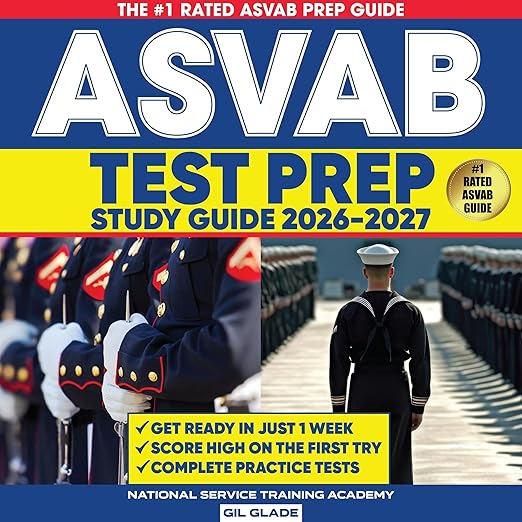
I was halfway through my morning commute when a reviewer’s comment in this guide’s listing stopped me: it does not treat the ASVAB as a generic test. That is a real differentiator. Most ASVAB prep materials are organized by subject, which is fine for covering content but useless when a prospective Navy applicant needs to know which line scores matter for specific ratings, or when a future Air Force enlistee wants to understand what ASVAB performance actually determines about job assignment. This guide, from author Gil Glade, takes the branch-specific dimension seriously.
The 4.8 rating across 335 reviews is one of the stronger signals in this batch of study guides, and the reviews themselves are specific in ways that track with what the synopsis promises.
The Branch-by-Branch Career Mapping
Reviewer Gracie McGaver made the point directly: the guide “clearly explains what to focus on depending on which branch of the military you’re aiming to join.” This is the structural choice that elevates this guide above the average ASVAB prep book. Understanding that Army clerical roles and Navy technical ratings require different AFQT emphases, or that Space Force has its own qualification thresholds distinct from Air Force, turns abstract subject mastery into applied strategy. The line score calculation content addresses something that many first-time ASVAB takers do not even know to ask about: AFQT is not the only score that matters, and this guide explains why.
Vinnie Angelo’s narration carries the career pathway sections with an energy that suits the framing. These are not dry regulatory charts being read aloud. The guide treats military career selection as a decision worth making deliberately, and Angelo’s delivery reflects that.
Subject Coverage and What Six Hours Can Realistically Do
At six hours and sixteen minutes, this is a focused listen rather than an exhaustive one. The guide covers mathematics and arithmetic, science fundamentals, vocabulary, mechanical knowledge, and logical reasoning. The reviewer JamesH noted it serves as “a complete and highly structured roadmap combining clear instruction with motivational focus.” That framing is accurate: this is not a 20-hour comprehensive drill but a structured orientation that prioritizes understanding over volume.
For audio, the mathematics sections are the ones that require the most active engagement. Arithmetic reasoning and mathematics knowledge are two distinct ASVAB subtests, and the audio format works better for explaining the reasoning behind a problem type than for drilling calculation fluency. Listeners who are weak in math should treat this guide as conceptual grounding and pair it with written practice problems. The vocabulary and word knowledge sections, by contrast, are genuinely well-suited to audio, as Angelo can model pronunciation and usage in ways a static page cannot.
The Disclaimer Worth Noting
The synopsis includes an important honesty note: the guide explicitly disclaims any guarantee of a 99 score or first-attempt success, despite the marketing language in the opening section that makes those claims. This tension between the headline copy and the fine-print disclaimer is common in exam prep publishing, and I appreciate that the guide flags it transparently rather than burying it. The actual claims that reviewers validate, the subject coverage, the branch-specific guidance, the test-taking strategy, are all realistic and the content lives up to them.
Reviewer Zameer highlighted the bonus video content as a practical differentiator, noting the guide felt “more practical than other guides” they had used. The multi-format approach, combining audio with bonus material, mirrors what the best exam prep systems do: they do not pretend that any single format is sufficient.
Who Should Listen / Who Should Skip
Listen if: You are preparing for the ASVAB and want to understand not just the test content but how your scores map to specific military job opportunities across different branches. The branch-specific career path coverage is genuinely rare in this category and alone justifies the listen.
Skip if: You need intensive math drilling or mechanical knowledge practice from worked examples. Audio can introduce these subject areas, but fluency in the quantitative sections requires pencil-and-paper practice that this format cannot provide.
Frequently Asked Questions
Does this guide explain AFQT versus line scores, and how they affect job eligibility in different branches?
Yes, the branch-specific career mapping is one of the guide’s key differentiators. It covers line score calculations, qualification thresholds per branch, and how specific ASVAB subtest performance translates to occupational specialty eligibility across Army, Navy, Air Force, Marines, Coast Guard, and Space Force.
How does Vinnie Angelo’s narration handle the technical mechanical and science content?
Angelo’s delivery is described as energetic and structured, which works well for the motivational and strategic sections. For the more technical science and mechanical knowledge content, the narration is clear, though listeners who are not already comfortable with these subjects may want to supplement with written materials.
Is this guide appropriate for someone with no prior military knowledge who is just starting to think about enlistment?
Yes, the guide is explicitly designed for first-time ASVAB takers and does not assume existing military knowledge. The branch overview and career path sections are built as orientation material, not as a reference for people already familiar with military structure.
The synopsis claims an average score improvement of 25+ percentile points. Is that a realistic expectation?
The guide itself includes a disclaimer noting it cannot guarantee specific scores. Score improvement depends heavily on individual starting point, study time invested, and supplemental practice. The 25-point improvement figure is a marketing claim, not a guarantee, though the structured coverage does provide a solid content foundation.