- Narration: Ryan Holiday narrates his own material with the conviction of someone arguing a position he actually holds, which suits the book's persuasive, anecdote-driven structure.
- Themes: Stoic philosophy applied to modern setbacks, historical case studies of resilience, perception versus action
- Mood: Brisk, motivational, confidently practical
- Verdict: A fast, accessible entry point into applied Stoicism for listeners who want a push through a current setback rather than a philosophy seminar.
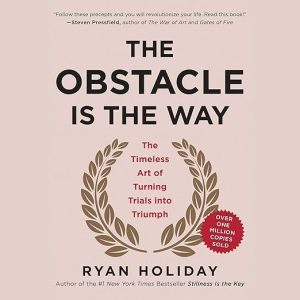
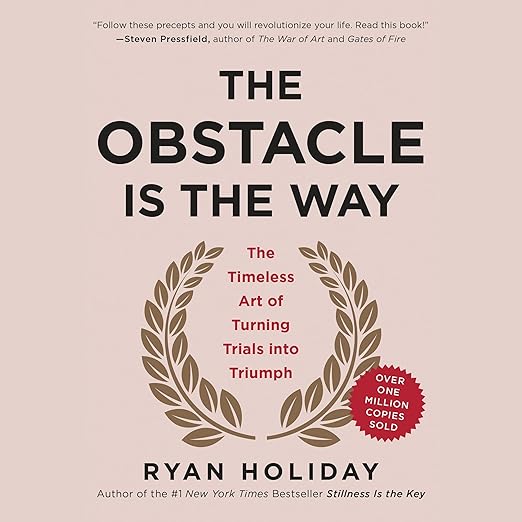
Nearly two thousand years before Ryan Holiday turned it into a self-help bestseller, Marcus Aurelius wrote, "The impediment to action advances action. What stands in the way becomes the way," and that single line is the entire architecture this audiobook builds on. Holiday narrates his own book, tracing that Stoic idea through a long run of historical case studies, John D. Rockefeller, Amelia Earhart, Ulysses S. Grant, Steve Jobs, each treated as evidence that turning obstacles into fuel is a repeatable skill rather than a rare personality trait.
The book's core move is translating ancient Stoic philosophy, control what you can control, let go of what you can't, into modern, story-driven chapters that read more like a highlight reel of grit under pressure than a philosophy course. That accessibility is clearly part of the book's appeal and part of why it became a #1 Wall Street Journal bestseller with fans ranging from Arnold Schwarzenegger to LL Cool J to entire NFL and NBA locker rooms, according to the publisher description; Holiday is translating a two-thousand-year-old framework for readers who want practical application, not a seminar in ancient philosophy.
That cross-audience appeal, professional athletes, entertainers, and general readers all citing the same slim volume, says something about how deliberately Holiday stripped Stoicism down to its most transferable core idea. Whether that simplification counts as a strength or a limitation probably depends on how much philosophical rigor a given listener wants; readers looking for a rigorous treatment of Stoic philosophy proper may find Holiday's version more motivational than scholarly, while readers who came for the motivation will likely find exactly what the reputation promises.
Structurally, Holiday organizes the book around three classical Stoic disciplines, perception, action, and will, treating them as a sequence: first controlling how you interpret an obstacle, then how you act on that interpretation, and finally how you sustain the effort once the initial motivation fades. That three-part scaffolding gives even casual listeners an easy mental model to hold onto after the book ends, which likely explains why reviewers describe returning to it repeatedly rather than treating it as a single read-through experience.
Ryan Holiday Narrates His Own Conviction
Holiday narrating his own material matters here in a way it wouldn't for every business or self-help book, since so much of the persuasive force depends on conviction landing as genuine rather than performed. A hired narrator reading Holiday's Rockefeller and Earhart anecdotes could easily default to generic motivational-audiobook cadence; Holiday reading his own arguments, and his own reporting on people he clearly has real intellectual investment in, keeps the delivery closer to argument than performance.
Reviewer Julian Kennedy calls the book "pithy and genuinely impressive," specifically recommending it as something "worth revisiting every six months or so just to reset your mindset," which points to a real structural strength: short, self-contained chapters built around a single example each, making the book easy to dip back into rather than requiring a full linear re-listen. That same reviewer credits Holiday's method of taking "a simple subject" and finding "a relatable example" as the throughline of his style, and that pattern holds consistently enough across the book that a listener can identify the formula by the third or fourth chapter.
Holiday's own background outside this book, he built a career in marketing and media before becoming a full-time author, gives the narration an additional layer of authenticity when he discusses business figures navigating setbacks; he's writing from inside that world rather than observing it as an outside academic. That insider vantage point comes through in how confidently he moves between ancient philosophy and modern boardroom or locker-room examples without either register feeling like a stretch.
This book helped lay the groundwork for Holiday's later Daily Stoic project, the newsletter, podcast, and devotional-style books that eventually grew out of his ongoing Stoic writing, and listeners who know him primarily through that later, more institutionalized brand may be surprised by how much more single-mindedly focused this earlier, foundational book reads by comparison.
Stoicism's Reputation Problem, Compared to Puritan
One reviewer, Peter Butler Jr., frames The Obstacle Is the Way as the opening entry in what became a three-book examination of Stoic philosophy, and also argues that the word Stoicism carries an unfairly corrupted modern reputation, comparable to how the word Puritan has drifted from its original meaning. That's a useful corrective to keep in mind going in: Holiday's version of Stoicism is deliberately accessible and modernized, and listeners who arrive with preconceptions about ancient philosophy being dense or joyless may be surprised by how conversational the actual content is.
At four hours and thirty-eight minutes, the book moves briskly through its historical examples, which is part of its appeal but also means individual case studies get relatively compressed treatment rather than deep biographical dives; listeners wanting a fuller portrait of any single figure, Grant's Civil War command decisions or Earhart's actual flying career, will need a dedicated biography rather than expecting this book to deliver one. The case-study structure, while effective, does repeat its basic rhythm, obstacle, historical figure, lesson, enough times across the book that listeners sensitive to formula may notice the pattern by the halfway point.
The broader genre this book helped popularize, ancient philosophy repackaged for modern professional audiences, has since become genuinely crowded, with a wave of similar Stoicism-adjacent business and self-help titles following in its wake. Listeners who have already worked through several books in that now-familiar lane may find some of Holiday's specific moves, the historical case study, the pithy restatement of the lesson, less novel today than they read when the book first built its reputation.
The historical figures Holiday draws on, Rockefeller, Earhart, Grant, Jobs, are also almost entirely drawn from Western, and mostly American, business and public life, which is a narrower lens than the book's universal-sounding philosophical claims might suggest; listeners hoping for a more globally varied set of case studies won't find that range here.
Best for Someone Facing a Setback Right Now
Self-help skeptics should know upfront that despite its philosophical framing, this is still fundamentally a motivational business book in structure, built on anecdote and repeated principle rather than sustained argument; listeners allergic to that genre's conventions won't find Holiday's Stoic packaging enough to change their mind about the format itself.
Athletes and coaches primed toward mental-toughness frameworks will recognize the appeal that reportedly won over locker rooms from the Patriots to the Seahawks, and the short, example-driven chapters suit pre-game or pre-practice listening in a way a denser philosophy text wouldn't. Anyone navigating a genuine setback right now, a layoff, a failed venture, a stalled project, is probably the ideal listener for this specific book at this specific moment, since its entire design is built around reframing an active obstacle rather than offering general life philosophy for its own sake.
Does Ryan Holiday narrate this audiobook himself?
Yes, Holiday reads his own material, which suits a book built around personal conviction and historical case studies he's clearly invested in.
Is this audiobook a rigorous introduction to Stoic philosophy or something more motivational?
It leans motivational and modernized rather than academic, translating a two-thousand-year-old framework into brisk, story-driven chapters aimed at practical application over philosophical depth.
How long is The Obstacle Is the Way audiobook?
It runs about four hours and thirty-eight minutes, short enough for a single sitting or a few commutes, with short chapters that make it easy to revisit specific sections later.