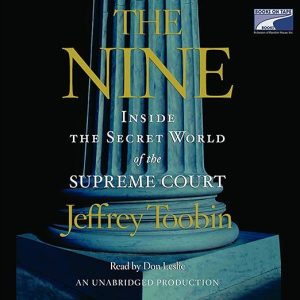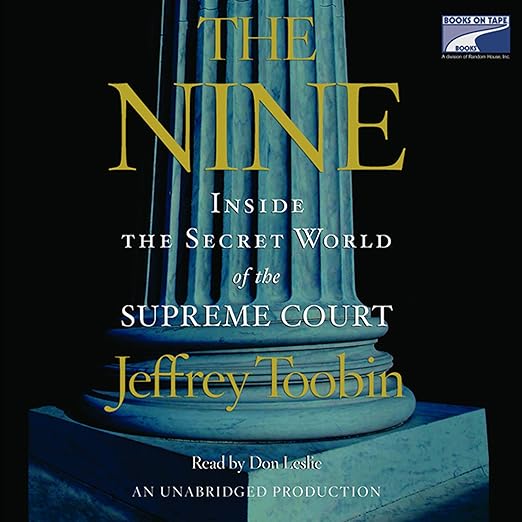
A small, oddly shaped plot of land wedged between two other buildings is how one reviewer describes the physical home of the Supreme Court before this audiobook even gets to the justices themselves, and that image sets the tone for what Jeffrey Toobin is actually doing here: making an institution most people only encounter through headlines feel physically and personally real. Published ahead of the 2008 election, The Nine goes inside the chambers to explain how nine people, appointed for life, ended up deciding the direction of "abortion, civil rights, presidential power, and church-state relations" for the rest of the country.
The synopsis calls it flatly "the book Toobin was born to write", a bold claim for any nonfiction title to make about itself, but the pairing of his legal-journalism background with a Court that had just tipped into a conservative majority gives the claim real backing rather than leaving it as jacket-copy bravado.
Stripping Away the Court's Marble Formality
Toobin's access is the book's real engine: "exclusive interviews with the justices themselves" produce a level of behind-the-scenes detail rarely available on a sitting Court, from Anthony Kennedy's outsized sense of his own importance to Clarence Thomas's "well-tended grievances against his critics" to David Souter's genuinely odd, almost nineteenth-century personal habits. The full story of Bush v. Gore gets real space here, including Sandra Day O'Connor's break with the president she'd effectively helped install, which reviewer Pete describes as a history to be read "with a grain of skepticism" given Toobin's own clear point of view.
That skepticism doesn't undercut the book's usefulness so much as define how to listen to it. Carrie Bradshaw's review credits Toobin with making the justices "seem human, quirks and follies included", without losing sight of the actual legal stakes underneath the personality profiles. Pete's review also credits Toobin with a genuine gift for writing history that an average reader can follow, tracing the Burger, Rehnquist, and Roberts courts as one continuous story of ideological drift rather than three disconnected eras.
That same reviewer notes the original architect built in dozens of stone steps rising toward the entrance, flanked by tall marble columns meant to impress upon visitors the Court's institutional weight before they ever set foot inside. Toobin's book performs a similar function in reverse, stripping away that intimidating formality to show nine specific people making decisions under very human pressures, ambition, grudges, personal loyalty, rather than the faceless institutional authority the building itself is designed to project.
One Sustained Voice Beats Jumping Around Print
The book's structure rewards audio specifically because Toobin builds arguments cumulatively, tracing how a single seat change on the bench ripples through a decade of rulings, and hearing that argument unfold in one sustained voice makes the throughline easier to hold onto than jumping around a print edition chapter by chapter. Don Leslie's reading brings a measured, newsroom-steady authority to material that could easily tip into either dry legal summary or tabloid gossip, and he lands closer to the serious-journalism register this book is actually going for.
The personality profiles are where the audiobook earns its keep. Reading about Souter's famously spartan lifestyle or Kennedy's self-regard on the page is interesting; hearing it delivered with the same measured tone used for the constitutional analysis two paragraphs later makes the human material land as reporting rather than gossip; Toobin's CNN and New Yorker background is doing real work here, and Don Leslie's delivery matches that journalistic register throughout.
Toobin's own resume, decades in legal journalism paired with a national broadcast platform, isn't just biographical filler; it explains how he secured direct interviews with sitting justices in the first place, access that would be extraordinarily difficult for a less connected journalist to obtain, and Don Leslie's steady delivery treats that access with the seriousness it deserves rather than sensationalizing it.
The synopsis stakes out a strong claim about Toobin's authority on this subject specifically, stating plainly that "no one is more superbly qualified to profile the nine justices", a description that leans on his dual identity as both a practicing legal analyst and a working journalist rather than pure academic credentials. That combination shows up in how the book balances two things a Supreme Court history needs simultaneously, legal precision accurate enough that a law professor wouldn't wince, and narrative pacing propulsive enough that a listener with zero constitutional-law background stays engaged through complex doctrinal shifts. Don Leslie's narration threads that same needle, never simplifying the legal stakes for the sake of pace, but also never letting a dense procedural passage slow the book's forward momentum for more than a paragraph or two before returning to the personalities driving the actual decisions.
A Snapshot From Just Before 2008
The book arrived in stores just before the 2008 election, and it shows; the Court's composition has changed substantially since then, and any listener expecting current analysis of the sitting bench needs to recalibrate expectations before starting. This is a history of the Rehnquist Court's final years and the Roberts Court's opening chapters, not a guide to the Court as it exists now, and the framing works best when you treat it as a specific historical snapshot rather than a running commentary.
Toobin's own political lean is visible enough that Pete's "grain of skepticism" caveat is worth taking seriously going in; this isn't a neutral civics primer, but a reported argument with a point of view, and readers looking for strict ideological balance across all nine justices should know that going in rather than discovering it partway through.
Readers drawn specifically to Clarence Thomas or David Souter as individual subjects should know the book distributes its attention across all nine justices rather than centering on any single figure; Thomas's grievances and Souter's unusual personal habits get real color, but neither gets a dedicated deep-dive chapter separate from the book's broader institutional narrative.
Getting This Close to the Justices as People
Court watchers who currently only know the justices from headline moments and confirmation hearings will get the fuller picture this book is built to provide, and the reporting depth makes it genuinely useful for anyone trying to understand how the current ideological alignment of the Court took shape over decades rather than overnight. Readers who enjoy character-driven nonfiction generally, not just legal-specific audiences, will find the personality material accessible even without a law degree.
A book built around 2008-era stakes carries an expiration date that later Court histories don't share, so anyone wanting an up-to-the-minute account of the current bench should pair this with more recent reporting rather than treating it as the final word. Within that historical window, though, few audiobooks get this close to the justices as people rather than robed abstractions.
The Short Version
- Performance: Don Leslie brings a measured, newsroom-steady authority well suited to the book's mix of legal analysis and personality reporting.
- What it covers: Supreme Court power struggles, ideological realignment, behind-the-scenes access to the justices
- Feel: Analytical, occasionally dishy, high-stakes
- Our call: Essential for anyone who wants the Court's personalities explained clearly, though its 2008 framing means it reads as history now, not current events.
Good to Know
Is The Nine audiobook still relevant given it covers the Court as of the 2008 election?
It works best as a history of the Rehnquist and early Roberts Courts rather than a guide to the current bench; the reporting on how justices shape rulings over time still holds up, but the specific composition it describes has since changed.
Does the audiobook go into detail on Bush v. Gore?
Yes, the synopsis and reviews confirm a full behind-the-scenes account of the case, including Sandra Day O'Connor's break with George W. Bush after the ruling that helped decide his presidency.
Do I need a legal background to follow The Nine audiobook?
No. Reviewer Carrie Bradshaw specifically praises Toobin for making the justices feel human rather than legally abstract, and the personality-driven approach keeps the material accessible without a law degree.