Quick Take
- Narration: Roger Clark brings authoritative clarity to Declan Walsh’s dense political and cultural reporting, his measured pacing suits the weight of the material without slowing it into academic territory.
- Themes: State failure and resilience, the gap between official Pakistan and lived Pakistan, journalism under surveillance
- Mood: Intimate, politically urgent, and quietly devastating
- Verdict: One of the most accomplished works of narrative journalism about South Asia in recent years, essential for anyone serious about understanding Pakistan beyond the headlines.
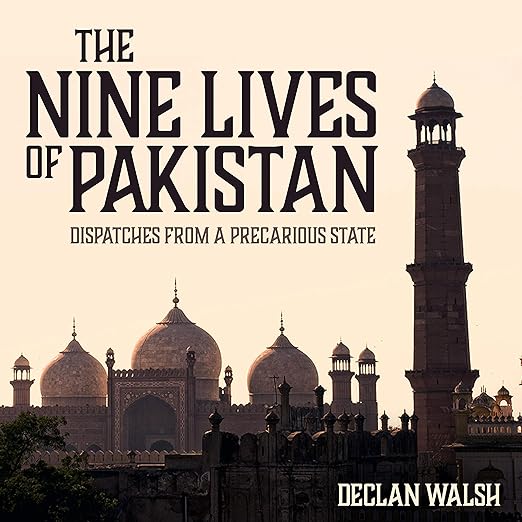
I was halfway through my morning commute when Roger Clark read the passage where Declan Walsh realizes an intelligence agent has been tracking him throughout his time in Pakistan, and I had to sit with that for a moment before continuing. The Nine Lives of Pakistan is the kind of journalism book that uses the personal narrative frame not as a device for self-promotion but as an honest account of what it costs to report from a country that does not want to be fully understood by outsiders. Walsh spent a decade covering Pakistan for the New York Times before being abruptly deported, and this book was written in the aftermath of that expulsion.
The structure is built around nine individuals Walsh encountered during his time in the country: a chieftain readying for war at his desert fort, a retired spy working through the borderlands, a crusading lawyer risking death for her beliefs, among others. The nine-lives framework is not a gimmick. Each chapter functions as a standalone portrait while contributing to a cumulative picture of a country that defies the single narrative frame most international coverage attempts to apply. By the time you finish, you have something considerably more complex than a geopolitical briefing from a standard media outlet.
The Nine Subjects Themselves and What They Reveal About Pakistan
Walsh’s choice of subjects across his decade of Pakistan coverage is instructive about his method. He is not primarily interested in official Pakistan, the government communiques and press conferences and formal statements. He is interested in Pakistan at its edges: the borderlands, the courts, the desert forts, the provinces that receive international attention only during crises. His nine subjects are people whose lives are shaped by Pakistan’s fault lines in ways that explain those fault lines more clearly than any policy analysis could.
A reviewer who describes Walsh as putting himself up there with the best modern geopolitical writers, alongside Robert Kaplan and Martin Meredith, is identifying the specific quality that distinguishes this book from good reporting: it is literature as much as journalism. Walsh writes his subjects with novelistic attention to gesture, context, and internal contradiction. The crusading lawyer is not a symbol of legal idealism; she is a specific person with specific vulnerabilities and specific courage. The retired spy is not a representative of the security state; he is a man whose life choices created their own consequences. That specificity is the book’s primary achievement and what separates it from journalism that documents without understanding.
Walsh’s Deportation and the Book’s Devastating Final Chapter
The ending of The Nine Lives of Pakistan is remarkable in a way that Walsh himself could not have planned when he began reporting the book. His abrupt deportation by Pakistani intelligence services was not simply the end of his posting; it became the final chapter of the book itself, the moment when the subject of his reporting reached into his personal life and removed him from it. The intelligence agent who had been tracking him throughout his time in Pakistan eventually met with Walsh, and their conversation forms the book’s conclusion.
Walsh describes this encounter in his synopsis as astonishing, and reviewers who have reached it consistently use similar language. One describes the book as making you feel like you have ridden in the truck and had tea at the table with Pakistanis from every stratum of society, then describes the reality that each is more like the other than they would want to admit. That observation is precisely what the finale crystallizes: the security agent and the journalist and the chieftain and the lawyer are all, in different ways, products of the same pressurized national environment, and that shared formation is more revealing than any of their surface differences.
Roger Clark’s Narration and How to Come to This Book
Roger Clark handles Walsh’s dense reporting with the authority the material requires. This is not light travel writing. The historical context is substantive, the political analysis is detailed, and the characters’ lives carry weight that requires a narrator willing to let silence and gravity do their work. Clark does not rush the material or smooth its edges. His pacing through the more demanding passages of Pakistani political history gives listeners time to absorb context rather than feeling like they are racing to keep up.
A reviewer who describes this as a grim portrait of a dysfunctional country and asks whether it is really this bad is capturing the honest discomfort the book produces. Walsh is not pessimistic for effect. His reporting across a decade gives him the accumulated evidence to describe Pakistan’s challenges with specificity rather than generalization, and the cumulative picture is both grimmer and more humanly hopeful than any single news story could convey.
The Nine Lives of Pakistan is not casual listening. It is demanding, rich, and fully worth the eleven hours it requires. For listeners who have read and valued other narrative journalists working in this tradition, Walsh stands clearly in the first rank of them. His writing about the crusading lawyer who risks death for her beliefs, the chieftain in his desert fort, and the spy in the borderlands stays with you in the specific way that real people encountered through excellent writing tend to stay: as presences rather than as information. Roger Clark’s performance delivers them at exactly the right level of seriousness, and the combination of excellent source material and excellent narration makes this one of the stronger audiobook experiences available in the travel and narrative journalism space.
Who Should Listen and What to Know Before Starting
Readers with an existing interest in South Asian history and politics will get the most from The Nine Lives of Pakistan. Walsh assumes a basic awareness of the geopolitical context, though he provides enough background through his stories that genuinely engaged newcomers can follow the larger picture that emerges. The nine-chapter structure, each built around a single life, means you can find your footing in the first chapter before the deeper historical complexity accumulates.
Listeners who approach Pakistan primarily through news coverage of its relationship with the United States, Afghanistan, or India will find Walsh’s portrait significantly more complex and more sympathetic than that frame allows. He is interested in what Pakistan is from the inside rather than in what it represents from the outside, and that difference of perspective is the most valuable thing the book offers to Western readers who have heard of the country but never understood it.
Frequently Asked Questions
Do I need significant background knowledge about Pakistan and South Asian history to follow this book?
Some basic awareness of Pakistan’s history and geopolitical situation helps, but Walsh provides enough context through his stories that engaged readers without deep background can follow the narrative. The nine-lives structure means each chapter introduces its subject’s context before building on it.
The synopsis mentions Walsh’s deportation. Does the book explain why he was expelled from Pakistan?
The book addresses the deportation in its concluding chapters and includes Walsh’s encounter with the intelligence agent who had been tracking him. The explanation offered is not fully explicit, which is itself revealing about how Pakistan’s security state operates. It serves as the book’s emotional and journalistic climax.
Is this primarily a travel memoir, a political analysis, or journalism?
It operates across all three modes but is fundamentally literary journalism in the tradition of writers like Robert Kaplan. Readers interested in Pakistan specifically, in international reporting, or in narrative nonfiction as a form will find the most value. Pure travel memoir readers may find it more politically dense than they prefer.
How does Roger Clark’s narration handle the cultural and geographic diversity of Pakistan that Walsh covers across the book?
Clark maintains a consistent register of serious engagement across the varied geographic and cultural contexts. He does not attempt accent differentiation for the many Pakistani subjects Walsh encounters, which is the right choice for material that requires the listener to absorb complex content without distraction.