
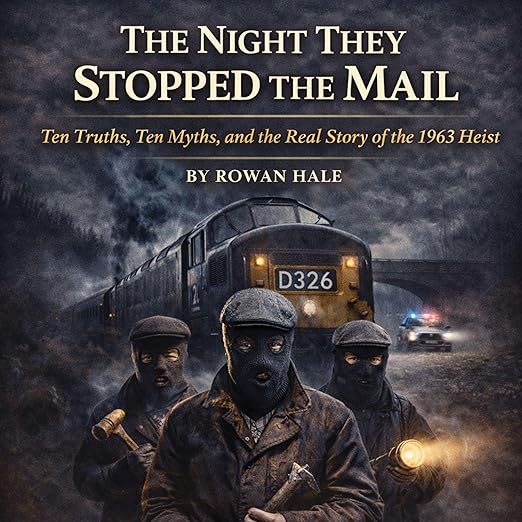
Can the robbery of a mail train become a mirror for how societies construct myths around crime? The Night They Stopped the Mail opens with that implicit question and spends its two hours and twenty-one minutes working steadily toward an answer that is more uncomfortable than the popular legend of the 1963 Great Train Robbery tends to admit. This audiobook handles one of Britain's most mythologized crimes with the kind of analytical patience that separates serious narrative nonfiction from the genre's more sensationalized corners, and Michelle Peitz's narration delivers Rowan Hale's prose with a clarity and intelligence that serve the argument throughout.
Charming Rogues Only in Popular Retelling
In the early hours of August 8, 1963, a Royal Mail train carrying high-value packages was brought to a halt by a false signal on a Buckinghamshire line. Masked men boarded the train, unloaded an astonishing haul, and disappeared into the night in under half an hour. The sum stolen was staggering even by contemporary standards, and the audacity of the plan, its near-cinematic execution in the quiet countryside, created the conditions for a mythology that has never entirely faded from British cultural memory. Hale is not interested in celebrating that mythology. The book is a careful examination of how the Great Train Robbery became what it became in the public imagination and what the romantic version of events consistently leaves out.
What gets left out, primarily, is the violence. The gang were not, Hale argues, the charming rogues of popular retelling. The train driver, Jack Mills, was coshed on the head and suffered injuries that affected the remainder of his working life. Members of the crew experienced the robbery as an act of overwhelming force, not a clever trick performed by men who took pride in avoiding harm. Hale keeps the human consequences visible throughout, returning to Mills and the crew as the book traces the robbery's aftermath through the investigation, the arrests, and the formation of the legend. The contrast between the public story and the private experience of the people who were actually on that train is where the book's real argument lives, and Hale pursues it without flinching.
When the Post Office Was the Country's Bloodstream
Michelle Peitz narrates with a measured, intelligent delivery that suits Hale's analytical prose well. This is a book about interpretation as much as event, and Peitz conveys the distinction between Hale's journalistic assertions and her more speculative contextualizing with appropriate vocal variation. The 2-hour-21-minute runtime is short for a work of this ambition, and Peitz's pacing ensures that Hale's argument lands without compression damage. The audiobook format is well-suited to narrative nonfiction of this kind: Hale's prose is constructed around argument and implication rather than dense data, so the short form feels complete rather than truncated at any point.
The book's treatment of Britain's cultural response to the robbery is the section that benefits most from audio delivery. Hale describes the robbery as feeling, to many people at the time, like a breach in Britain's sense of order. The Post Office train was part of the country's bloodstream, dependable and routine. Stopping it was more than a theft. Peitz conveys that layered meaning in her narration: the robbery was not just a crime but a statement about what can be disrupted when systems people trust as inviolable turn out to be exposed. That resonance is the reason the Great Train Robbery stayed in the cultural memory when equally large crimes of the era did not receive the same mythologizing treatment.
Twenty-Five Ratings, Zero Reader Reviews on File
Hale is careful about what she claims to know and what she is inferring from the historical record. The book does not pretend to resolve long-standing questions about who was responsible for what, about the full disposition of the stolen money, or about the exact internal dynamics of the gang. These are honest limitations rather than evasions, and they prevent the book from the kind of overclaiming that gives some true crime its characteristic unreliability. Listeners who want a comprehensive procedural account of the investigation and prosecution will need to consult longer treatments of the subject. What Hale provides is a sustained argument about myth and reality, which is a different and in some ways more valuable service to the historical record.
No reader reviews were available at the time of this writing for The Night They Stopped the Mail, which is unusual for a book with a 5.0 rating across 25 responses. The consistent ratings suggest a strong reception from listeners who found the analytical framing valuable, and the internal evidence of the writing supports that assessment. The book punches above its runtime in both scope and seriousness, which makes the under-3-hour investment particularly good value for listeners with limited listening time who want serious nonfiction rather than entertainment.
Rewards Careful Listening Over Passive Consumption
True crime listeners who prefer analytical, myth-interrogating nonfiction over procedural narrative will find exactly the kind of treatment they are looking for here. British history enthusiasts and those interested in how crimes become cultural events will appreciate Hale's framing of the robbery as a rupture in national self-understanding rather than simply a large-scale theft. Listeners with prior familiarity with the Great Train Robbery's popular legend will find the book's corrective argument most rewarding; those coming to the subject entirely fresh may want a brief orienting read before the audiobook to establish the basic facts that Hale presupposes. At under 2.5 hours, this is an efficient and substantive audiobook that rewards careful listening over passive consumption.
In Brief
- Read by: Michelle Peitz delivers Hale's analytical prose with measured intelligence; her pacing ensures the argument lands cleanly in a compact runtime.
- At its heart: Myth-making around crime, the human cost beneath romantic criminal legend, Britain's cultural relationship with institutional order
- Vibe: Precise and quietly revisionist, with a consistent focus on what popular history leaves out
- Short version: A short but substantive audiobook that earns its revisionist stance on the Great Train Robbery through careful argument rather than sensationalism.
Does this audiobook provide a full account of the Great Train Robbery investigation and trial?
No. Hale's focus is on the mythology that grew around the robbery rather than a comprehensive procedural account. Listeners wanting full investigative and trial detail will need to supplement with longer treatments of the subject.
Is prior knowledge of the Great Train Robbery necessary to follow this audiobook?
Some basic familiarity helps, since Hale presupposes that listeners know the broad outline of events. Those entirely new to the subject may benefit from a brief orienting read before listening.







