Quick Take
- Narration: Mark Cabus gives a warm, unhurried read that suits Helmreich’s conversational fieldwork style; he captures the sociologist as curious neighbor rather than academic authority.
- Themes: Urban ethnography, immigrant experience and neighborhood identity, what makes a city knowable
- Mood: Expansive and humanizing, like walking a city block by block with someone who notices everything
- Verdict: An extraordinary act of urban attention that rewards anyone who has ever lived in or wondered about the city that insists it cannot be known.
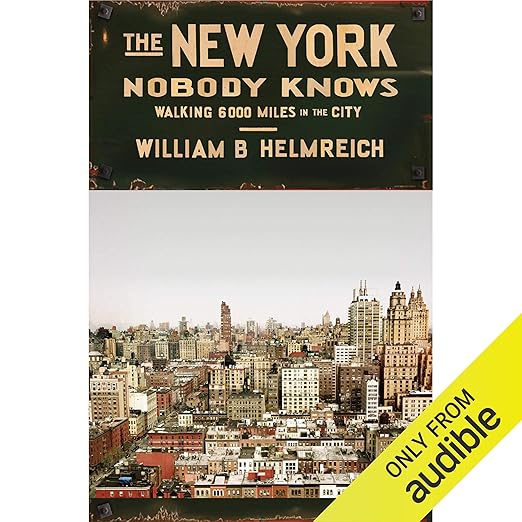
I grew up reading Jane Jacobs, and I came to William Helmreich’s book expecting something in that tradition: close observation of urban space, argument about what makes neighborhoods work, a polemical edge. What I found was something more unusual and, in its way, more moving. Helmreich is not primarily an urban planner or a polemicist. He is a sociologist who decided the only way to understand New York was to walk every block of all five boroughs. Six thousand miles over four years. That is not a methodology. It is a commitment bordering on obsession, and it produces a book that reads like nothing else in the urban studies literature.
The premise of The New York Nobody Knows is that you cannot know a city at the level of its famous streets, its tourist maps, or even its neighborhood reputations. The city is in the ordinary blocks, the residential streets, the commercial strips that no guidebook mentions, the intersections where you can see four different immigrant communities have layered their presence over fifty years of successive arrivals. Helmreich walked those blocks. He stopped and talked to the people he found there. He recorded what they said and what the streets themselves said about who had lived in them and who was living in them now.
What 6,000 Miles of Walking Reveals
The scale of Helmreich’s project deserves a moment of attention before you start listening. Walking every block of New York means walking through the showcase neighborhoods and the forgotten ones equally. It means Riverdale and Soundview in the Bronx, Richmond Terrace and Tottenville on Staten Island, every reach of Brooklyn and Queens where a subway line terminates and most visitors stop. One reviewer who grew up in the Bronx during the 1960s and 1970s described the book as enlightening about how things had changed in neighborhoods they had known personally. That reader-as-returning-native experience seems to be common: the book functions differently depending on what relationship you bring to New York, but it functions well for all of them.
The people Helmreich encounters are the book’s real content. The Guyanese immigrant who grows flowers outside his Queens home to remember a homeland left behind. The Brooklyn grandchild of Italian immigrants who keeps a family neon grocery sign lit in a brownstone window. These are not human interest vignettes designed to soften a sociological argument. They are the argument: that the city is made of specific attachments to specific places, and that those attachments tell you more about urban social life than any statistical analysis of the same neighborhoods would.
The Sociology Behind the Walking
Helmreich is a professor, and the book is grounded in academic literature in ways that elevate it above a mere travel narrative. His analysis of gentrification, for example, is notable for its refusal to assign the phenomenon a single moral valence. He documents what is being lost and what is changing, but he also documents what established residents say about the changes, including cases where long-term residents hold more complicated views about gentrification than the prevailing political discourse tends to assign them. His chapter on ethnicity and neighborhood identity similarly resists easy conclusions, presenting what he observed rather than fitting observation to predetermined argument.
He also interviewed mayors. Bloomberg, Giuliani, Dinkins, Koch all appear in the book, not as authorities on New York but as people who governed it and understand specific aspects of it from that particular vantage. Their perspectives are placed alongside those of the Guyanese flower-grower and the Italian-American grocer’s grandchild, which creates an interesting leveling effect: the political perspective on the city is one among many rather than the explanatory frame for all of them.
Mark Cabus and the Long Listen
At thirteen hours and forty-one minutes, this is a substantial commitment, and the narration from Mark Cabus is one of the things that makes it feel less like an obligation than it might. Cabus has a conversational warmth that suits Helmreich’s mode of inquiry. Helmreich is not a show-off prose stylist: he writes clearly and directly, occasionally with humor, and Cabus’ delivery preserves that plainness without making it sound flat. The long chapters on individual boroughs reward sustained listening, but the book is also structured in a way that allows you to dip in and out without losing the thread, since each section of walking generates relatively self-contained encounters.
Helmreich died of COVID-19 in March 2020, which one reviewer notes with evident sadness. That knowledge gives the book a retrospective quality it did not have at publication in 2013: this six thousand mile walk is now also a record of a city that does not quite exist in the same form anymore, captured by someone who is no longer here to update it. The New York of the Guyanese flower-grower and the Brooklyn neon sign is still there, but it is changing. The book preserves a specific moment of it with unusual fidelity.
For Readers Who Have Never Been to New York and For Those Who Know It Well
If you have never visited New York, this book will give you a better understanding of what the city actually is than any amount of tourism would. Helmreich’s attention moves between the famous and the completely overlooked with a consistency that makes the whole feel real rather than curated. If you know the city, you will find blocks you recognize and blocks that surprise you, and the combination of familiarity and novelty is exactly what good urban writing produces. If you are a sociologist or urban planner, the methodology itself is worth examining: there are things you learn by walking that no other research instrument captures.
Frequently Asked Questions
Does this book cover all five boroughs equally, or does it focus on Manhattan?
It covers all five boroughs deliberately and with genuine balance. Helmreich was specifically committed to reaching the parts of the city that neither tourists nor most urban writing ever touches, which means Staten Island and the outer reaches of Queens and the Bronx receive as much attention as the neighborhoods that appear on maps most New Yorkers use.
Is this a sociological academic text or an accessible narrative?
Both, in the best sense. Helmreich draws on academic literature in urban sociology but writes for a general audience. The book reads as a narrative account of what he found walking and talking, with the theoretical framework present but never dominant. Multiple reviewers describe it as easy to read despite its intellectual depth.
How current is the book’s portrait of New York, given it was published in 2013?
Some neighborhoods have changed significantly since Helmreich’s walks, and he died in 2020 without being able to update the account. Read it as a portrait of New York in the years immediately following the 2008 financial crisis and before the most recent wave of gentrification. That framing makes it a useful historical document as well as a contemporary one.
Is the 13-hour listening length manageable as a commute audiobook?
Yes. The book’s structure, organized by borough and then by neighborhood clusters, allows you to treat each section as a relatively self-contained listening unit. You do not need to track a narrative thread across all thirteen hours; each walk generates its own observations and encounters.