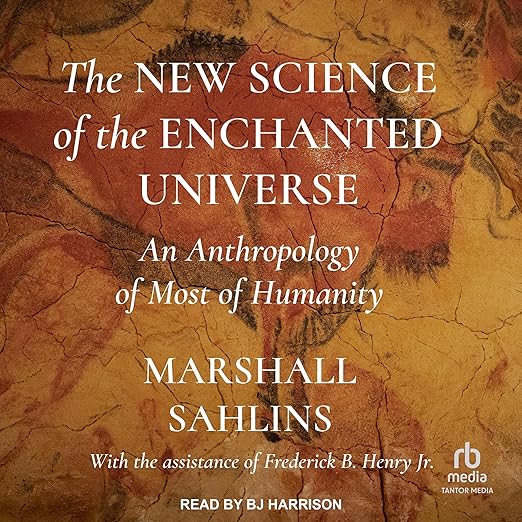
Quick Take
- Narration: BJ Harrison reads with appropriate scholarly gravity, keeping the academic material accessible without flattening its complexity.
- Themes: Cultures of immanence versus transcendence, spirits as social persons, the limits of Western rationalism as universal framework
- Mood: Intellectually demanding, genuinely mind-expanding, occasionally ponderous
- Verdict: Sahlins’ final book is a significant anthropological argument for a new methodology, best appreciated by readers already comfortable with social science and comparative religion.
I encountered Marshall Sahlins’ work first through a different route than most, a course on historical anthropology that spent considerable time on his arguments about how non-Western cultures understand causality and agency. When The New Science of the Enchanted Universe appeared as his final book, published posthumously in this form, I came to it with genuine curiosity and a certain amount of prepared investment. It is, as his work always was, dense with insight and sometimes difficult to navigate. The experience of listening to it is different from reading it in ways that are worth examining.
Sahlins’ argument, stated plainly, is this: the dominant modern Western worldview treats the cosmos as disenchanted, gods, spirits, and ancestors have been relocated to a “transcendent beyond” and removed from ordinary human affairs. This is not the universal human experience but a specific cultural configuration, and a relatively recent and geographically limited one. The vast majority of human cultures, across history and into the present, treat spirits and ancestors as active members of a social world who interact with and shape human life. Sahlins calls these “cultures of immanence” and argues that social scientists have systematically distorted them by forcing them into the categories of “religion” and “the supernatural”, categories that belong to the transcendent framework, not to the worldviews being analyzed.
Our Take on The New Science of the Enchanted Universe
The methodological ambition here is substantial. Sahlins is arguing for a wholesale shift in how anthropologists and social scientists approach cultures of immanence, not describing them from outside using Western categories, but analyzing them on their own terms. The book moves across an impressive geographic range, from ancient Mesopotamia through Polynesia, Sub-Saharan Africa, and into contemporary America, tracing how immanent cosmologies structure economics and politics in ways that don’t map onto secular Western categories.
One reviewer made the comparison to Sahlins’ collaboration with David Graeber, noting that where Graeber makes you think and laugh and keeps you reading, Sahlins in this book is “ponderous and insecure, sprinkling the pages with epistemological jargon.” That criticism is partially fair. The book is his last, and it reads in places like a scholar who has been thinking about a problem for decades and is trying to get everything out in the limited time available. The density is real. But another reviewer, who described Sahlins as one of those writers “like Levi-Strauss whose writing sharpens your mind regardless of your interests”, captures something equally true about the experience. The book demands and rewards.
Why Listen to The New Science of the Enchanted Universe
BJ Harrison is a reliable choice for academic material of this kind. His delivery maintains the appropriate scholarly register without becoming monotonous, which is a genuine challenge for a text that is arguing at the level of epistemology and methodology throughout. Harrison reads the cross-cultural ethnographic examples clearly enough that the comparative architecture of Sahlins’ argument, this is how it works in Mesopotamia, this is how it works in Polynesia, this is what they have in common, comes through in audio despite the text’s complexity.
Tantor Media produced the recording cleanly at 8.5 hours, which is an appropriate length for this kind of scholarly argument. The comparative method Sahlins employs requires space to build, and the audio gives it room.
What to Watch For in The New Science of the Enchanted Universe
The epistemological language is real and not ornamental. Readers without background in philosophy of social science, anthropological theory, or comparative religion will encounter terms like “ontological” and “immanentist” used with precision rather than loosely. This is not a popular science book about how other cultures experience the world; it’s a scholarly argument for methodological reform in a specific academic discipline. That distinction matters for setting expectations.
The experience of listening rather than reading this book also has specific implications. Sahlins’ argument builds through accumulation of ethnographic examples, and keeping track of which cultural examples support which theoretical claim requires more active attention in audio than on the page, where you can flip back. Harrison reads clearly, but the intellectual tracking required is still real.
Who Should Listen to The New Science of the Enchanted Universe
Readers with genuine interest in anthropology, comparative religion, or the philosophy of social science will find this rewarding and substantive. Sahlins died in 2021, and this final book represents the culmination of a lifetime of thinking about how Western categories distort our understanding of other cultures. For that audience, the density is the point, he is doing serious work, and the reward is proportional.
Listeners looking for accessible cross-cultural exploration or a popular account of indigenous cosmologies will be better served by more introductory texts. The book’s ambition is methodological reform in a scholarly discipline, not public education. If you’ve read Sahlins before and found his mind clarifying, this final entry deserves your attention. If you’re new to the subject, start elsewhere and come back.
Frequently Asked Questions
Is The New Science of the Enchanted Universe accessible to general readers, or does it require anthropology background?
It requires some comfort with academic argument and social science vocabulary. Sahlins writes for an educated general audience and explains his core distinction between immanence and transcendence clearly, but the epistemological sections and methodological argument assume familiarity with the relevant debates. Readers new to anthropology may want an introductory text first.
One reviewer compared Sahlins unfavorably to David Graeber, is the book actually difficult to get through, or is that an exaggerated criticism?
The comparison has merit in terms of prose style: Graeber was notably more readable and generous to the lay reader than Sahlins in this final book. The density is real, especially in the sections on epistemological methodology. But other reviewers found the same book mind-sharpening and essential. How well it reads depends significantly on your prior investment in the subject matter.
How does BJ Harrison’s narration handle the academic and technical vocabulary in the text?
Harrison handles the scholarly vocabulary with consistency and appropriate gravity. He doesn’t flatten the complexity or speed through technical passages, which is the right approach for material that requires active comprehension. The narration is functional and professional rather than particularly interpretive.
This is listed as Sahlins’ last book, does it feel like a complete argument or an unfinished project?
It reads as a complete argument in its central thesis, the distinction between cultures of immanence and transcendence, and the methodological implications for social science. It is denser and more compressed in some sections than Sahlins’ earlier books, which some readers attribute to the urgency of a final project. But the agenda it sets is coherent and substantial.