Quick Take
- Narration: Mike Lenz reads with appropriate authority for financial content, keeping the denser strategic sections moving without losing the listener.
- Themes: modern portfolio strategy, government investment tracking, impact investing and wealth buckets
- Mood: Measured and practical, with an occasional UBS institutional hum beneath the advice
- Verdict: More substantive than its wealth-management pedigree might suggest, though listeners should note the second half becomes more prescriptive and less analytical than the opening chapters.
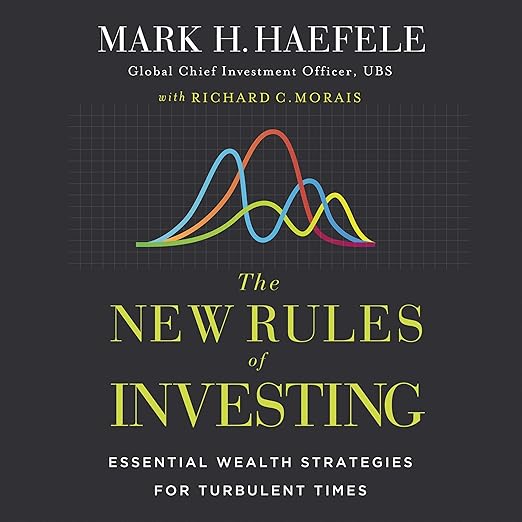
I picked up The New Rules of Investing with some skepticism, specifically the kind that a book jacket promising to disrupt your investing approach from the chief investment officer of the world’s largest wealth manager tends to generate. The gap between institutional finance advice and actual useful guidance for individual investors can be wide, and the UBS brand makes certain structural assumptions about audience that do not always translate to the general reader. Having finished it, I found the book more interesting and less promotional than I expected, with real caveats that are worth naming.
Mark Haefele’s central argument is that the conditions that shaped investing strategy for most of the twentieth century have genuinely changed, and that approaches built around those conditions, stock picking in the Buffett tradition, passive buy-and-hold, the standard sixty-forty equity-bond split, need to be rethought rather than refined. He is making a case for structural reorientation rather than tactical adjustment, and the scope of that ambition gives the book more intellectual weight than a typical wealth-management primer.
Our Take on The New Rules of Investing
The most substantive section of the book is the opening argument about following government investment flows. Haefele’s position is that sovereign wealth funds, central bank policy, and large-scale government industrial investment now move markets in ways that individual stock analysis cannot capture, and that investors who understand where governments are putting their capital have a structural advantage over those who are purely bottom-up stock pickers. This is a genuine insight rather than a truism, and Haefele develops it with enough specific examples to be useful rather than merely conceptual.
The three-bucket framework he introduces for thinking about personal wealth, short-term liquidity needs, long-term growth, and legacy or impact allocation, is the book’s most actionable contribution for individual investors. It is not a new idea in financial planning, but Haefele presents it with enough client case study texture to make it feel concrete rather than schematic. One reviewer who is an active individual investor but not a UBS billionaire wrote that the book delivered more than expected, which is the best outcome for this kind of institutional-to-general audience translation.
Why Listen to The New Rules of Investing
Mike Lenz handles the financial content with the kind of steady authority the material requires. He does not overdramatize the subject, which would be strange given the content, but he keeps the pace lively enough that the denser strategic sections do not become slogs. Seven and a half hours is a manageable length for a finance audiobook, and Lenz’s consistency across that runtime makes the experience more comfortable than it might otherwise be with a narrator who varied more in energy.
The accessible explanations and client case studies that Haefele deploys throughout the book give the audio format something concrete to work with. Abstract portfolio theory is harder to follow in audio than in print, and the case study structure provides enough narrative anchoring to keep the listener oriented. One review praised the book as informative and genuinely useful for gaining a deeper understanding of how markets work, which reflects the authorial intent accurately.
What to Watch For in The New Rules of Investing
The most consistently noted limitation in the reviews is that the second half of the book does not maintain the analytical quality of the first four chapters. One reviewer described the back half flatly as filler, noting that Haefele’s UBS background eventually pulls the book toward service advertising rather than pure investment guidance. This is a structural problem rather than a fatal one, but it is real. The chapters on impact investing and legacy planning are valuable in principle but read more as institutional positioning than as rigorous investment analysis.
There is also an honest tension in the book between its stated ambition to help all investors and its actual frame of reference, which is built around high-net-worth clients navigating complex global portfolios. The forty billionaires gathered at The Fontenay Hotel in Hamburg to hear Haefele’s thinking are mentioned early, and the book never quite forgets that audience even as it gestures toward broader applicability. Individual investors with modest portfolios will find the principles useful but will need to translate significantly.
Who Should Listen to The New Rules of Investing
This audiobook is most useful for experienced investors who want a rigorous framework for thinking about structural changes in global markets and are willing to do the translation work from institutional to individual scale. Novice investors looking for basic guidance will find the opening chapters illuminating but the middle sections demanding. Financial advisors and investment professionals who want a well-articulated macro perspective to test against their own views will find the most consistent value here. Go in knowing the second half is weaker than the first, and extract the government investment tracking argument and the bucket framework as the book’s two genuinely durable contributions.
Frequently Asked Questions
Does The New Rules of Investing offer actionable advice for individual investors with modest portfolios?
The principles are applicable but require translation. Haefele’s primary frame of reference is high-net-worth clients navigating complex global portfolios, and the book is most directly useful at that scale. The three-bucket framework and the government investment tracking argument work at any portfolio size, but the case studies and examples skew toward wealth levels that individual investors will need to adjust for.
How significant is the UBS promotional dimension of the book?
Reviewers are split on this. Some found it more intellectually honest than expected for a book by a major bank’s CIO. Others noted that the second half in particular drifts toward institutional positioning rather than rigorous investment analysis. The first four chapters are consistently praised as genuinely substantive. Approach the back half with appropriate skepticism.
Does the book address cryptocurrency or alternative assets?
One reviewer specifically praised Haefele’s commentary on crypto as incisive. The book engages with the full contemporary investment landscape including alternative assets, impact investing, and the role of technology in market structure, rather than focusing exclusively on traditional equity and bond strategies.
How does Mike Lenz’s narration handle the financial terminology and strategic concepts?
Lenz handles the material with steady authority and appropriate pacing. The financial terminology is delivered clearly without being simplified, and the case study sections are given enough narrative coloring to maintain engagement through what could otherwise be dense analytical passages.