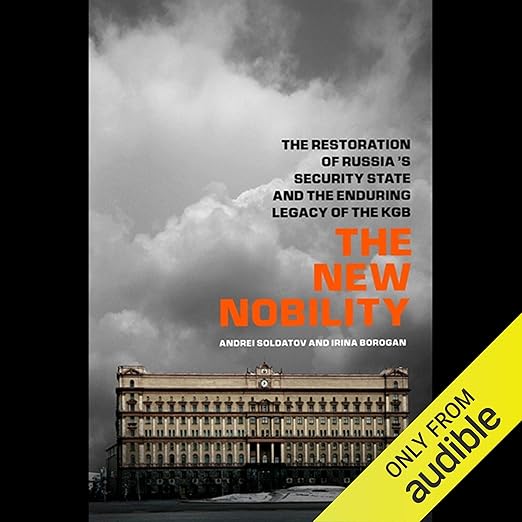
Quick Take
- Narration: Christian Rummel delivers the material with measured authority, suited to the documentary seriousness of investigative journalism, no dramatics, which is the right call for this kind of institutional history.
- Themes: State security versus democratic accountability, the rehabilitation of Soviet power structures, journalism under threat
- Mood: Measured and unsettling, like reading a well-sourced warning
- Verdict: Essential listening for anyone tracking the internal logic of Putin-era Russia, though its 2010 publication date means some of the political landscape has since grown more extreme than even the authors anticipated.
I remember picking this one up originally around 2014, when the Ukrainian crisis had sent a lot of Western readers back to basics on Russian power structures. I returned to the audiobook version more recently, and the experience was disconcertingly clarifying. Andrei Soldatov and his co-author Irina Borogan were, at the time of writing, among the very few Russian journalists willing to turn an investigative lens on the FSB. That the book exists at all is an act of professional courage that deserves acknowledgment before any literary assessment. Both authors continued reporting inside Russia on these subjects for years after publication, at considerable personal risk.
The premise is direct: after the chaos of the 1990s, when the old Soviet security apparatus was briefly marginalized, the FSB rebuilt itself into a new aristocracy. Putin, himself a product of the KGB, presided over and accelerated this restoration. The authors trace this rehabilitation through specific case studies: the Moscow apartment bombings, the Chechnya wars, the Beslan school siege, and various overseas assassination operations. The result is less a narrative thriller than an institutional history, and readers expecting the propulsive energy of spy fiction will need to recalibrate their expectations before pressing play. This is a book about systems and the people who build and inhabit them.
Our Take on The New Nobility
What Soldatov and Borogan accomplish here that few Western journalists had managed at the time is to humanize the FSB without excusing it. They show an organization that makes catastrophic blunders, that is riven with internal rivalries and factional competition, and that nevertheless accrues power precisely because accountability is absent. One reviewer, writing with evident alarm, compared the reading experience to well-detailed research about the Inquisition or the Stasi: the past-tense comfort we normally bring to such histories is unavailable here because the subject is contemporary. That discomfort is the book’s most important feature, and the authors earn it through documented specificity rather than rhetorical inflation.
Why Listen to The New Nobility
Christian Rummel narrates with the kind of steady, unshowy delivery that investigative nonfiction demands. He does not editorialize through tone, which is the correct approach for material that is already alarming without vocal embellishment. The 7-hour-and-20-minute runtime feels efficient rather than padded, a function of the authors’ economy with their argument. Soldatov and Borogan apparently wrote directly in English, and one reviewer noted the clarity of the language and the absence of the posturing common in Western liberal journalism. Aurally, that directness is an asset: no translation seams, no awkward phrasing to navigate, just clear institutional analysis delivered with appropriate gravity. The combination of accessible prose and competent narration makes a genuinely difficult subject approachable without trivializing it.
What to Watch For in The New Nobility
The 2010 publication date is both the book’s strength and its limitation. The research is meticulous for its era, but the years since have added layers, including the Salisbury poisonings, the full-scale invasion of Ukraine in 2022, and the further consolidation of FSB influence in domestic Russian political life, that the authors could not have fully anticipated. Treat this as a foundational text that explains the structure and the appetite rather than a current events guide. Listeners hoping for coverage of post-2014 developments will need to supplement it with more recent journalism from the same investigative tradition.
Who Should Listen to The New Nobility
Anyone working to understand Russian foreign policy as an expression of internal security culture rather than conventional national interest calculations. Students of post-Soviet history and journalists covering the region will find it required background. It is also valuable for general readers who want a serious, documented account rather than the more impressionistic treatments that dominate the Russia-in-the-West genre. Those seeking narrative drama or a clear protagonist should look elsewhere; this is institution-focused analysis, and it makes no apologies for that. But for readers who want to understand how the modern Russian state actually functions at its security core, there is no better single starting point in English.
Frequently Asked Questions
How does The New Nobility compare to other books on Putin and the FSB published around the same period?
It is more operationally specific than many. Where books like Karen Dawisha’s Putin’s Kleptocracy focus on the financial architecture of the system, Soldatov and Borogan stay focused on the security service itself, its internal culture, its case-by-case operations, and its political rehabilitation. The two approaches complement rather than duplicate each other.
Does the 2010 publication date significantly undermine the book’s usefulness for a reader in the mid-2020s?
It limits but does not undermine it. The structural arguments about FSB power consolidation and its relationship to Putin remain accurate and explanatory. The specific case studies are the historical record of a particular period, and they read as such.
Is Christian Rummel’s narration appropriate for the material’s seriousness?
Yes. Rummel is well-matched to nonfiction of this kind. He maintains consistency across names and acronyms that a less experienced narrator might stumble over, and his restraint keeps the tone documentary rather than sensational.
Do the authors maintain any semblance of journalistic neutrality given the subject matter?
They are investigative journalists, so the stance is that of documented critique rather than polemic. Several reviewers noted the absence of ideological posturing, which makes the book more convincing, not less, precisely because the facts they present are alarming enough without rhetorical amplification.